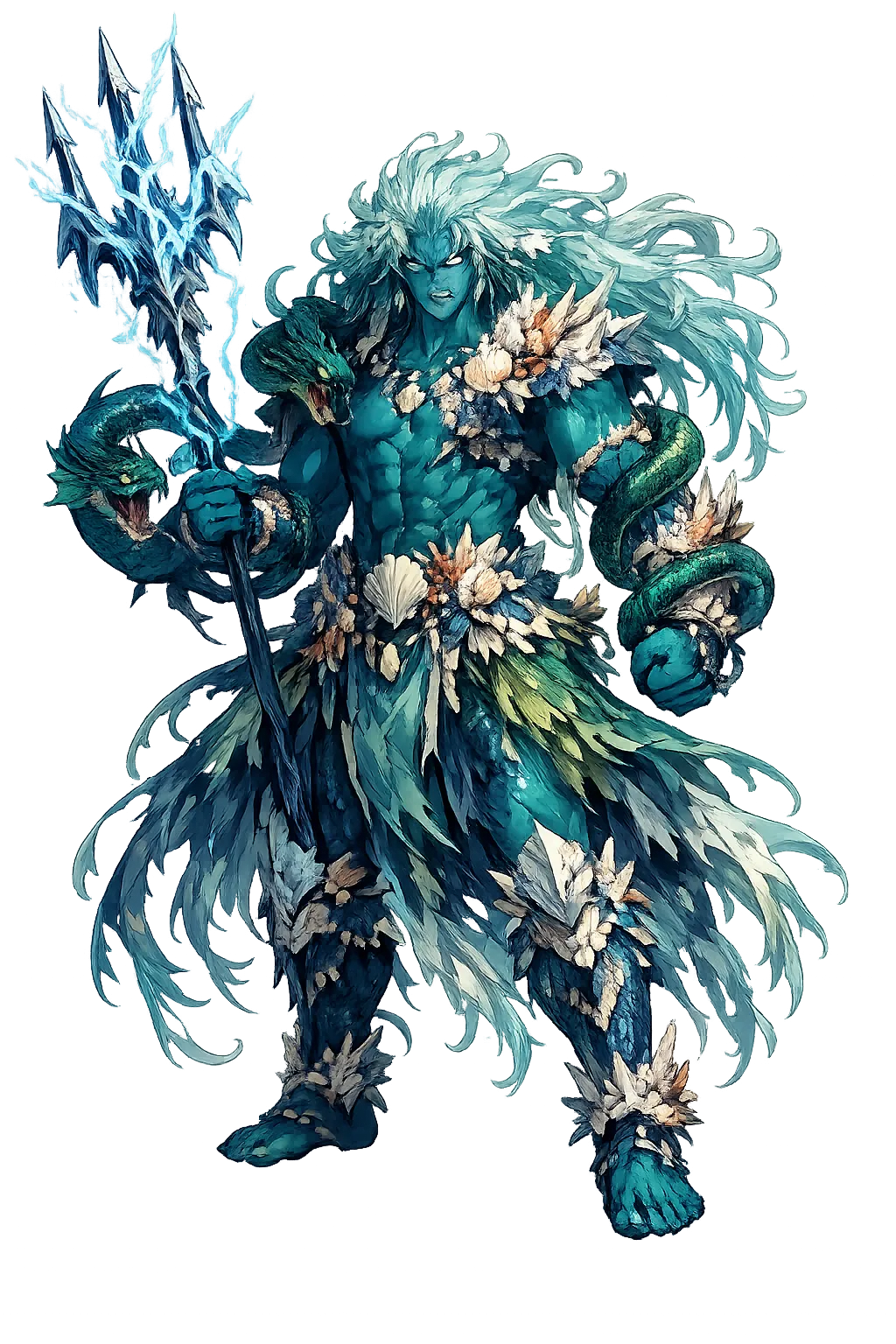
Stories of Yām
Yām's story is told in the Ugaritic Baal Cycle, where he plays the role of the chaos monster that the young storm god must defeat to establish his kingship. The myth is one of the oldest and most influential combat narratives in the ancient Near East, echoed in the Bible's Leviathan, Babylonian Tiamat, and Greek Typhon.
Before Baꜥal can be king, the Sea claims the crown. In KTU 1.2 i, the deified ocean — Yamm, 'Prince Sea, Judge River' — sends two terrible emissaries into the divine assembly with a demand for Ēl, the father of gods: hand over the storm god Baꜥal for his watery house. Yamm wants Baꜥal as a slave, and Ēl, reluctant, is constrained to agree. The scene establishes the myth's central tension: the primordial deep does not attack the order of the gods from outside; it claims to be the order, the senior claimant to cosmic rule, and it speaks the language of law and tribute. Chaos, in this telling, arrives as a creditor with impeccable credentials. That is what makes Baꜥal's eventual resistance theologically daring — and why the whole assembly holds its breath when the storm god finally refuses to surrender.
The decisive battle occupies a single magnificent tablet (KTU 1.2 iv). Baꜥal, armed by the craftsman god Kothar-wa-Ḫasīs with two named maces — Yagrush, 'Chaser,' and Ayamur, 'Driver' — advances on Yamm and strikes the Sea between the eyes. Yamm collapses, and Baꜥal scatters him. Then, in a famous crux, the text seems to show the victor pausing — is he finishing Yamm off, or is he being told to stay his hand? The surviving copies do not agree, and translators have argued over the lines for a century. What is beyond dispute is the outcome: the Sea is subdued, and the assembly acclaims Baꜥal king on the cosmic mountain Ṣaphon. The combat re-enacts the primal separation of sea and land: dry ground, cities, harbors, and fields exist only because a storm god once beat the ocean into bounds.
Yamm's most terrible avatar is a serpent. Twice in the cycle, goddesses recount — almost as liturgy — the storm god's victories over the dragon: over tnn, the wriggling serpent, over btn ʿqltn, 'the twisting serpent, the seven-headed one,' and over the dragon Tunnanu (KTU 1.3 iii 38–42; 1.5 i 1–3). In these lines the Sea is not a claimant in a lawsuit but a many-headed monster, kin to the Babylonian Tiamat and the biblical Leviathan. The echo is direct: Isaiah 27:1 still promises that the sword will punish 'Leviathan the fleeing serpent, Leviathan the twisting serpent... the dragon that is in the sea' — a near translation of the Ugaritic phrases, moved into the service of Israel's God. The seven heads are the myth's way of saying that the Sea's threats are never single: defeat one breaker, and six more rise behind it.
Defeated at Ugarit, Yamm did not die; he migrated. The Hebrew Bible keeps translating his myth into monotheism: in Psalm 74, God crushes 'the heads of Leviathan' and breaks 'the heads of the sea monsters'; in Job 26:12, 'by his power he stilled the Sea (Rahab)'; in Job 38, the Sea is told it may go no farther than its bounds — 'here shall your proud waves be stayed.' Scholars call this the chaoskampf pattern, the victory of order over primordial water, and Yamm is one of its clearest early witnesses. A caution belongs here: the Bible never worships the Sea; Leviathan and Rahab are enemies or metaphors, not gods. But the poetry preserves the skeleton of the older story — a divine warrior, a named weapon, a monster of the deep, and a world made safe for ships. Yamm's afterlife in scripture is the myth's own final tribute: he survived by being disarmed.
Primordial Ocean, Chaos, and the Rival of Baal
Yām is the deified sea of the Ugaritic Baal Cycle, the vast primordial water that claims kingship over the gods before Baal defeats him. He is not simply the Mediterranean; he is the dangerous, chaotic deep that threatens to overwhelm the ordered world of dry land and storm-fed fields. In Canaanite myth, the storm god's victory over Yām is the founding act that makes civilization possible.
Yām represents the pre-creation waters that must be pushed back for land and life to appear.
He demands that El hand over the divine kingship, setting up the central combat of the Baal Cycle.
In battle Yām is a seven-headed sea monster, kin to the biblical Leviathan and Rahab.
His domain is the boundary between chaos and order, the sea that feeds and destroys.
From the original script to the living URL
𐎊𐎎
The name in its original Canaanite form. Yām (𐎊𐎎) is attested in the source tradition — “Sea; the deified primordial ocean in Ugaritic and Canaanite myth”. Its macron-length vowels carry the full phonetic and orthographic weight of the source tradition.
yam
Reduced to plain yam, the name loses everything that made it specific: macron-length vowels. What remains is an ASCII string that machines can parse but that no longer speaks with its original voice.
Yām
The Unicode restoration recovers what ASCII flattened. Yām restores macron-length vowels, returning the name to its original written dignity. The domain encodes to Punycode, but the browser displays the truth.
Yām.com → xn--ym-dla.com
The non-ASCII characters in Yām are encoded while the ASCII remains visible. To the DNS, it is Punycode. To humanity, it is Yām.
Owned, ideal, and ASCII forms of Yām
Yām
Restores 𐎊𐎎. The live temple domain — yām.com.
yam
Flattens 𐎊𐎎. The plain ASCII fallback — what DNS and legacy systems see.
How Yām was spoken
How Yām travels from ancient script to the modern URL
The lore you have read is the living myth. Extended Lore opens the scholarly vault beneath it: the cult and its material remains, a history of the image, the name after antiquity, a meditation on what the name still means, and the full scholarly apparatus — etymology, orthography, sources.
Enter Extended Lore