PuniCodex

Extended Lore

𐎊𐎎 Yām

Etymology · Orthography · Cult · Iconography · Reception · Sources

Tier 1 Yām.com
Yām — Sea, Primordial Waters, Chaos
01

Quick Facts

Essential information about Yām, Sea, Primordial Waters, Chaos

Original Script𐎊𐎎
Unicode RestorationYām
Reconstructed Pronunciation/jaːm/
PantheonCanaanite
DomainSea, Primordial Waters, Chaos
MeaningSea; the deified primordial ocean in Ugaritic and Canaanite myth
ClassificationTier 1
Primary DomainYām.com
Sacred SymbolsCresting wave, Seven-headed serpent or dragon, Net or muzzle, Lotus or conch
02

Etymology & Word Family

From original script to Unicode restoration

Proto-semitic *yamm- sea, ocean
Original Script 𐎊𐎎 Yām — "Sea; the deified primordial ocean in Ugaritic and Canaanite myth"
Unicode Restoration Yām Restored stress, length, and script
Modern ASCII yam Plain-ASCII fallback

From Proto-Semitic *yamm- "sea"; cognate with Hebrew yām יָם. In Ugaritic myth Yām is a chaotic sea deity defeated by Baal.

03

Unicode Character Breakdown

Character-by-character philological analysis

CharacterUnicodeNameBlockPhonetic Role
YU+0059Latin Capital Letter YBasic LatinSame, capitalized
āU+0101Latin Small Letter A with MacronLatin Extended-AMacron: long a
mU+006DLatin Small Letter MBasic LatinSame

The Tier 1 classification reflects how much of the original phonology this restoration preserves — stress and vowel length for Greek names, distinctive letters and diacritics for every other tradition.

04

Cult & Worship

How the sacred was kept — rites, sanctuaries, remains

The Cult

Yām's cult is a case study in the difference between a mythological role and a liturgical presence. No sanctuary at Ugarit has been identified as his, and the ritual offering lists that parcel out sacrifices among the gods barely feature him — his battlefield is poetry, not the cultic calendar. Yet for a city that lived from the Mediterranean, the sea itself was the object of constant, practical propitiation, and some scholars have detected a 'day of the sea' in the fragmentary ritual texts, though the reading is disputed. What is secure is indirect: every voyage launched, every harbor vow made to Baal, every cargo freighted in cedar ships tacitly acknowledged the deep that could erase fleet and city in an afternoon.

In the Earth

Yām's mythology is preserved in the Ugaritic tablets from Ras Shamra (KTU 1.2), written in alphabetic cuneiform in the Late Bronze Age. The coastal setting of Ugarit itself — a trading city dependent on the Mediterranean — explains the cultural importance of a sea-god who must be both propitiated and subdued. Iconographic parallels include Levantine seals and ivory plaques showing a storm god battling a serpentine or aquatic foe.

05

Iconography

How Yām was imaged across the ages

The Image

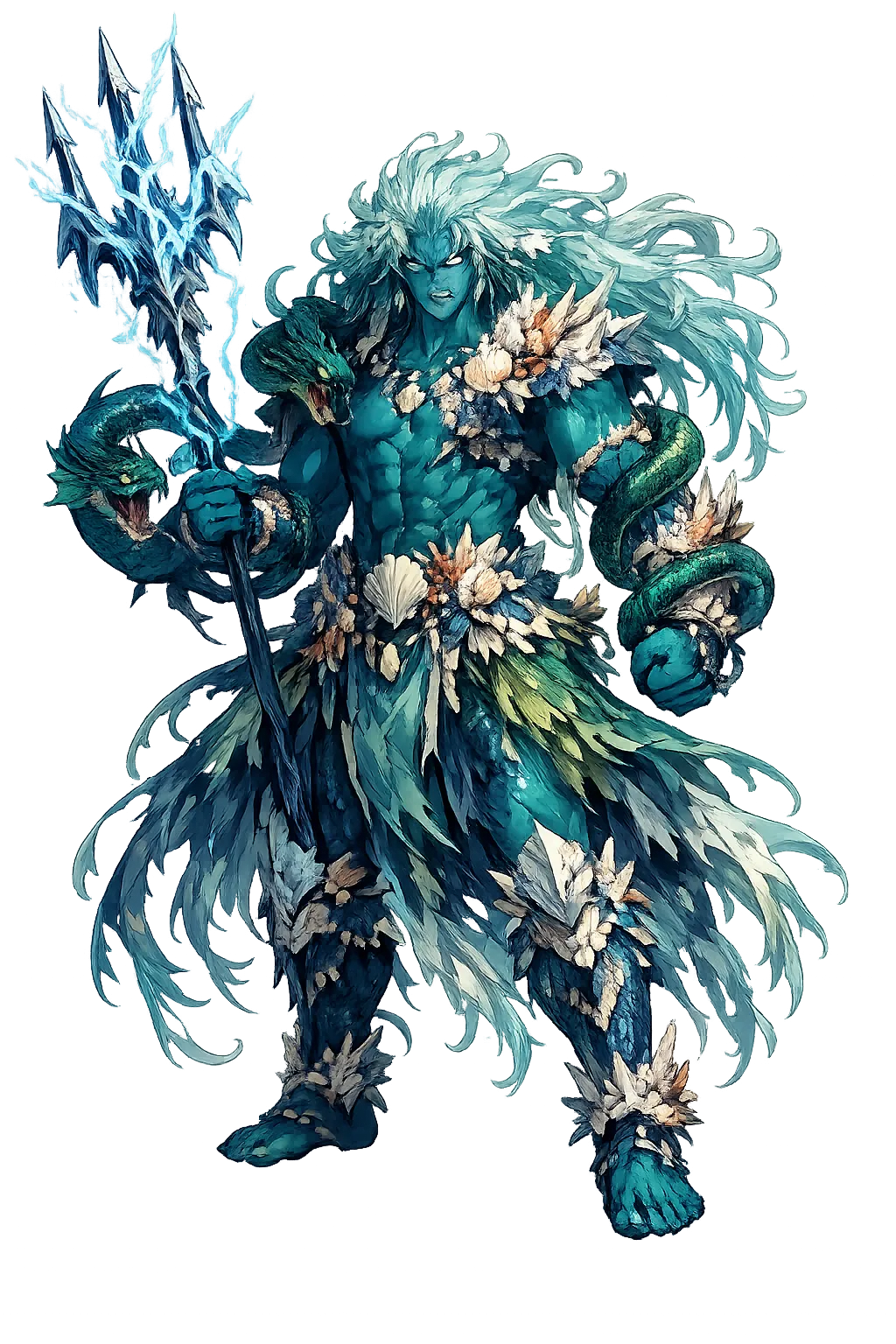
No image can be labeled Yām with certainty, and probably none ever existed — he was imaged as the sea itself. What survive are images of his defeat. Levantine cylinder seals from Ugarit show a striding storm god, club or thunderbolt raised, striking a serpentine or multi-headed aquatic foe; scholars widely read the scene as the Baal–Yām combat, and the ivory carver's workshops of the city produced the same monster-smiting repertoire. The famous bronze Baal figurine with the raised arm (Louvre) is the victor, not the sea. Textually Yām is draconic — seven-headed, writhing, vast. The storm god smiting the chaos serpent became one of the ancient Near East's most durable compositions, and Yām's iconographic afterlife is written in the poses of his enemies.

06

Reception & Transformation

The name after its own age — transmission, translation, survival

Afterlives

Yām vanished twice and returned twice. His first afterlife was biblical: long after the Bronze Age cities burned, the combat hymns kept his defeat alive — the sea split at creation, Rahab crushed, Leviathan pierced (Psalm 74, Isaiah 51) — a story transmitted without its hero's name. The second disappearance was total: the name itself was forgotten for three millennia. His return is one of the great detective stories of modern scholarship. In 1895 Hermann Gunkel reconstructed the chaos-combat pattern from the biblical texts alone; in 1929 Claude Schaeffer's excavations at Ras Shamra produced the actual tablets, Yām's demand for kingship written in alphabetic cuneiform, and the decipherment announced within a year confirmed what Gunkel had predicted. Twentieth-century scholarship placed the Baal–Yām combat at the head of the Near Eastern combat tradition — Frank Moore Cross's comparative work, John Day's God's Conflict with the Dragon — while the word itself never died: Hebrew yām, Arabic yamm, a name every Semitic speaker still says daily.

Identifications Across Traditions

Yām is closely related to the Babylonian Tiamat and to the biblical Leviathan and Rahab: all three embody primordial watery chaos subdued by a younger storm or creator god, and all three belong to the combat pattern scholars call the chaoskampf. In Greek myth, Zeus's battle against Typhon carries a related structure, though the genealogies differ; in Egypt, the nightly defeat of the serpent Apophis answers the same anxiety. Yām also overlaps with the Hurrian-Hittite sea and river gods known from treaty lists, and the Ugaritic tablets themselves show him as part of a wider Bronze Age diplomatic world in which the Sea was a boundary to be governed, not merely feared. The sea remained a boundary zone in Canaanite religion: source of wealth, highway of trade, and home of the monster who would reclaim the land if the storm god ever slept.

Modern Legacy

The myth of Yām survives most powerfully in the biblical Leviathan and in the combat hymns of the Psalms, which shaped Jewish, Christian, and Islamic imagery of cosmic evil defeated by divine power. The seven-headed sea dragon remains a staple of modern fantasy and role-playing games, usually without any memory of its Ugaritic ancestor. For scholars of mythology, Yām is a textbook example of the chaoskampf pattern — the victory of order over primordial water that underlies civilizations from Mesopotamia to the Hebrew Bible. And for the coastal cities of the Levant, his cult was once practical theology: the harbor, the fleet, and the storm warning were all arguments in his favor. Every age that lives by the sea rewrites his myth; none has yet retired it.

07

The Meditation

What Yām means — beyond the dictionary

Yām is the sea that cannot be owned, the chaos that lies just beyond the harbor wall. For Ugarit, a trading city built on the Mediterranean's edge, he was doubly real: the source of cedar, silver, purple dye, and wealth, and the force that could erase a fleet in an afternoon. His myth teaches that civilization rests on land wrested from water, and that the boundary must be maintained — not once, but every season.

In an era of rising seas and storm surges, Yām returns not as metaphor but as warning: the primordial deep remembers what was taken from it, and only restraint keeps it at its bounds. The ancients did not sentimentalize the ocean. They built their theology out of it: beautiful, generous, and waiting.

08

Frequently Asked Questions

Common questions about Yām, Sea, Primordial Waters, Chaos, and Unicode restoration

01How do you pronounce Yām?

In reconstructed pronunciation, Yām is /jaːm/ — approximately YAHM — a long, open 'ah' like 'father,' preceded by a smooth y-glide and closed by a humming m.

02What does Yām mean?

Yām means Sea; the deified primordial ocean in Ugaritic and Canaanite myth in the canaanite tradition.

03What are the symbols of Yām?

Yām is associated with Cresting wave (The uncontrollable deep he personifies — beautiful, wealthy, and fatal to those who mistake it for a road), Seven-headed serpent or dragon (btn ʿqltn, 'the twisting serpent with seven heads' (KTU 1.5 i), his combat form and Leviathan's twin), Net or muzzle (The binding weapons of the storm god's arsenal, named to leash the Sea he once ruled), Lotus or conch (Maritime wealth and fertility that follow once the sea accepts its bounds).

04Why are there different spellings of Yām?

Each form is a historically attested restoration rather than a mistake: Yammu is the alt form (Nominative case form in Ugaritic scholarly transliteration). PUNICODEX registers the full set so the tradition is preserved under every defensible spelling.

05Why restore Yām in Unicode?

Plain ASCII yam strips the stress, length, and script that make the name specific. Unicode restoration returns the name to its original written dignity.

06What is the most important myth about Yām?

“Yamm Demands the Kingship” — the The Throne story that anchors the mythology of Yām, told in full on the lore page.

09

Scholarly Sources

The philological foundations of this restoration

Every claim on this page is grounded in established scholarship. The orthographic restorations follow disciplinary convention. The etymological chain follows the best available reference works. This is not invention — it is resurrection through scholarship.

◈

Lexicography & Philology

  • Coogan
  • De Moor
◎

Primary Texts

  • KTU
  • KTU 1.2 (Baal Cycle: Yām's demand and defeat)
  • Smith, The Ugaritic Baal Cycle
  • Hebrew Bible, Psalm 74:13–14; Isaiah 27:1; Job 26:12 (Leviathan and Rahab)
◉

Archaeology & Art History

  • Material evidence — iconography, inscriptions, and temple archaeology — for Yām and related cults.
✦

Religious Studies

  • Coogan, Stories from Ancient Canaan
  • Wyatt, Religious Texts from Ugarit
  • Day, Yahweh and the Gods and Goddesses of Canaan
Return

The Surface Awaits

You have traced the name from its earliest attestation to its Unicode restoration. Now return to the myth. The story is where the name lives.

Back to Lore
Yām mascot