
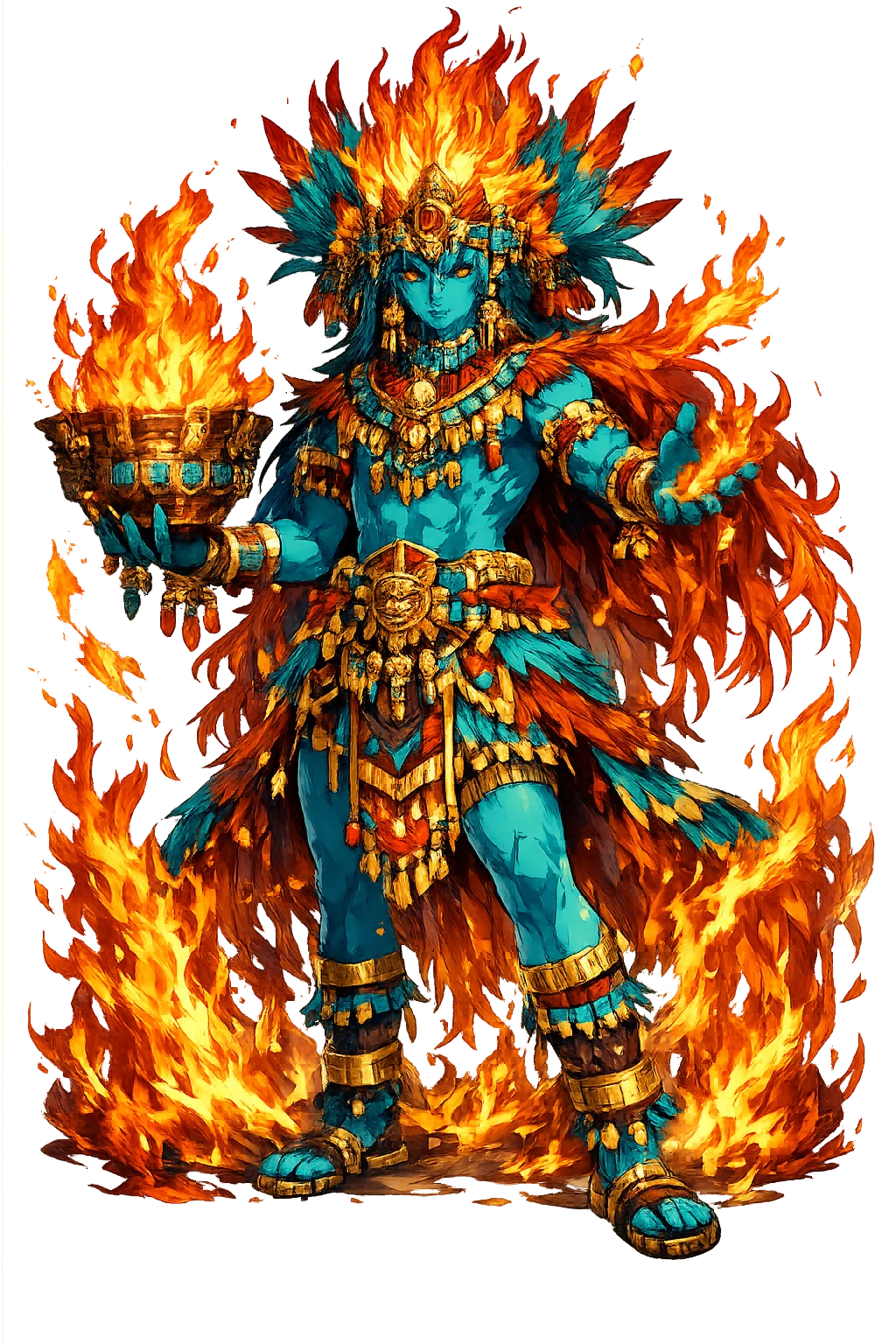
The provenance file on Xiuhtēcuhtli
Catalogue entry — Xiuhtēcuhtli. Every claim below carries its chain of custody.
Provenance
1. The attestation. —, from the tradition's own record. On record: Sahagún, Florentine Codex, Book 1 (the gods) and Book 7 (the sun, moon, and stars; the New Fire), Diego Durán, The History of the Indies of New Spain, Book of the Gods, Frances Karttunen, An Analytical Dictionary of Nahuatl, Eduardo Matos Moctezuma, The Great Temple of the Aztecs.
2. The narrative record. The Drilling of the New Fire — At the close of each 52-year cycle (the xiuhmolpilli, the 'tying of the years'), the Aztec world extinguished every flame: households went dark, pots were smashed, debts were settled, and the people waited on their rooftops, fasting, watching the sky. Sahagún's informants told him the terror plainly — if the Pleiades (tianquiztli) had not yet crossed the zenith by midnight, some said, the sun would not rise and the demons of darkness would come down to eat the last men (Florentine Codex, Book 7). Huehueteotl, the Old One — Under his other name he is the oldest thing in the cosmos: Huehueteotl, 'the Old, Old God,' the wrinkled figure who carries the fire-bowl on his bent back, present before the suns were set in motion. Sahagún lists him among the primordial gods (Florentine Codex, Book 1), and the tonalamatl — the book of days — set him at the head of the first trecena, 1-Cipactli: the count of time begins under his sign.
3. The physical record. The Templo Mayor's excavations found his shrine among the precinct's gods; the great Huehueteotl brazier-figures — stone elders carrying the fire-bowl — survive from Teotihuacan to Tenochtitlan, making him the longest-documented god-image in Mesoamerica (a thousand years of the same bent back). Huixachtlan's summit is preserved within Mexico City, and the Florentine Codex's New Fire account is the fullest ritual description from the pre-Columbian world.
4. The current holding. The temple at /xiuhtecuhtli/, classified Tier 1. What survives here cannot be shown in ASCII: a feature of the original that the fallback alphabet flattens. That is the Tier-1 test, and this name passes it without argument.
5. The documented resonances. Timekeeping & Calendar Systems, Thermal, Geothermal & Fire Energy, Manufacturing, Craft & Automation — seats argued and weighted in the pattern atlas, read through the myths in this temple's Resonance File.
6. The continuing record. The 52-year cycle's shadow falls on Mexico's calendar still; Huixachtlan's hill is in today's Mexico City sprawl, and the last New Fire was drilled in 1507 — the empire fell before the next. His wrinkled, brazier-backed figure is one of the most-recognized images of Aztec art (the great stone Huehueteotl of the Museo Nacional), and the fire-drill remains the emblem of renewal ceremonies across Mexican civic culture.
At a Glance
- Restored name: Xiuhtēcuhtli
- ASCII form: xiuhtecuhtli
- Meaning: ""Fire Lord" — the Aztec fire god, lord of the hearth and of the year"
- Domain of influence: Fire, Time, Hearth
- Pantheon: Nahuatl
- Classification: Tier 1
- Original script: —
- Series: The Restoration Files, No. 532 of 546
The File Continues
Read the founding dispatch for the name's full story, the Resonance File for the archetype at work — or the whole archive in one sitting.
Continue the series — previous file: Xipe (read it here) · next file: Xīwángmǔ (read it here).
The Restoration Files are written from the same canonical record as the temples themselves: the lexicon, the lore catalog, the pattern atlas, and the cited scholarly sources. If a file ever disagrees with its temple, the temple is right — tell us, and the file will be corrected.