
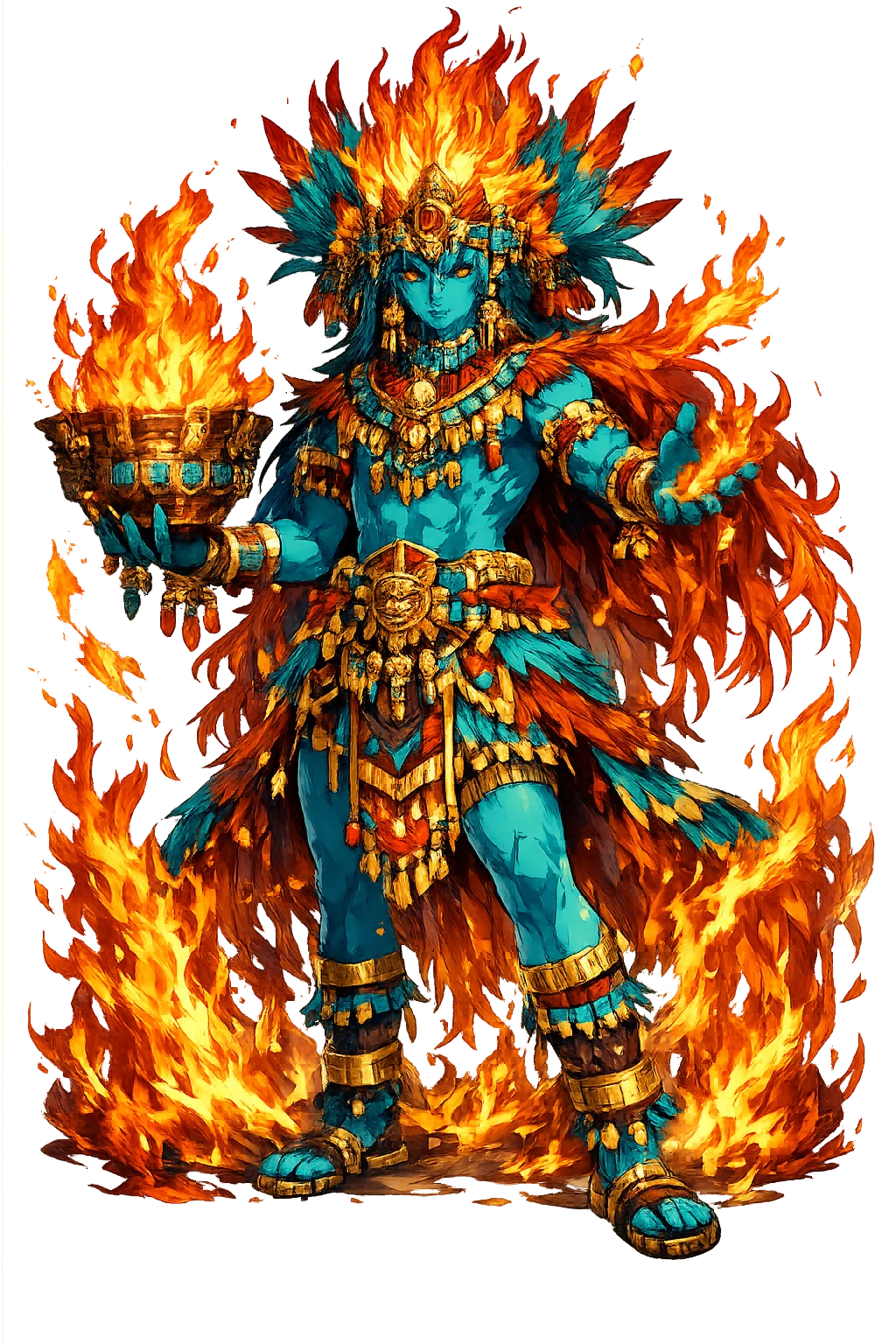
Xiuhtēcuhtli in 2026: why scholars still care
In 2026, names are treated as data points. Xiuhtēcuhtli is a reminder that they are also cultural artifacts — and that the difference matters for search engines, AI training corpora, and anyone who types the name of a Nahuatl figure into a browser. Scholars never stopped caring about the difference between xiuhtecuhtli and Xiuhtēcuhtli; the web simply made that care actionable. What follows is the full scholarly picture — name, script, sound, myth, cult, and legacy — followed by the engineering compromise that lets a restored spelling live at a real address. The question is not whether the name is old. It is whether the digital world is old enough to hold it.
At a Glance
- Restored name: Xiuhtēcuhtli
- ASCII form: xiuhtecuhtli
- Meaning: ""Fire Lord" — the Aztec fire god, lord of the hearth and of the year"
- Domain of influence: Fire, Time, Hearth
- Pantheon: Nahuatl
- Classification: Tier 1
- Live domain: xiuhtecuhtli.com
Overview
Xiuhtēcuhtli (xiuhtecuhtli) — Fire, Time, Hearth · "Fire Lord" — the Aztec fire god, lord of the hearth and of the year — belongs to the Nahuatl tradition, where it is catalogued under the domain "Fire, Time, Hearth". The name means ""Fire Lord" — the Aztec fire god, lord of the hearth and of the year".
Xiuhtēcuhtli is the Aztec fire itself: first and last of the gods, the hearth at the center of every home and of the universe, and the god whose great ceremony — the drilling of the New Fire — restarted time itself every fifty-two years.
PuniCodex restores the name as Xiuhtēcuhtli and serves its temple at xiuhtecuhtli.com. The original carries both stress and vowel length, and exactly one historically valid Unicode restoration exists, which places the name in Tier 1. The plain ASCII form xiuhtecuhtli survives as a modern convenience imposed by the early domain-name system; the restoration, not the fallback, is the form the project defends as philologically complete.
The Name
No indigenous written attestation survives for this name; Xiuhtēcuhtli is a scholarly transliteration of the reconstructed spoken form. Etymologically the name means ""Fire Lord" — the Aztec fire god, lord of the hearth and of the year".
The ASCII form xiuhtecuhtli survives only because the early domain-name system could not carry diacritics; it is a technological compromise, not an ancient spelling. The Unicode restoration Xiuhtēcuhtli recovers the full diacritic detail of the scholarly transliteration directly in the address bar. The original carries both stress and vowel length, and exactly one historically valid Unicode restoration exists, which places the name in Tier 1.
The letter-by-letter transformation runs:
- x → X — Same
- i → i — Same
- u → u — Same
- h → h — Same
- t → t — Same
- e → ē — Long ē of tēcuhtli
- c → c — Same
- u → u — Same
- h → h — Same
- t → t — Same
- l → l — Same
- i → i — Same
The project holds the domain xiuhtecuhtli.com (xiuhtecuhtli.com) as the canonical home of this name.
The Original Script
No indigenous writing system is securely attested for individual nahuatl names. The form shown is a modern scholarly transliteration.
The form Xiuhtēcuhtli is therefore a scholarly transliteration rather than an attested ancient spelling; it encodes the reconstructed sound of the name for modern use, and no mark in it is decorative.
Pronunciation
The reconstructed pronunciation of the name is /ʃiw.teːˈkʷi.tɬi/ — Classical Nahuatl.
For the modern speaker, the closest approximation is: shee-oo-teh-KWEE-tlee — the final -tl released sideways.
Kindred and historical forms of the name:
- Nahuatl — Xiuhtēcuhtli
- His elder name — Huehueteotl
- Owned form — xiuhtecuhtli (ASCII)
Xiuhtēcuhtli — "Fire Lord" — takes the long ē of tēcuhtli (lord) in Nahuatl; the domain keeps the plain ASCII form xiuhtecuhtli.com, which the temple explains: the canonical form bears the macron, the address bar carries what the registrar allows.
Mythology
Xiuhtēcuhtli's myths are the calendar's: the fire that must be renewed, and the darkness that waits if it is not.
The Drilling of the New Fire (The Cycle)
At the close of each 52-year cycle (xiuhmolpilli), the Aztec world extinguished every flame: households went dark, debts were settled, and the priests climbed Huixachtlan — Hill of the Star — to watch for the Pleiades' midnight passage. On a captive's chest the fire-priest drilled the new flame; if it caught, the runner carried it to the Templo Mayor, and every hearth in the empire was relit from it. If it failed, the stars said, the sun would not rise — and the world would end in the dark.
Huehueteotl, the Old One (The Elder)
Under his other name he is the oldest thing in the cosmos: Huehueteotl, the wrinkled god who carries the brazier on his bent back, present before the suns. The Aztecs put him at the center of the universe's four directions — the fire-pillar of the world — and every domestic hearth was his shrine: the smallest and the greatest cult at once, the god of the kitchen who is also the god of the calendar.
What Fire Asks (The Nourishment)
The codices show his contract: fire feeds the world and feeds on it. Offerings of copal, of the first fruits, and — in the empire's hard logic — of the heart, were given to the flame that gives light, heat, and the year. Xiuhtēcuhtli's priests performed the fire-walking and the self-sacrifice by fire: the god who is the gift and the cost of the gift, the oldest bargain in the Americas.
Symbols & Iconography
The iconography associated with Xiuhtēcuhtli concentrates in a small set of recurring attributes, each a compressed statement about the name:
- The fire drill — The instrument of the New Fire — time kindled by friction
- The brazier — His back-mounted bowl — the old god carrying the hearth
- The butterfly — The fire-moth drawn to his flame — the soul seeking the light
Archaeology & Evidence
The Templo Mayor's excavations found his shrine among the precinct's gods; the great Huehueteotl brazier-figures — stone elders carrying the fire-bowl — survive from Teotihuacan to Tenochtitlan, making him the longest-documented god-image in Mesoamerica (a thousand years of the same bent back). Huixachtlan's summit is preserved within Mexico City, and the Florentine Codex's New Fire account is the fullest ritual description from the pre-Columbian world.
Realm & Domain
Xiuhtēcuhtli is the Aztec fire itself: first and last of the gods, the hearth at the center of every home and of the universe, and the god whose great ceremony — the drilling of the New Fire — restarted time itself every fifty-two years.
The Hearth
The three stones of every Aztec kitchen — his throne in every house.
The New Fire
Every 52 years, all fires died and one was drilled anew — the cosmos restarted.
Huehueteotl
"The Old God" — his other name: the ancient of days, wrinkled with a brazier on his back.
The Center
The axis mundi: fire as the pillar between the levels of the world.
Across Cultures
The friars saw him as the devil's furnace — and the people quietly kept lighting the hearth: the vigil-candle of Mexican folk Catholicism and the copal-smoke of Day of the Dead altars are his continuing liturgy. The Maya fire-lords and the Zapotec coquihani are his southern cousins; the New Fire concept — the cosmos rekindled by human hands — has no closer parallel than the Vedic agni-liturgies on the other side of the world.
Within the Nahuatl tradition, closely related names in the corpus include Cihuacōātl, Cōātlīcue, Huitzilopōchtli, Itzpapālōtl, Mictlāntēcutli, and Mixcōātl.
Cultural Legacy
The 52-year cycle's shadow falls on Mexico's calendar still; Huixachtlan's hill is in today's Mexico City sprawl, and the last New Fire was drilled in 1507 — the empire fell before the next. His wrinkled, brazier-backed figure is one of the most-recognized images of Aztec art (the great stone Huehueteotl of the Museo Nacional), and the fire-drill remains the emblem of renewal ceremonies across Mexican civic culture.
The Scholarly Record
The account of Xiuhtēcuhtli given in this edition rests on the witnesses and reference works listed below. Lexica and etymological dictionaries secure the form and meaning of the name; the literary and religious texts supply the narrative evidence.
- Florentine Codex (General History of the Things of New Spain), Bernardino de Sahagún; School of American Research, 1577. Full text
- Bernardino de Sahagún, Florentine Codex, General History of the Things of New Spain, 1577. Full text
- Frances Karttunen, An Analytical Dictionary of Nahuatl, University of Texas Press, 1983. Full text
- Nahuatl dictionary (collective modern and colonial sources), Karttunen, Molina, and modern reference works, various.
- Cambridge Ancient History, Multiple volumes, 1970. Full text
- Oxford Classical Dictionary, 4th ed., Oxford University Press, 2012. Full text
A Meditation
Xiuhtēcuhtli is the god of the tending. Civilizations, households, and marriages are all the same fire: it is not the lighting that matters but the keeping, and the empire knew it — 52 years of warmth, one night of terror, and the drill again. He asks the hearth's question, which is the oldest one there is: what, in your house, are you keeping alight — and what would you do on the night it goes out?
The last New Fire was drilled in 1507; the empire never saw the next. But the hearth refused the conquest's arithmetic: the vigil-candle, the copal, the kitchen's three stones — the old god simply moved into smaller rooms. Fire, of all the gods, was the one nobody could convert.
The drill and the chest are the two halves of his arithmetic: the fire that is rubbed into being by hands, and the life given to keep it burning. Modern ceremonies keep the first and retire the second, and the god, presumably, accepts the revision — the hearth always preferred being fed by work anyway.
His hill is surrounded now by the largest city in the Americas, and the suburb's kitchens still hold the three stones. The old god does not need the empire; he never did. He needs three stones and a flame — the world's most durable temple, rebuilt nightly, everywhere, by anyone who cooks.
The Unicode Restoration
Xiuhtēcuhtli is classified as Tier 1: the restoration preserves at least one distinctive feature — a diacritic or a distinctive letter — that the ASCII form loses. The ASCII fallback xiuhtecuhtli still resolves everywhere, but it is the restored form that carries the name's full information. Across the 12 characters of the name, the restoration adjusts 1: 1 further adjustment (ē). That is the whole thesis of this temple: the marks are the message.
Character by Character
The journey from xiuhtecuhtli to Xiuhtēcuhtli, one character at a time:
- x → X — Same
- i → i — Same
- u → u — Same
- h → h — Same
- t → t — Same
- e → ē — Long ē of tēcuhtli
- c → c — Same
- u → u — Same
- h → h — Same
- t → t — Same
- l → l — Same
- i → i — Same
The Domain Name
The restored name is live as a working domain: xiuhtecuhtli.com, which the DNS carries in punycode form as xiuhtecuhtli.com — an ASCII-compatible encoding that lets a non-ASCII name travel the global network without breaking older infrastructure. The visitor sees Xiuhtēcuhtli; the machines see the encoding. That duality is the engineering compromise on which the entire restoration rests, and it is why a name written the way its own tradition wrote it in Nahuatl transcription can now be typed into any browser on earth.
The Nahuatl Pantheon
Xiuhtēcuhtli is one of 31 entries the PuniCodex lexicon catalogues under the Nahuatl pantheon. The Pantheon page gathers the tradition's major figures in one place, and the Lexicon lets you filter all 974 restorations by tradition, tier, or script — the fastest way to see where this name sits among its kin.
Frequently Asked Questions
What does Xiuhtēcuhtli mean? The traditional gloss is ""Fire Lord" — the Aztec fire god, lord of the hearth and of the year."
Which tradition does Xiuhtēcuhtli belong to? Xiuhtēcuhtli is catalogued in the Nahuatl pantheon of the PuniCodex lexicon.
Why is Xiuhtēcuhtli classified as Tier 1? Because the restoration preserves at least one distinctive feature — a diacritic or a distinctive letter — that the ASCII form loses — and the marks in the restored spelling preserve exactly that evidence.
Is Xiuhtēcuhtli a working domain? Yes — xiuhtecuhtli.com resolves today and routes to this temple.
What is the punycode for xiuhtecuhtli.com? The DNS encoding is xiuhtecuhtli.com; browsers perform the translation automatically, so visitors only ever see the restored name.
Can I use Xiuhtēcuhtli in a normal browser? Yes. The DNS resolves the punycode form automatically, and the type tool on this site converts xiuhtecuhtli to Xiuhtēcuhtli for copying and pasting.
Where does the scholarly information come from? The entry is built from lexica, inscriptional evidence, and reviewed scholarly sources listed in the Scholarly Edition. Every claim is traceable to a canonical source.
Typing Xiuhtēcuhtli
You do not need a special keyboard to use this restoration. The PuniCodex Type Tool converts the ASCII form xiuhtecuhtli into Xiuhtēcuhtli as you type, and the browser extension offers the same conversion inside any text field. Copy the restored form, paste it into the address bar, and the DNS does the rest.
Sister Temples
Other temples in the Nahuatl pantheon include Quetzalcōātl, and Tēzcatlīpōca — each with its own restoration story, its own scholarly record, and its own place in the lexicon.
Why This Restoration Matters
In 2026 the stakes are practical. Search indexes, language models, and localization pipelines all inherit whatever spelling the web normalizes — which means every Unicode domain is also a training signal. Xiuhtēcuhtli teaches the machinery that the restored form exists, that it is used, and that it points to a real place. That is why a project built on philology ends up caring about DNS: the infrastructure decides which names the future sees. This restoration makes sure the future sees the whole name.
Explore Further
This post is one doorway into the temple. The home page carries the full character breakdown and the ambient canvas; the lore page tells the myths in long form; the Scholarly Edition preserves the sources, pronunciation data, and revision history; and the patron wall supports the restoration directly. For the wider map, browse the Lexicon, explore the Pantheon, or return to the PuniCodex blog.
A Closer Look at the Marks
A restored name is a small map. In Xiuhtēcuhtli, the journey from the ASCII fallback xiuhtecuhtli to the Unicode form can be read letter by letter, and each letter tells a story. Of the 12 characters, 11 remain unchanged; they anchor the name to its modern shape. The remaining adjustments recover marks the source tradition used to distinguish this name from every other word built from the same letters.
The x stays as it is — Same.
The i stays as it is — Same.
The u stays as it is — Same.
The h stays as it is — Same.
The t stays as it is — Same.
The e becomes ē — Long ē of tēcuhtli.
The c stays as it is — Same.
The u stays as it is — Same.
The h stays as it is — Same.
The t stays as it is — Same.
The l stays as it is — Same.
The i stays as it is — Same.
Together these changes are not decoration. They are the minimum set of marks needed to keep the name legible in its own tradition. Remove them and you still have a string of letters; you no longer have the name as it was written.
Xiuhtēcuhtli in Its Tradition
Xiuhtēcuhtli does not stand alone. It belongs to the Nahuatl tradition, where it is counted among 31 names in the PuniCodex lexicon. Its sphere — Fire, Time, Hearth — places it beside other figures who govern similar aspects of experience. The restored spelling is therefore not only a philological decision; it is a way of keeping the name in the company of its kin. When the address bar shows Xiuhtēcuhtli, it marks the boundary between a generic search term and a named entry in a living catalog of myth. That catalog is the point of the project. Every restored name is a vote for specificity: the web should know the difference between a figure and a keyword, between a tradition and a trend. Xiuhtēcuhtli is one such vote.
Related Names
Sources
The full scholarly apparatus — every citation, revision, and review — lives in the Scholarly Edition. Key references for this post:
- Florentine Codex (General History of the Things of New Spain), Bernardino de Sahagún; School of American Research, 1577.
- Frances Karttunen, An Analytical Dictionary of Nahuatl, University of Texas Press, 1983.
- Cambridge Ancient History, Multiple volumes, 1970.
- Oxford Classical Dictionary, 4th ed., Oxford University Press, 2012.
- Florentine Codex, Books 1, 2, 7 (New Fire).
- Leyenda de los Soles; Codex Borgia; Primeros Memoriales.
- Durán and Motolinia (hearth cult); Sahagún, Florentine Codex.
- Nahuatl dictionary (collective modern and colonial sources), Karttunen, Molina, and modern reference works, various.
- Lexicon authorities for this entry: Florentine Codex, Sahagún, Karttunen, Nahuatl dictionary, Cambridge.