PuniCodex

Extended Lore

Xiuhtēcuhtli

Etymology · Orthography · Cult · Iconography · Reception · Sources

Tier 1 xiuhtecuhtli.com
Xiuhtēcuhtli — Fire, Time, Hearth
01

Quick Facts

Essential information about Xiuhtēcuhtli, Fire, Time, Hearth

Scholarly TransliterationXiuhtēcuhtli
Unicode RestorationXiuhtēcuhtli
Reconstructed Pronunciation/ʃiw.teː.ˈkʷ.tɬi/
PantheonNahuatl
DomainFire, Time, Hearth
Meaning"Fire Lord" — the Aztec fire god, lord of the hearth and of the year
ClassificationTier 1
Primary Domainxiuhtecuhtli.com
Sacred SymbolsThe fire drill, The brazier, The three hearthstones (tenamaxtli), Turquoise (xiuhuitl), The butterfly
02

Etymology & Word Family

From original script to Unicode restoration

Scholarly Transliteration Xiuhtēcuhtli Xiuhtēcuhtli — ""Fire Lord" — the Aztec fire god, lord of the hearth and of the year"
Unicode Restoration Xiuhtēcuhtli Restored stress, length, and script
Modern ASCII xiuhtecuhtli Plain-ASCII fallback

The name Xiuhtēcuhtli carries the orthographic signature of the nahuatl tradition. Unicode restoration recovers what ASCII flattens.

03

Unicode Character Breakdown

Character-by-character philological analysis

CharacterUnicodeNameBlockPhonetic Role
XU+0058Latin Capital Letter XBasic LatinSame
iU+0069Latin Small Letter IBasic LatinSame
uU+0075Latin Small Letter UBasic LatinSame
hU+0068Latin Small Letter HBasic LatinSame
tU+0074Latin Small Letter TBasic LatinSame
ēU+0113Latin Small Letter E with MacronLatin Extended-ALong ē of tēcuhtli
cU+0063Latin Small Letter CBasic LatinSame
uU+0075Latin Small Letter UBasic LatinSame
hU+0068Latin Small Letter HBasic LatinSame
tU+0074Latin Small Letter TBasic LatinSame
lU+006CLatin Small Letter LBasic LatinSame
iU+0069Latin Small Letter IBasic LatinSame

The Tier 1 classification reflects how much of the original phonology this restoration preserves — stress and vowel length for Greek names, distinctive letters and diacritics for every other tradition.

04

Cult & Worship

How the sacred was kept — rites, sanctuaries, remains

The Cult

Xiuhtēcuhtli's defining rite was the Xiuhmolpilli, the New Fire ceremony held every fifty-two years at Huixachtlan, when priests kindled a new flame in the breast of a sacrificial victim and relayed it across the altars and hearths of the valley. The household fire itself was his daily temple: every tlalticpac hearth was a small shrine to the fire lord, and the fire-drilling that began each day repeated the cosmogonic act. At the Templo Mayor his shrine stood within the sacred precinct, receiving offerings of paper, incense, and human victims. The rite bound time, fire, and kingship together, so that the renewal of the calendar was also the renewal of cosmic heat.

In the Earth

The Templo Mayor's excavations found his shrine among the precinct's gods; the great Huehueteotl brazier-figures — stone elders carrying the fire-bowl — survive from Teotihuacan to Tenochtitlan, making him the longest-documented god-image in Mesoamerica (a thousand years of the same bent back). Huixachtlan's summit is preserved within Mexico City, and the Florentine Codex's New Fire account is the fullest ritual description from the pre-Columbian world.

05

Iconography

How Xiuhtēcuhtli was imaged across the ages

The Image

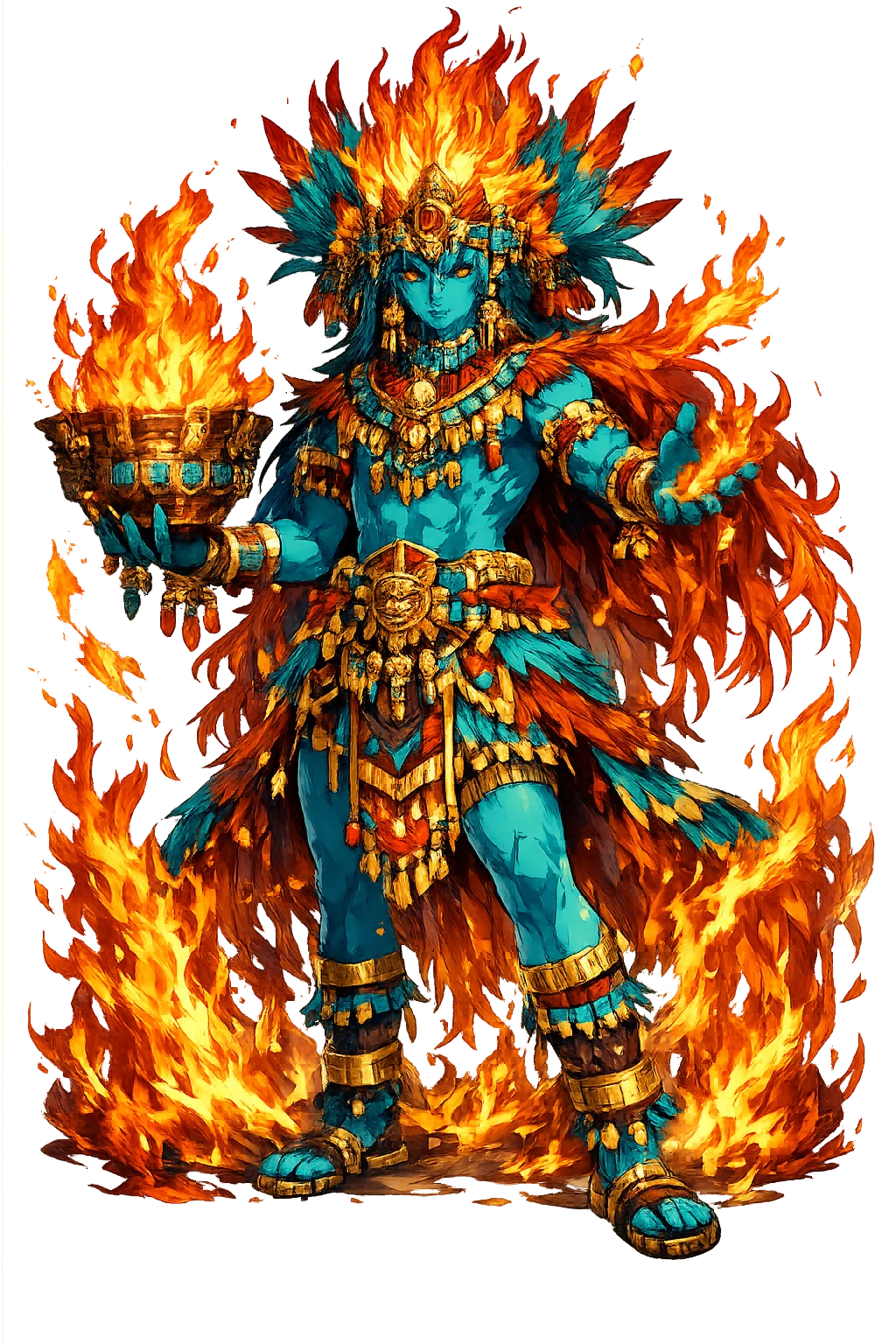
Xiuhtēcuhtli's most durable image is the Huehueteotl type: a hunched, wrinkled elder carrying a brazier or fire-bowl on his head or back. The form appears at Teotihuacan centuries before the Aztec empire and persists through Tenochtitlan, a thousand-year continuity of the fire-bearing old man. Sculptures emphasize the bent spine, the aged face, and the bowl from which flames emerge; turquoise (xiuhuitl) and fire-stone inlay sometimes ornament the surface. Younger, more regal images show him as a seated lord with the xiuhcoatl fire-serpent, but the brazier elder remained the public face of hearth and calendar renewal.

06

Reception & Transformation

The name after its own age — transmission, translation, survival

Afterlives

Xiuhtēcuhtli's rites were recorded under duress in Sahagún's Florentine Codex, the great sixteenth-century encyclopedia compiled by Nahua scribes and Franciscan friars. Spanish evangelization suppressed the New Fire ceremony and destroyed temple images, yet the brazier figures could not be wholly erased: they survive in museum basements and in the Templo Mayor excavations begun in the twentieth century. Modern Mexico has reclaimed him as a symbol of indigenous continuity, and archaeologists such as Eduardo Matos Moctezuma have made his shrine a centerpiece of national heritage. Outside scholarship he circulates in New Age Mesoamerican spirituality, contemporary Mexica revival movements, and festival fire rituals, where the old fire lord has become an emblem of endurance, calendar time, and the sacred communal household hearth.

Identifications Across Traditions

The friars saw him as the devil's furnace — and the people quietly kept lighting the hearth: the vigil-candle of Mexican folk Catholicism and the copal-smoke of Day of the Dead altars are his continuing liturgy. The Maya fire-lords and the Zapotec coquihani are his southern cousins; the New Fire concept — the cosmos rekindled by human hands — has no closer parallel than the Vedic agni-liturgies on the other side of the world.

Modern Legacy

The 52-year cycle's shadow falls on Mexico's calendar still; Huixachtlan's hill is in today's Mexico City sprawl, and the last New Fire was drilled in 1507 — the empire fell before the next. His wrinkled, brazier-backed figure is one of the most-recognized images of Aztec art (the great stone Huehueteotl of the Museo Nacional), and the fire-drill remains the emblem of renewal ceremonies across Mexican civic culture.

07

The Meditation

What Xiuhtēcuhtli means — beyond the dictionary

Xiuhtēcuhtli is the god of the tending. Civilizations, households, and marriages are all the same fire: it is not the lighting that matters but the keeping, and the empire knew it — 52 years of warmth, one night of terror, and the drill again. He asks the hearth's question, which is the oldest one there is: what, in your house, are you keeping alight — and what would you do on the night it goes out?

The last New Fire was drilled in 1507; the empire never saw the next. But the hearth refused the conquest's arithmetic: the vigil-candle, the copal, the kitchen's three stones — the old god simply moved into smaller rooms. Fire, of all the gods, was the one nobody could convert.

The drill and the chest are the two halves of his arithmetic: the fire that is rubbed into being by hands, and the life given to keep it burning. Modern ceremonies keep the first and retire the second, and the god, presumably, accepts the revision — the hearth always preferred being fed by work anyway.

His hill is surrounded now by the largest city in the Americas, and the suburb's kitchens still hold the three stones. The old god does not need the empire; he never did. He needs three stones and a flame — the world's most durable temple, rebuilt nightly, everywhere, by anyone who cooks.

08

Frequently Asked Questions

Common questions about Xiuhtēcuhtli, Fire, Time, Hearth, and Unicode restoration

01How do you pronounce Xiuhtēcuhtli?

In reconstructed pronunciation, Xiuhtēcuhtli is /ʃiw.teː.ˈkʷ.tɬi/ — approximately shee-oo-TEH-kwtlee — the kʷtɬ cluster released as one, no extra vowel; the final -tl sideways.

02What does Xiuhtēcuhtli mean?

Xiuhtēcuhtli means "Fire Lord" — the Aztec fire god, lord of the hearth and of the year in the nahuatl tradition.

03What are the symbols of Xiuhtēcuhtli?

Xiuhtēcuhtli is associated with The fire drill (The instrument of the New Fire — time kindled by friction), The brazier (His back-mounted bowl — the old god carrying the hearth), The three hearthstones (tenamaxtli) (The tripod of stones in every kitchen — the smallest shrine in the empire, rebuilt nightly), Turquoise (xiuhuitl) (His name shares xiuh- with 'turquoise' and 'year' — fire, time, and the blue-green stone are one phoneme), The butterfly (The fire-moth drawn to his flame — the soul seeking the light).

04Why restore Xiuhtēcuhtli in Unicode?

Plain ASCII xiuhtecuhtli strips the stress, length, and script that make the name specific. Unicode restoration returns the name to its original written dignity.

05What is the most important myth about Xiuhtēcuhtli?

“The Drilling of the New Fire” — the The Cycle story that anchors the mythology of Xiuhtēcuhtli, told in full on the lore page.

09

Scholarly Sources

The philological foundations of this restoration

Every claim on this page is grounded in established scholarship. The orthographic restorations follow disciplinary convention. The etymological chain follows the best available reference works. This is not invention — it is resurrection through scholarship.

◈

Lexicography & Philology

  • Florentine Codex
  • Sahagún
  • Karttunen
  • Nahuatl dictionary
  • Cambridge
◎

Primary Texts

  • The Florentine Codex (Sahagún); the Anales de Cuauhtitlan; colonial Nahuatl testimonies and pictorial manuscripts.
◉

Archaeology & Art History

  • Eduardo Matos Moctezuma, The Great Temple of the Aztecs
✦

Religious Studies

  • Sahagún, Florentine Codex, Book 1 (the gods) and Book 7 (the sun, moon, and stars; the New Fire)
  • Diego Durán, The History of the Indies of New Spain, Book of the Gods
  • Frances Karttunen, An Analytical Dictionary of Nahuatl
Return

The Surface Awaits

You have traced the name from its earliest attestation to its Unicode restoration. Now return to the myth. The story is where the name lives.

Back to Lore
Xiuhtēcuhtli mascot