
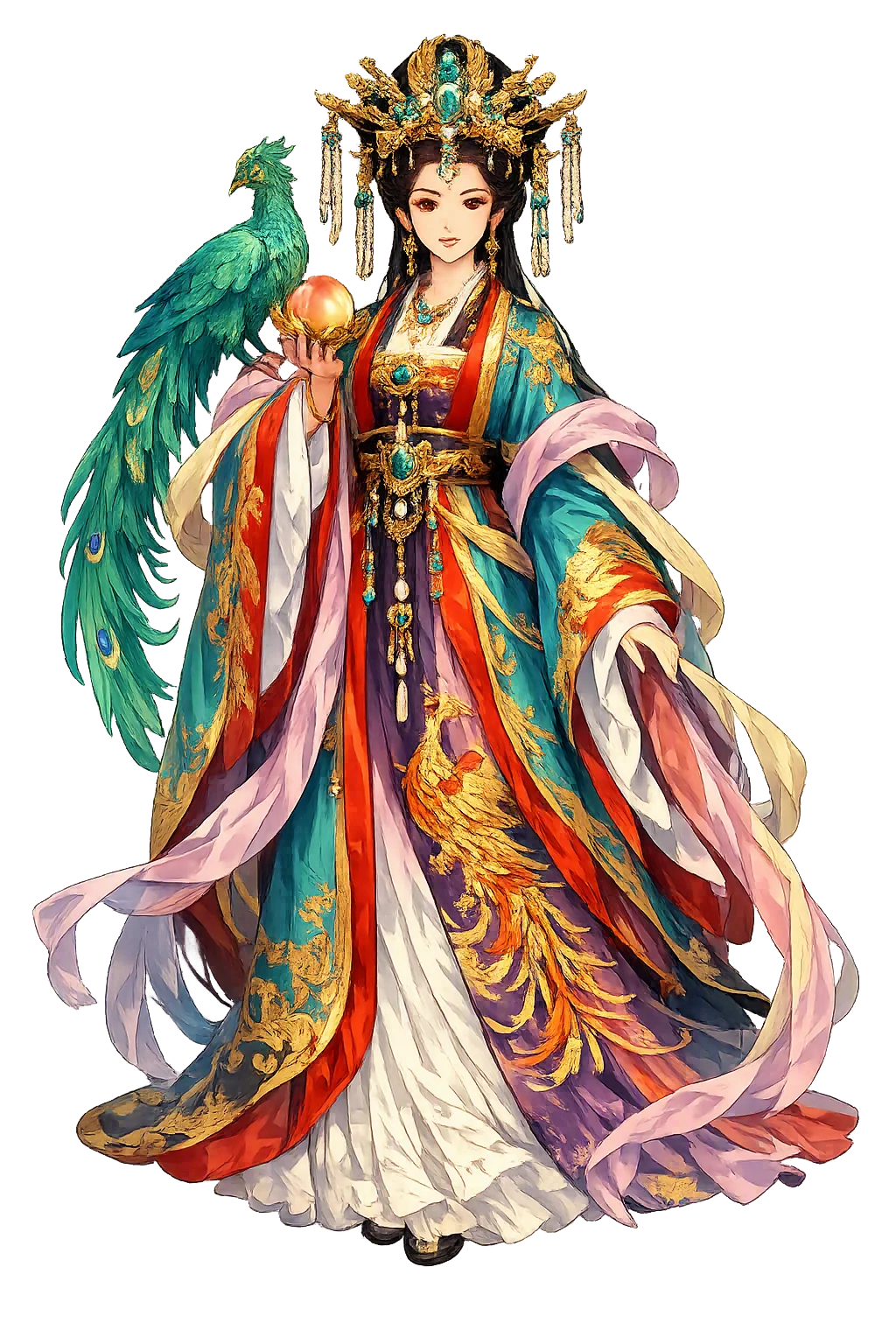
The provenance file on Xīwángmǔ
Provenance record 533 · Xīwángmǔ · one temple, fully accounted for.
Provenance
1. The attestation. 西王母 — "Western queen mother". On record: Shan Hai Jing (Classic of Mountains and Seas), ch. 2 & 16, Huainanzi, Han Shu (Book of Han), ch. 11 (Annals of Emperor Ai), Mu Tianzi Zhuan (Account of King Mu, Warring States).
2. The preserved evidence. i → ī (Long vowel); a → á (Stress on a) — absent from the ASCII form xiwangmu, present in the restoration, verifiable against the sources above.
3. The narrative record. The Fearsome Portrait — Her oldest portrait is the strangest. In the Classic of Mountains and Seas, compiled from Warring States to Han materials, the Queen Mother "has the form of a human, the tail of a leopard, the teeth of a tiger, and is good at whistling; her tangled hair is bound with a sheng headdress" (ch. The Elixir for Hòuyì — It is from Xīwángmǔ that immortality flows. The Huainanzi records that Hòuyì, the archer who shot down the nine excess suns, "begged the elixir of undying from the Queen Mother of the West" — and that his wife Héng'é stole it and fled to the moon, where she became the moon's goddess (her name later softened to Cháng'é under a Han emperor's name-taboo).
4. The physical record. The Queen Mother's earliest textual portrait is in the Classic of Mountains and Seas, compiled from Warring States through Han materials (roughly 4th–1st centuries BCE), where she appears with tiger's teeth and a leopard's tail on Mount Kūnlún. Her great material flourishing is Han: bronze mirrors invoke her by name for blessing and long life, and tomb reliefs and murals — most famously the Wu Liang shrine of the 2nd century CE — show her enthroned in the west, increasingly paired with Dōngwánggōng in the east. The Book of Han preserves the documentary trace of her popular cult in the millenarian movement of 3 BCE, when her tallies passed through the commanderies. By the medieval period, Taoist scriptures and liturgical texts had raised her to the summit of the goddess hierarchy, the form in which she has been worshipped ever since.
5. The current holding. The temple at /xiwangmu/, classified Tier 1. The restoration preserves more than the ASCII form can express — stress, length, or a letter the Latin keyboard lost — which places it, mechanically, in Tier-1.
6. The documented resonances. Biotech, Longevity & Life Sciences, Faith & Spiritual Organizations, Food & Hospitality — seats argued and weighted in the pattern atlas, read through the myths in this temple's Resonance File.
7. The primary sources. Tao Te Ching — the library this file answers to, open at the Sacred Texts collection.
8. The continuing record. The Queen Mother never retired from the heavens. In Taoist temples across Taiwan and the diaspora she is venerated still, often under the title Golden Mother of the Jasper Pool, and her birthday is kept with festival observance.
At a Glance
- Restored name: Xīwángmǔ
- ASCII form: xiwangmu
- Meaning: "Western queen mother"
- Domain of influence: Queen Mother of the West
- Pantheon: Taoist
- Classification: Tier 1
- Original script: 西王母
- Series: The Restoration Files, No. 533 of 546
The File Continues
Read the founding dispatch for the name's full story, the Resonance File for the archetype at work — or the whole archive in one sitting.
Continue the series — previous file: Xiuhtēcuhtli (read it here) · next file: Xōlōtl (read it here).
The Restoration Files are written from the same canonical record as the temples themselves: the lexicon, the lore catalog, the pattern atlas, and the cited scholarly sources. If a file ever disagrees with its temple, the temple is right — tell us, and the file will be corrected.