
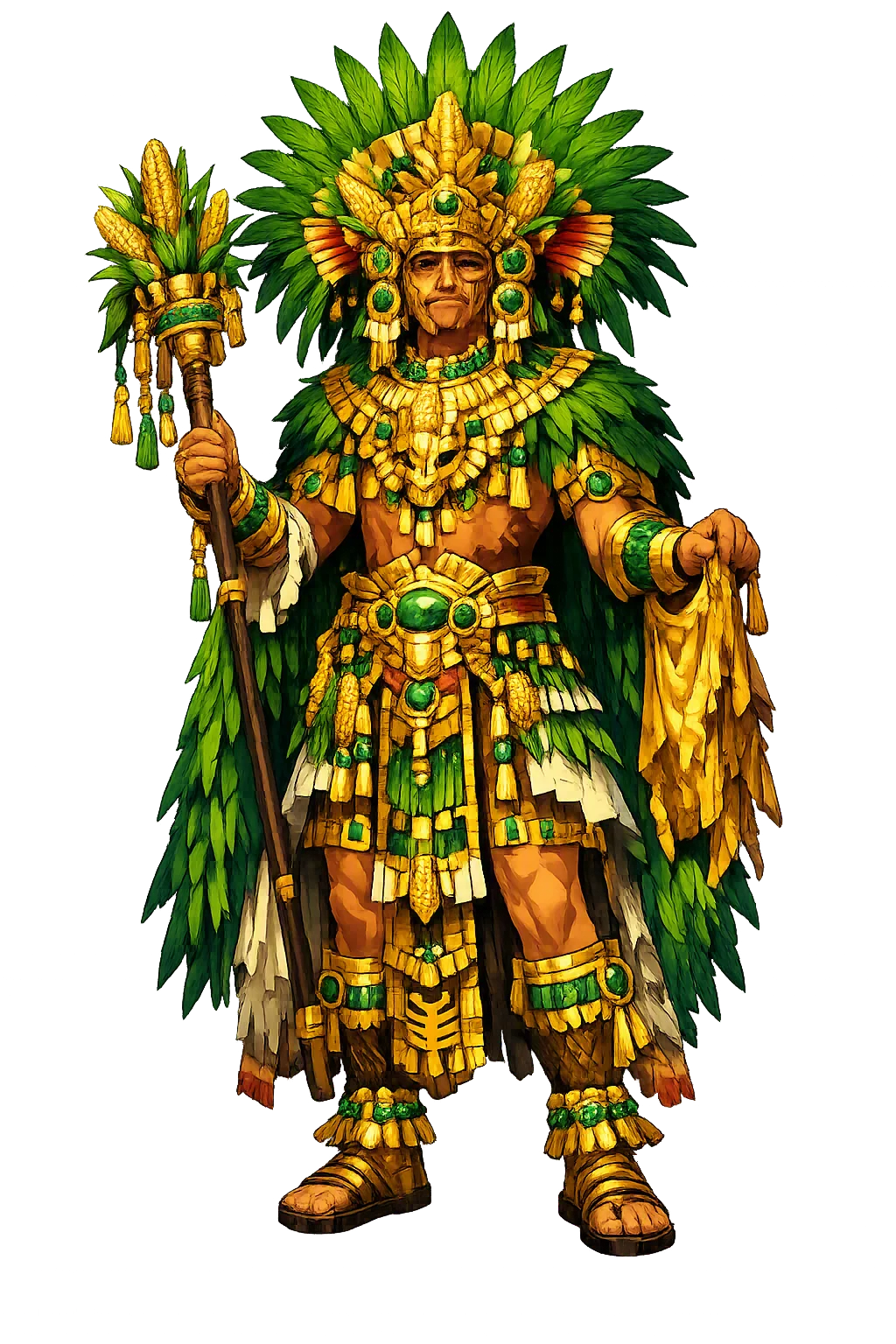
Xipe: the stories first, then the spelling
Before the spelling, the story. Xipe earns its restoration the old way — through what was actually told.
The Stories That Carry the Name
The Lord Who Fed the World. One late account, preserved in the colonial Histoyre du Mechique, tells that after the great flood the earth gave humanity nothing to eat, and the god Xipe Tōtec flayed himself so that people might be fed; for this reason his images are always shown wearing a human skin. Diego de Durán, who watched the rite's last performances in sixteenth-century Mexico, recorded the same conviction: the god had given his own covering for the world's sustenance. The friars were witnessing an agricultural allegory they only half understood.
The Festival of the Flaying. The Florentine Codex (Book 2) and Durán describe the great feast of the second veintena, roughly February–March: captives taken in war were dedicated at Yopico, the flayed lord's shrine in the Templo Mayor precinct; bound to the round temalacatl stone, they fought gladiatorial combats against seasoned warriors, then were stretched across the sacrificial stone. The priests then flayed the victims and wore their skins for twenty days, knotted at the wrists and ankles, visiting houses and receiving offerings as living images of the god, until the dried skins were laid away. Sahagún's informants named them tototectin, 'the flayed ones.
The Red Lord of the West. In the theological geography recorded from Sahagún's informants, Xipe Tōtec was also Tlatlauhqui, 'the red one' — the Red Tezcatlipoca, lord of the west, the quarter of the setting sun and of the earth's buried treasures. During Tlacaxipehualiztli the goldsmiths held their own feast, for Xipe was patron of their craft: gold, the Nahuatl-speakers called teocuitlatl, 'divine excrement', the sun's deposit in the earth's gut. The same festival that flayed a man to renew the fields also honored the men who pulled shining metal from the ground.
And Here Is What the Spelling Preserves
At a Glance
- Restored name: Xipe
- ASCII form: xipe
- Meaning: "The flayed one"
- Domain of influence: Spring, Agriculture, Flayed
- Pantheon: Nahuatl
- Classification: Tier 2
- Original script: —
- Series: The Restoration Files, No. 533 of 548
The Name Travels
The Dominican Diego de Durán, watching Tlacaxipehualiztli in the decades after the Conquest, was struck that the feast fell near Holy Week — the god who wore a flayed skin commemorated at the season when Christians mourned a god who wore a body and lost it. The friars suppressed the rite, yet its imagery proved durable: in the Puebla and Guerrero regions, masked and costumed dance confraternities — ancestors of today's concheros and Danza Azteca — carried the flayed lord's memory in transformed dress.
The Address It Earned
The temple of Xipe stands at /xipe/ — lore, scholars, patterns — because a name carrying this much story deserves more than a parking page. One decisive feature survives — a single, honest mark — which places the restoration in Tier-2: exact, and exactly labeled.
The File Continues
Read the founding dispatch for the name's full story, the Resonance File for the archetype at work — or the whole archive in one sitting.
Continue the series — previous file: Xiān (read it here) · next file: Xiuhtēcuhtli (read it here).
The Restoration Files are written from the same canonical record as the temples themselves: the lexicon, the lore catalog, the pattern atlas, and the cited scholarly sources. If a file ever disagrees with its temple, the temple is right — tell us, and the file will be corrected.