PuniCodex

Extended Lore

Xipe

Etymology · Orthography · Cult · Iconography · Reception · Sources

Tier 2 Xipe
Xipe — Spring, Agriculture, Flayed
01

Quick Facts

Essential information about Xipe, Spring, Agriculture, Flayed

Scholarly TransliterationXipe
Unicode RestorationXipe
Reconstructed Pronunciation/ˈʃi.pe/
PantheonNahuatl
DomainSpring, Agriculture, Flayed
MeaningThe flayed one
ClassificationTier 2
Primary DomainXipe
Sacred SymbolsFlayed human skin, Maize husk, Temalacatl, Pointed cap (copilli), Chicahuaztli
02

Etymology & Word Family

From original script to Unicode restoration

Scholarly Transliteration Xipe Xipe — "The flayed one"
Unicode Restoration Xipe Canonical scholarly spelling — ASCII-identical
Modern ASCII xipe Plain-ASCII fallback

The name Xipe reaches the modern world through scholarly transliteration of the nahuatl tradition. Because the conventional spelling uses only Latin letters, its Unicode and ASCII forms coincide — the tradition it carries is in the name itself, not in diacritics.

03

Unicode Character Breakdown

Character-by-character philological analysis

CharacterUnicodeNameBlockPhonetic Role
XU+0058Latin Capital Letter XBasic LatinSame
iU+0069Latin Small Letter IBasic LatinSame
pU+0070Latin Small Letter PBasic LatinSame
eU+0065Latin Small Letter EBasic LatinSame

The Tier 2 classification here reflects fidelity to the attested tradition, not recovered diacritics: every character of Xipe already survives in ASCII. What the restoration preserves is the canonical spelling itself — the form scholarship standardised.

04

Cult & Worship

How the sacred was kept — rites, sanctuaries, remains

The Cult

Xipe's cult was the most theatrical in Mesoamerica. Its center was Yopico, the flayed lord's shrine in the Templo Mayor precinct at Tenochtitlan — excavated by INAH from 1978 — and its season was the second veintena, Tlacaxipehualiztli, when the agricultural year began. War captives, each an ixiptla 'representation' of the god, were dedicated at Yopico, fought bound on the round temalacatl stone, and were sacrificed; the priests then flayed them and wore the skins, knotted at the wrists and ankles, for twenty days, walking from house to house blessing the households — Sahagún's informants called them tototectin, 'the flayed ones,' and Durán watched the rite's last performances. The same veintena hosted the goldsmiths' feast, for Xipe was their patron too. The votive evidence is unusually direct: the shrine's excavations recovered caches with ceramic flayed-skin effigy vessels, three-dimensional catechisms of the rite. Modern Danza Azteca troupes revive the spring season, not the sacrifice; the attested cult ended with the friars' suppression in the sixteenth century.

In the Earth

The earliest material witness to the flayed-skin complex comes from the shaft tombs of West Mexico (Colima, Jalisco, Nayarit, c. 200 BCE–500 CE), whose ceramic figures wear the flayed skins of other men — proof the imagery predates the Aztec state by centuries. At Tenochtitlan, the INAH excavations of the Templo Mayor precinct (from 1978) located Xipe's shrine, Yopico, and its caches; the Templo Mayor Museum preserves a monolithic Xipe Tōtec whose back shows the wearer's own skin beneath the knotted cords of the second skin. The cult's heartland lay among the Yope of the Guerrero coast and in the Puebla region, and the screenfold Codex Borgia (c. 1500) gives the god's fullest painted dossier.

05

Iconography

How Xipe was imaged across the ages

The Image

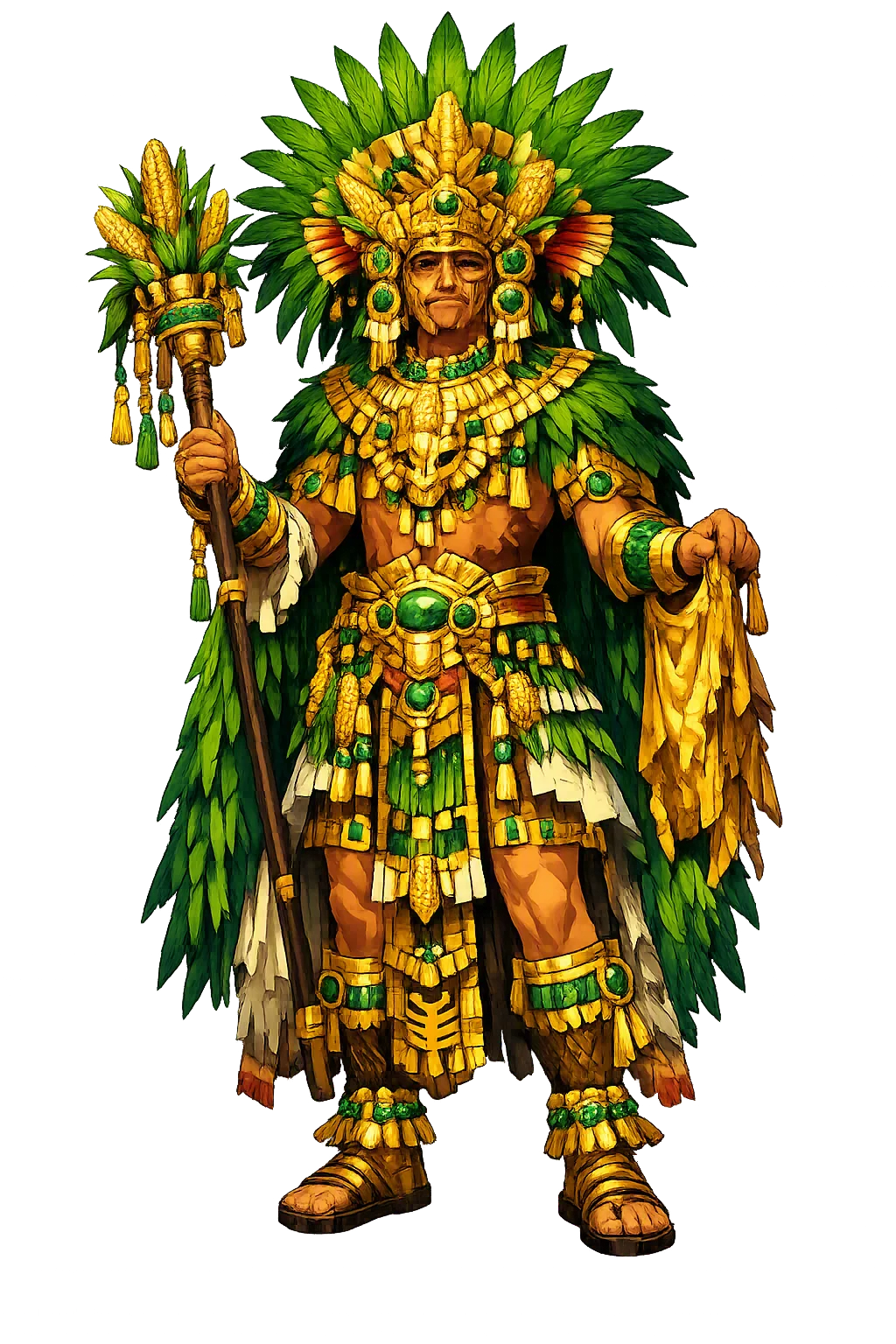
Xipe is the rare god whose iconography can be dated a thousand years before his name: the earliest images are the ceramic figures of West Mexico's shaft tombs (Colima, Jalisco, Nayarit, c. 200 BCE–500 CE) — solid little men wearing the flayed skins of other men, the theology already fully formed. The Mexica version froze the type: a standing figure wearing a second skin knotted at the wrists, ankles, and across the back, the dead face of the flayed man pulled over his own like a mask, his true skin showing beneath the cords — death and renewal rendered in stone. The type specimen is the monolithic Xipe of the Templo Mayor Museum in Mexico City, life-size, whose back still carries the knotted cords and slit openings of the borrowed skin. The Codex Borgia (c. 1500) gives the painted dossier: the red lord of the west, pointed copilli cap on his head, chicahuaztli rattle staff in hand, maize springing at his feet. The image never needed to evolve: a seed's argument, carved once and kept.

06

Reception & Transformation

The name after its own age — transmission, translation, survival

Afterlives

Xipe's reception is a four-century argument about what the skin means, and the argument is the afterlife. The friars wrote it down: Sahagún's Florentine Codex, compiled 1545–76 and carried to Europe within a generation, described Tlacaxipehualiztli in forensic detail; Durán's Book of the Gods and Rites preserved the rite's last performances; the anonymous French Histoyre du Mechique kept the self-flaying myth — and waited until 1905 for its first printing. These manuscripts then slept: the Florentine Codex waited for Bustamante's 1829–30 Spanish publication and its full facsimile of 1979. Enlightenment Europe received the flayed god through prints and museum pieces — Kingsborough's nine-volume Antiquities of Mexico (1829–48) put the codices, and the god, before a wide public — while Eduard Seler's turn-of-the-century scholarship read the rite as agricultural allegory rather than barbarism, the reading that has framed everything since. The twentieth century found the rite in the ground: the Mexico City excavations crowned by the Templo Mayor's rediscovery in 1978 recovered Yopico and its effigy vessels, turning Sahagún's paragraphs into architecture. Modern scholarship — León-Portilla's editions, Clendinnen's interpretations, Miller and Taube's dictionary — still stands where the sources leave the question: a barbarism, a theology, or, as the seed-husk parallel suggests, a farming people telling the exact truth about the cost of spring. The afterlife of the Flayed One is that the debate refuses to close.

Identifications Across Traditions

The Dominican Diego de Durán, watching Tlacaxipehualiztli in the decades after the Conquest, was struck that the feast fell near Holy Week — the god who wore a flayed skin commemorated at the season when Christians mourned a god who wore a body and lost it. The friars suppressed the rite, yet its imagery proved durable: in the Puebla and Guerrero regions, masked and costumed dance confraternities — ancestors of today's concheros and Danza Azteca — carried the flayed lord's memory in transformed dress. Twentieth-century revival movements such as the Mexicayotl circle reclaimed Xipe Tōtec as a figure of indigenous identity and renewal rather than barbarism. Comparative religion places him among the world's 'dying vegetation' gods, but the Mexica theology was stranger and more precise: not a god who dies like a plant, but a god who peels like a seed.

Modern Legacy

Xipe Tōtec stands at the center of the modern debate over Aztec sacrifice — read by some as the theological heart of a sophisticated agricultural civilization, by others as evidence of state terror (Clendinnen, Townsend). His images anchor museum collections: the monolithic Xipe of the Templo Mayor Museum, wearing his knotted second skin, is among the most reproduced Aztec sculptures. Nahuatl lexicography (Karttunen, Lockhart) keeps his name etymologically alive, and Danza Azteca troupes across Mexico and the United States still perform in the spring season his festival once owned. For better and worse, the Flayed One is now the world's most recognizable emblem of Mexica religion.

07

The Meditation

What Xipe means — beyond the dictionary

Xipe Tōtec asks the question every farmer knows and every city forgets: what must die for something else to live? His answer is a skin. The maize seed does not negotiate with its husk; it splits it. The god does not sympathize with the covering; he wears it. In a culture that now separates death from dinner by an almost perfectly opaque supply chain, the Flayed One insists on the connection: your bread was once a seed's corpse, your gold was once a stone's wound.

To meditate on Xipe is to meditate on the cost of renewal. He is not a god of resurrection — nothing in the rite promises the flayed man his life back. He is a god of transfer: life moves, and something is always left behind. The friars saw only cruelty; the Mexica saw the farming year. Both were reading the same skin.

08

Frequently Asked Questions

Common questions about Xipe, Spring, Agriculture, Flayed, and Unicode restoration

01How do you pronounce Xipe?

In reconstructed pronunciation, Xipe is /ˈʃi.pe/ — approximately 'SHE-peh' — both vowels are short, the stress falls on the first syllable, and the x is never the English 'ks' or 'z' sound.

02What does Xipe mean?

Xipe means The flayed one in the nahuatl tradition.

03What are the symbols of Xipe?

Xipe is associated with Flayed human skin (His defining attribute — a second skin knotted at the wrists and ankles, the visible claim that the old covering must die for new life to emerge.), Maize husk (The theological key to his cult: the seed cannot germinate until it sheds its sheath, as the god shed his skin to feed humanity.), Temalacatl (The round gladiator stone on which captive warriors fought bound during Tlacaxipehualiztli before being sacrificed in his honor.), Pointed cap (copilli) (The conical headgear of his image, marking lordship and linking him to the solar-warrior complex of the western sky.), Chicahuaztli (The rattle staff he carries in codex imagery, an instrument of fertility whose sound accompanies the ancestral dances.).

04Why restore Xipe in Unicode?

Xipe is written entirely in ASCII letters, so its restoration is about canonical fidelity rather than recovered diacritics: the temple fixes the name in its scholarly standard spelling, attested in the source tradition, instead of leaving it to drift.

05What is the most important myth about Xipe?

“The Lord Who Fed the World” — the The Flaying story that anchors the mythology of Xipe, told in full on the lore page.

09

Scholarly Sources

The philological foundations of this restoration

Every claim on this page is grounded in established scholarship. The orthographic restorations follow disciplinary convention. The etymological chain follows the best available reference works. This is not invention — it is resurrection through scholarship.

◈

Lexicography & Philology

  • Karttunen
◎

Primary Texts

  • The Florentine Codex (Sahagún); the Anales de Cuauhtitlan; colonial Nahuatl testimonies and pictorial manuscripts.
◉

Archaeology & Art History

  • Material evidence — iconography, inscriptions, and temple archaeology — for Xipe and related cults.
✦

Religious Studies

  • Sahagún, Florentine Codex, Book 2 (Tlacaxipehualiztli and the tototectin)
  • Diego de Durán, Book of the Gods and Rites (the festival and the Holy Week parallel)
  • Histoyre du Mechique, ed. Garibay (the flaying of the lord)
  • Miller & Taube, The Gods and Symbols of Ancient Mexico and the Maya (1993), s.v. Xipe Totec
  • Karttunen, An Analytical Dictionary of Nahuatl, s.v. xipehua
  • León-Portilla, Aztec Thought and Culture (1963)
Return

The Surface Awaits

You have traced the name from its earliest attestation to its Unicode restoration. Now return to the myth. The story is where the name lives.

Back to Lore
Xipe mascot