
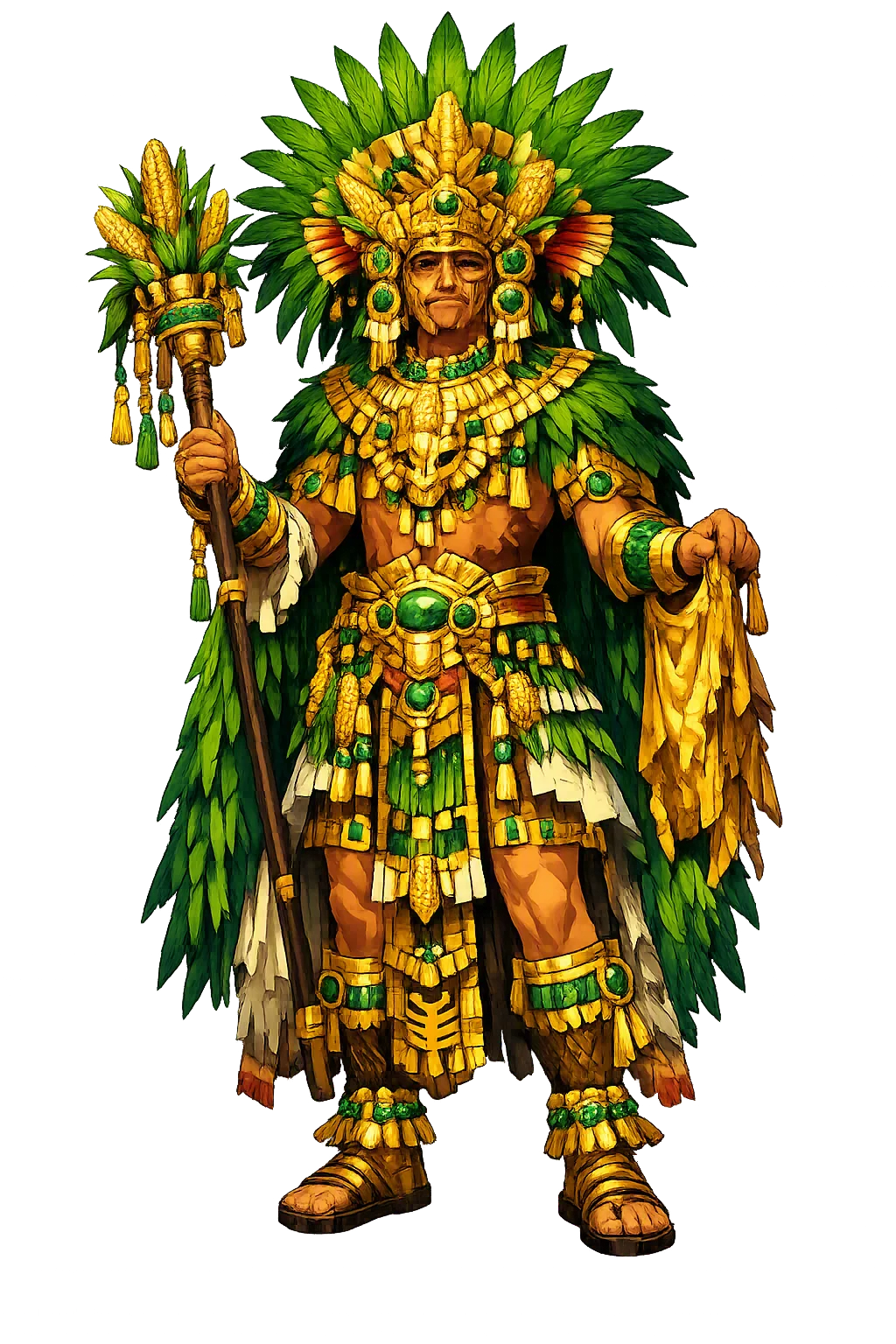
The hidden history behind Xipe
Behind the modern ASCII form xipe hides a much longer story. Xipe reaches back through manuscripts, inscriptions, and oral tradition long before it ever touched a keyboard, and the full name — Xipe Totec, "Our Lord the Flayed One" — is one of the most visually arresting in Mesoamerican religion. Every letter in the restored spelling is a receipt from that journey. In what follows we trace the name from its Nahuatl transcription attestations through its mythology, its cult, its symbols, and its afterlife in other cultures — and we show how the PuniCodex project turned that philological record into a Unicode domain that resolves today. The history was never lost. It was only waiting for the infrastructure to catch up.
At a Glance
- Restored name: Xipe
- ASCII form: xipe
- Meaning: "The flayed one"
- Domain of influence: Spring, Agriculture, Flayed
- Pantheon: Nahuatl
- Classification: Tier 2
Overview
Xipe (xipe) — Spring, Agriculture, Flayed — belongs to the Nahuatl tradition, where he is catalogued under the domain "Spring, Agriculture, Flayed". The full epithet by which he is most famously known is Xipe Totec, "Our Lord the Flayed One." The name means "The flayed one". He is one of the great agricultural deities of Mesoamerica, a god of springtime renewal, the germination of seeds, and the violent transformation that makes new growth possible.
PuniCodex restores the name as Xipe and serves its temple at its temple. The restoration needs no distinctive letters or diacritics its ASCII form would lose, which places the name in Tier 2. The plain ASCII form xipe survives as a modern convenience imposed by the early domain-name system; the restoration, not the fallback, is the form the project defends as philologically complete. The capital X and the full alphabetic spelling signal that this is a proper noun, a sacred name, and a scholarly citation form, not a lowercase keyword or a registry hack.
The Name
The name is attested in colonial Nahuatl sources as Xipe. Etymologically it means "The flayed one".
In classical Nahuatl, xipe is the past participle or stative form of the verb xipēhua, "to flay, to peel". A xipe is a flayed person or thing; as a divine name, it becomes a title of horrifying dignity. The initial X represents the Nahuatl voiceless postalveolar fricative [ʃ], the sound English speakers write as "sh". The following i is a short, bright vowel. The p is an unaspirated stop, and the final e closes the syllable with a clear front vowel. The spoken name is approximately SHEE-peh, with stress on the first syllable.
The full epithet Xipe Totec adds totec, "our lord" (to- "our", tec "lord"), a title of reverence applied to several deities. The combination names the god from his most distinctive attribute: he wears the flayed skin of a sacrificial victim, symbolizing the husk that covers the new growth beneath. Where other gods are identified by weapons, animals, or celestial bodies, Xipe is identified by a process — flaying — that turns death into the condition of renewal.
The ASCII form xipe preserves the letters but loses the capitalization that marks the word as a theonym. It also risks mispronunciation by English speakers who will read the initial X as a [ks] sound. The Unicode restoration Xipe recovers the scholarly citation form and invites the correct Nahuatl reading.
Etymology and Linguistic Roots
The root of Xipe's name lies in the Nahuatl verb xipēhua, "to flay, to skin, to peel". This verb belongs to a semantic field that includes agricultural peeling — the removal of husks from maize, the stripping of bark from trees — and ritual flaying. The overlap is not accidental. Xipe's mythology turns the violent act of flaying into an agricultural metaphor: the old skin is the dry husk; the new skin beneath is the sprouting seed.
The name Xipe is therefore a verbal adjective or participle applied to a god. It is not a personal name in the usual sense but a functional title that describes what the deity does and what he represents. This kind of theonym is common in Nahuatl, where gods are often named by their actions or domains: Huitzilopochtli is "Hummingbird-on-the-Left", Tezcatlipoca is "Smoking Mirror", and Xipe is "The Flayed One".
The epithet Totec, "Our Lord", elevates the title into a cultic name. Xipe Totec is the flayed lord who presides over the dangerous transition from dry season to rainy season, from death to life, from the old year to the new.
The Flayed God and Agricultural Renewal
Xipe Totec's defining image is the god wearing the skin of a sacrificed human. The skin is yellowish, tight, and still recognizably human; the god's own face peers through the mouth opening of the flayed face. To modern eyes the image is disturbing. To Nahuatl ritual thought, it was a precise visual statement about how life renews itself. The seed must die and split open; the sprout emerges from the husk; the new maize pushes through the old covering. Xipe is that moment of emergence personified.
The god's domain is spring, agriculture, and the flayed. These three elements are inseparable. Spring is the season when the earth flays itself of its dry surface and exposes the green growth beneath. Agriculture depends on this cycle of death and rebirth. The flayed victim is the ritual enactment of the same process on a human body. Xipe does not merely symbolize renewal; he embodies the violence without which renewal cannot occur.
In the agricultural calendar, Xipe's festival, Tlacaxipehualiztli, fell in the second month of the solar year, at the transition from dry season to rains. This was the moment when farmers prepared fields for planting and when the first green shoots began to appear. The festival aligned human sacrifice, cosmic transition, and agricultural labor into a single ritual complex.
Mythology
The myths of Xipe are less well preserved than those of Quetzalcóatl or Tezcatlipoca, but his presence in ritual and iconography shows that he was one of the most widely worshipped deities in the Nahuatl world. His mythology centers on transformation through sacrifice.
The Flayed Lord
Xipe's central mythic image is himself: a deity who puts on the skin of the slain. The act is not punitive but generative. The victim, often a war captive or a slave, was killed and flayed; the priest or cult image then wore the skin for days until it rotted and fell away. During that time, the wearer was treated as the god himself. The ritual made visible the belief that life feeds on death and that the new year cannot begin until the old covering is stripped.
Xipe and the Seasons
In some accounts, Xipe is associated with the east and with the morning star, the direction and time of renewal. He is the lord of the golden West in some cosmological schemes, the direction from which the rains come and where the sun enters the earth. His color is yellow-gold, the color of dried corn and of the flayed skin; his adornments include rattles and bells that sound like falling rain.
Xipe in the Pantheon
Xipe stands in a complementary relation to other agricultural and seasonal deities. Where Tlaloc governs rain and Cinteotl governs maize, Xipe governs the transitional violence that prepares the ground for both. He is sometimes grouped with the Teteoh Innan, the divine mothers, and with the forces of fertility and vegetation. His cult cuts across social boundaries: prisoners, slaves, merchants, and rulers all participated in his rites.
The Tlacaxipehualiztli Festival
The most important festival of Xipe was Tlacaxipehualiztli, "The Flaying of Men". It took place in the second month of the Nahuatl solar year and was one of the most elaborate ceremonies in the Aztec calendar. The name itself is a ritual gerund: tlacatl "person" + xipehua "to flay" + -liztli "the act of". The festival made the god's nature explicit.
During the festival, captives were sacrificed by gladiatorial combat, heart extraction, or arrow shooting. Their bodies were then flayed, and the skins were worn by priests and by individuals who had been promised the god's favor. The wearers were called xipeme. They went through the city begging, receiving offerings, and performing the role of the deity. The rotting of the skin over twenty days marked the passage from the dry, dead season to the new, growing season.
The festival was not only a spectacle of violence but also an economic and social event. It redistributed goods, affirmed military hierarchy, and bound the city together around a shared understanding of agricultural time. For modern scholars, Tlacaxipehualiztli is one of the most extensively documented Aztec ceremonies, described in detail by Sahagún and other colonial observers.
Symbols and Iconography
The iconography of Xipe is unmistakable and consistent across media:
- The flayed skin — The primary attribute, worn over the god's own body; the face of the victim hangs like a mask over Xipe's chest.
- Yellow-gold coloration — The color of dried corn and of the flayed skin; associated with spring and the sun's heat.
- Rattles and bells — Worn by the god and his impersonators; their sound evokes rain and the movement of growing plants.
- Maize and vegetation — Sprouting plants, especially maize, emerge from or surround the god, linking him to agricultural renewal.
- Weapons — Knives and sacrificial implements, reminders of the violence that produces renewal.
Colonial and modern representations often show Xipe with one hand raised and one lowered, a posture of active transformation. The doubled face — the god's face and the victim's flayed face — became a powerful visual emblem of Mesoamerican religion.
Archaeology and Evidence
Xipe was worshipped across Mesoamerica, not only among the Mexica but also among the Zapotec, Mixtec, Maya, and other peoples who used Nahuatl as a lingua franca or borrowed its religious vocabulary. Images of the flayed god appear from the Classic period onward, suggesting a long history for the cult.
In the Aztec capital of Tenochtitlan, Xipe had a major temple in the sacred precinct. Colonial sources describe the image of the god, the storage of ritual paraphernalia, and the performance of Tlacaxipehualiztli. Archaeological excavations in and around Mexico City have recovered sculptures, masks, and ceramic images of the flayed god.
The Florentine Codex remains the most important textual source, with detailed descriptions of the festival, the priesthood, and the god's attributes. Other colonial Nahuatl texts, including the Codex Magliabechiano and the Codex Borbonicus, include images of Xipe in ceremonial contexts.
Cultural Legacy
Xipe's legacy is complex. For modern Mexicans and scholars of Mesoamerica, he is a central figure in understanding Aztec religion and the agricultural imagination. The image of the flayed god appears in museum exhibitions, scholarly books, and popular accounts of the Aztecs. For indigenous-rights advocates and Nahuatl-language teachers, restoring the name Xipe is part of a larger project of keeping Nahuatl terms visible and correctly spelled in digital spaces.
The flayed god also challenges modern assumptions about the relationship between beauty and divinity. Xipe is not a serene figure; he is a god of necessary violence, of the transformation that requires tearing away the old. In an age of ecological crisis, his imagery can be read as a stark reminder that growth depends on decay, and that renewal is not painless.
Contemporary artists have returned to Xipe's doubled face and golden skin as symbols of identity, sacrifice, and transformation. The name itself, properly restored as Xipe, carries all of this history into the address bar.
Selected Sources
The account of Xipe given here rests on a small set of authoritative witnesses. The Florentine Codex is the single richest source for the Tlacaxipehualiztli festival, the priesthood, and the god's attributes. Frances Karttunen's Analytical Dictionary of Nahuatl secures the etymology of xipe and xipēhua. Miguel León-Portilla's work on Aztec thought situates the flayed god within the broader Nahuatl philosophical world. Mary Miller and Karl Taube's Gods and Symbols of Ancient Mexico and the Maya provide the essential iconographic guide, while the Codex Magliabechiano and Codex Borbonicus preserve contemporary painted images of the deity and his rites.
Archaeological reports from the Templo Mayor excavations and from sites across Mesoamerica continue to refine our picture of how widely the flayed god was worshipped and how his imagery changed over time.
The Unicode Restoration
Xipe is classified as Tier 2: the restoration needs no distinctive letters or diacritics its ASCII form would lose. The ASCII fallback xipe still resolves everywhere, but it is the restored form that carries the name's full dignity as a proper noun and theonym. That is the whole thesis of this temple: capitalization and correct scholarly form are not luxuries when they distinguish a deity from a common word.
Character by Character
The journey from xipe to Xipe, one character at a time:
- x → X — Same, capitalized; pronounced as Nahuatl [ʃ], like English "sh"
- i → i — Same
- p → p — Same
- e → e — Same
The Nahuatl Pantheon
Xipe is one of many entries the PuniCodex lexicon catalogues under the Nahuatl pantheon. The Pantheon page gathers the tradition's major figures in one place, and the Lexicon lets you filter all 980 restorations by tradition, tier, or script — the fastest way to see where this name sits among its kin.
Frequently Asked Questions
What does Xipe mean? The traditional gloss is "The flayed one".
Which tradition does Xipe belong to? Xipe is catalogued in the Nahuatl pantheon of the PuniCodex lexicon.
Why is Xipe classified as Tier 2? Because the restoration needs no distinctive letters or diacritics its ASCII form would lose — the restoration preserves the capitalization of a proper noun.
Can I use Xipe in a normal browser? Yes. The DNS resolves the punycode form automatically, and the type tool on this site converts xipe to Xipe for copying and pasting.
Where does the scholarly information come from? The entry is built from lexica, colonial sources, and reviewed scholarly works listed in the Scholarly Edition. Every claim is traceable to a canonical source.
Typing Xipe
You do not need a special keyboard to use this restoration. The PuniCodex Type Tool converts the ASCII form xipe into Xipe as you type, and the browser extension offers the same conversion inside any text field. Copy the restored form, paste it into the address bar, and the DNS does the rest.
Sister Temples
Other temples in the Nahuatl pantheon include Quetzalcóatl, and Huitzilopochtli — each with its own restoration story, its own scholarly record, and its own place in the lexicon.
Why This Restoration Matters
The four letters of Xipe are small, but they carry a large claim: that the flayed god of spring is not a horror-movie prop, not a lowercase keyword, not a string, but a named power with a continuous history from the temples of Tenochtitlan to the present browser tab. The PuniCodex temple keeps that name in circulation — as a domain, a dataset entry, and a scholarly argument — so that the choice to use it stays easy. Letter by letter, the original names come back.
Explore Further
This post is one doorway into the temple. The home page carries the full character breakdown and the ambient canvas; the lore page tells the myths in long form; the Scholarly Edition preserves the sources, pronunciation data, and revision history; and the patron wall supports the restoration directly. For the wider map, browse the Lexicon, explore the Pantheon, or return to the PuniCodex blog.
Related Names
- Centeōtl — Maize, Agriculture
- Chālchiuhtlīcue — Water, Rivers, Lakes
- Chicōmecōātl — Agriculture, Maize
- Cihuacōātl — Childbirth, Motherhood, Earth
- Citlālicue — Milky Way, Stars
Sources
- Bernardino de Sahagún, Florentine Codex (c. 1577).
- Miguel León-Portilla, Aztec Thought and Culture (1963).
- Alfredo López Austin, The Human Body and Ideology (1988).