Stories of Xipe
Xipe's mythology survives only in fragments: one late creation story, the great festival book of the Florentine Codex, and the uneasy testimony of Spanish friars. Pieced together, they reveal a god whose apparent cruelty is an agricultural theology — the flayed skin is the seed coat, and the death of the husk is the birth of the maize.
One late account, preserved in the colonial Histoyre du Mechique, tells that after the great flood the earth gave humanity nothing to eat, and the god Xipe Tōtec flayed himself so that people might be fed; for this reason his images are always shown wearing a human skin. Diego de Durán, who watched the rite's last performances in sixteenth-century Mexico, recorded the same conviction: the god had given his own covering for the world's sustenance. The friars were witnessing an agricultural allegory they only half understood. A maize seed cannot sprout until it splits and sheds its husk; the Mexica made that everyday miracle into a deity who wears the shed skin of a man. The myth teaches that feeding others is never costless: the renewal of the world is paid for with a skin.
The Florentine Codex (Book 2) and Durán describe the great feast of the second veintena, roughly February–March: captives taken in war were dedicated at Yopico, the flayed lord's shrine in the Templo Mayor precinct; bound to the round temalacatl stone, they fought gladiatorial combats against seasoned warriors, then were stretched across the sacrificial stone. The priests then flayed the victims and wore their skins for twenty days, knotted at the wrists and ankles, visiting houses and receiving offerings as living images of the god, until the dried skins were laid away. Sahagún's informants named them tototectin, 'the flayed ones.' The rite horrified the friars and obsesses modern readers, but its logic was exact: at the start of the farming year the city reenacted the first flaying, so that what was done to the god might be done to the seed. Shed skin, shed husk, new season.
In the theological geography recorded from Sahagún's informants, Xipe Tōtec was also Tlatlauhqui, 'the red one' — the Red Tezcatlipoca, lord of the west, the quarter of the setting sun and of the earth's buried treasures. During Tlacaxipehualiztli the goldsmiths held their own feast, for Xipe was patron of their craft: gold, the Nahuatl-speakers called teocuitlatl, 'divine excrement', the sun's deposit in the earth's gut. The same festival that flayed a man to renew the fields also honored the men who pulled shining metal from the ground. Modern scholarship (Miller & Taube) has long noted the coherence: metal and maize are both riches that must be stripped out of a dead covering — ore from rock, grain from husk, flesh from skin. The red lord of the west governs them all.
Central Mexicans did not think their gods watched the rite from afar. For the duration of the feast the chosen captive became an ixiptla — a 'representation', a living image of Xipe Tōtec — dressed, honored, and addressed as the god himself before he was killed and his skin assumed by the priests. Bernardino de Sahagún and Diego de Durán both describe how the impersonator was adorned and escorted through the city as though the deity had come down to walk among his people. The institution startled the friars into comparisons with the Christian God made man, and modern scholars such as Inga Clendinnen have made the ixiptla the key to understanding Mexica religion: a god who must enter a human body to renew the world, and leave it as a skin.
Spring
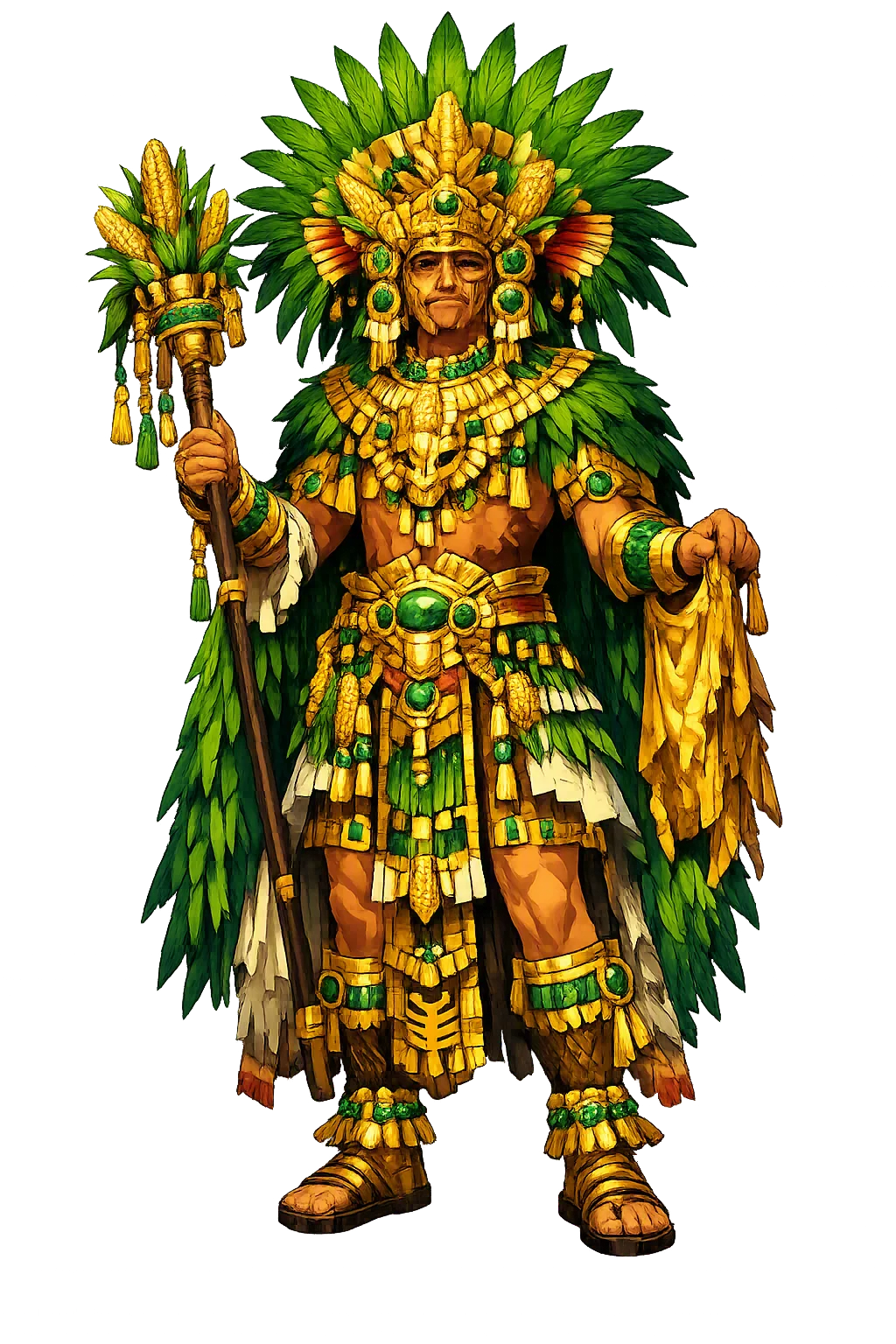
Xipe — Xipe Tōtec, 'Our Lord the Flayed One' — is the Mexica god of spring, agriculture, and renewal whose priests wore the flayed skins of sacrificial captives for twenty days. Beneath the terror lay a farming theology: as the maize seed sheds its husk to sprout, so the god sheds his skin to feed the world. He was also patron of goldsmiths and lord of the west.
Xipe Tōtec, 'Our Lord the Flayed One': the deity who wears a second skin, honored from the shaft tombs of West Mexico to the Great Temple of Tenochtitlan.
Patron of the planting season; his festival Tlacaxipehualiztli opened the agricultural year, when the maize sheds its husk (Sahagún, Florentine Codex, Book 2).
For twenty days his priests, dressed in flayed skins, walked from house to house — the renewal of the earth enacted in the streets.
Preserved as a flagship temple despite the unregistrable plain-ASCII form; the restoration returns the god's name to scholarly recognition.
From the original script to the living URL
Xipe
The name survives in scholarly transliteration. Xipe is the standard Nahuatl romanisation, documented in academic sources — “The flayed one”. Because the spelling uses only Latin letters, the form is the same in both ASCII and Unicode.
No indigenous writing system is securely attested for individual nahuatl names. The form shown is a modern scholarly transliteration.
xipe
The plain xipe form is identical to the Unicode restoration. Because this name is already written in Latin letters, no diacritics, stress, or script information were lost — only capitalization differs.
Xipe
The Unicode restoration does not need to recover lost marks for Xipe. Its value is canonical spelling and consistent cataloguing, not the reconstruction of erased orthography. The domain is readable as-is to both DNS and humanity.
Xipe.com
This restoration is written entirely in ASCII letters — no Punycode encoding stands between Xipe and the DNS. The domain reads identically to machines and to human eyes.
Owned, ideal, and ASCII forms of Xipe
Xipe
The full Unicode restoration. xipe.com is not in the PuniCodex collection — it is watched for release; if it drops, this temple upgrades to an owned flagship.
How Xipe was spoken
How Xipe is preserved in writing
No indigenous writing system is securely attested for individual nahuatl names. The form shown is a modern scholarly transliteration.
Contribute scholarly provenance →The lore you have read is the living myth. Extended Lore opens the scholarly vault beneath it: the cult and its material remains, a history of the image, the name after antiquity, a meditation on what the name still means, and the full scholarly apparatus — etymology, orthography, sources.
Enter Extended Lore