
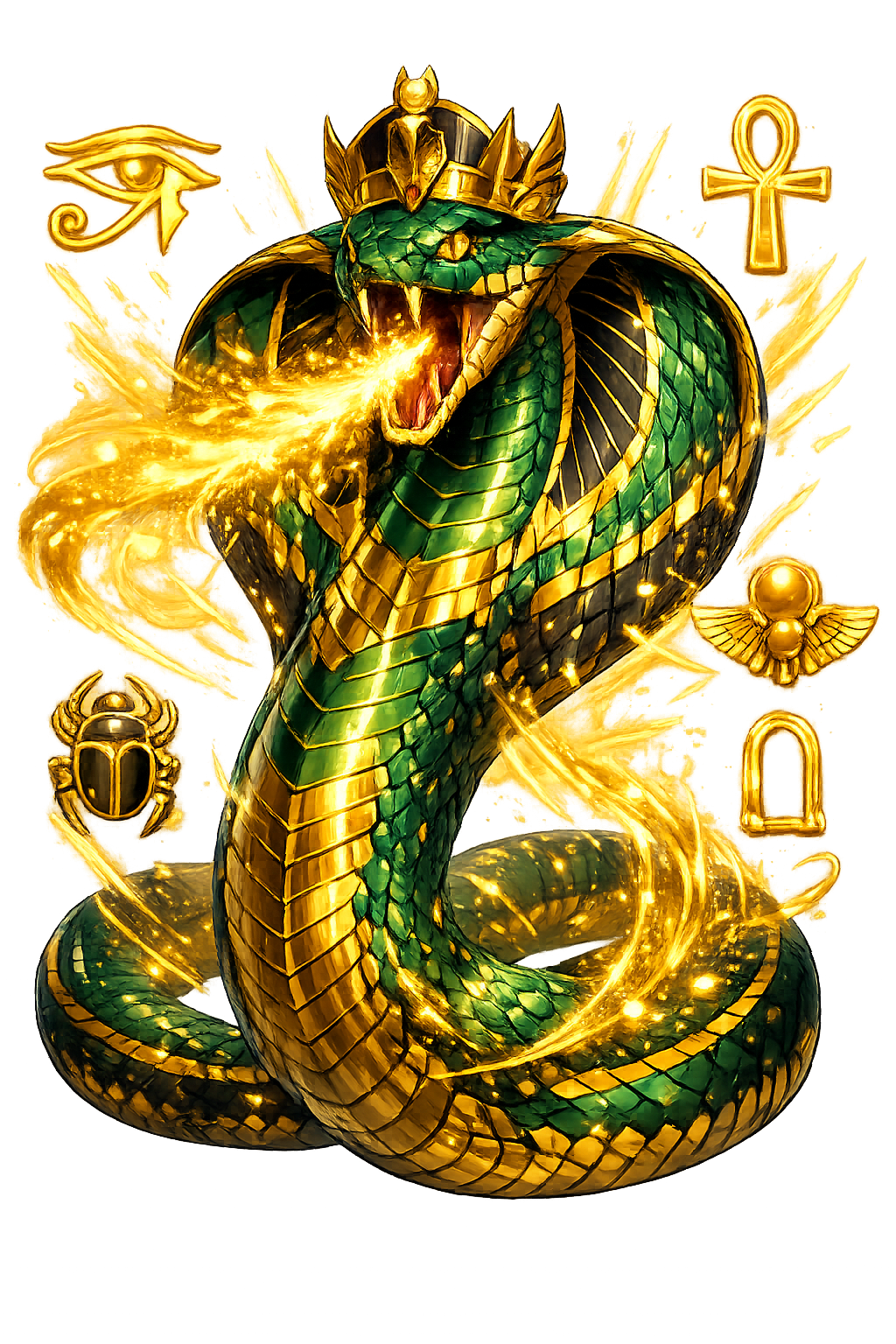
How Wꜣḏyt was rebuilt, mark by mark
The workshop file for Wꜣḏyt. Every rejected form is recorded here too — that is the point of keeping notes.
What We Found
The attestation runs through the tradition's own sources: 𓇅𓏏𓆗. Meaning: "The green one".
The figure behind the name: Wadjet's mythology is woven into kingship from the first dynasties, present more as an institution than a protagonist.
What the Name Carried In
The Two Ladies. From the unification of the Two Lands, the cobra stood beside the vulture over every royal name: Wadjet of the Delta and Nekhbet of Elkab together were the nbty, the Two Ladies, and their pairing was the political theology of Egypt — two lands, two crowns, one body wearing both. On the Narmer Palette (Cairo JE 32169), the king of the First Dynasty already processes beneath the standards of his protectors, and the serekhs of his successors frame the royal name with the two beasts.
Nurse of the Divine Child. In the Delta marshes, when Isis hid the infant Horus from Seth among the papyrus thickets of Chemmis, the snakes of the goddess stood guard. Wadjet is the serpent of the thicket — hood spread over the nursing god, flame ready for any scavenging demon.
A spelling that has to carry stories like these is not a label. It is equipment.
Where It Stood Before Us
Wadjet's earliest evidence appears on the Narmer Palette (Cairo JE 32169) and in the royal serekh of the First Dynasty, where the cobra guards the king's name. Her temple at Buto (Tell el-Fara'in / Pe-Dep) in the western Delta has been excavated by German and Egyptian teams, revealing Late Period and Ptolemaic remains above occupation layers reaching back into prehistory. Uraei in gold, faience, and stone crown royal statues and coffins from the Old Kingdom to the Ptolemaic era. Wedjat-eye amulets are found in virtually every Egyptian burial context, and the Metternich Stela (c. 360 BCE, now in the Metropolitan Museum) preserves the fullest monument of her child-guardian cycle. The bench inherits all of it — the web temple is the newest site, not the first.
What We Rejected
The plain ASCII wadjet — admissible as a fallback, never as the primary. A wrong accent would have been worse: the rulebook is explicit that a misplaced mark is worse than none.
What We Set Down
Wꜣḏyt — The restoration preserves more than the ASCII form can express — stress, length, or a letter the Latin keyboard lost — which places it, mechanically, in Tier-1.
For the voice: 'WAD-jeet' — start like 'wad', then 'jeet' with a long 'ee' and a crisp final t. The middle consonant may also be pronounced as a sharp emphatic 't' in stricter reconstructions.
The temple stands at /wadjet/ — the notes above are public in its Scholarly Edition, sources and all.
At a Glance
- Restored name: Wꜣḏyt
- ASCII form: wadjet
- Meaning: "The green one"
- Domain of influence: Cobra, Protection, Lower Egypt
- Pantheon: Egyptian
- Classification: Tier 1
- Original script: 𓇅𓏏𓆗
- Series: The Restoration Files, No. 522 of 546
The File Continues
The temple's founding dispatch tells the name's story; its Resonance File reads the myths into the industries; the blog index holds the whole archive.
Continue the series — previous file: Vulcānus (read it here) · next file: Wamani (read it here).
The Restoration Files are written from the same canonical record as the temples themselves: the lexicon, the lore catalog, the pattern atlas, and the cited scholarly sources. If a file ever disagrees with its temple, the temple is right — tell us, and the file will be corrected.