PuniCodex

Extended Lore

𓇅𓏏𓆗 Wꜣḏyt

Etymology · Orthography · Cult · Iconography · Reception · Sources

Tier 1 wꜣḏ.com
Wꜣḏyt — Cobra, Protection, Lower Egypt
01

Quick Facts

Essential information about Wꜣḏyt, Cobra, Protection, Lower Egypt

Original Script𓇅𓏏𓆗
Unicode RestorationWꜣḏyt
Reconstructed Pronunciation/waˈd͡ʒiːt/
PantheonEgyptian
DomainCobra, Protection, Lower Egypt
MeaningThe green one
ClassificationTier 1
Primary Domainwꜣḏ.com
Sacred SymbolsUraeus cobra, Red Crown (Deshret), Wedjat eye, Papyrus column, Malachite
02

Etymology & Word Family

From original script to Unicode restoration

Original Script 𓇅𓏏𓆗 Wꜣḏyt — "The green one"
Unicode Restoration Wꜣḏyt Restored stress, length, and script
Modern ASCII wadjet Plain-ASCII fallback

The name Wꜣḏyt carries the orthographic signature of the egyptian tradition: 𓇅𓏏𓆗. Unicode restoration recovers what ASCII flattens.

03

Unicode Character Breakdown

Character-by-character philological analysis

CharacterUnicodeNameBlockPhonetic Role
WU+0057Latin Capital Letter WBasic LatinSame, capitalized
ꜣU+A723Latin Small Letter Egyptological AlefLatin Extended-DSpecial phonetic character
ḏU+1E0FLatin Small Letter D with Line BelowUnknownD with dot: palatalized
yU+0079Latin Small Letter YBasic LatinSpecial phonetic character
tU+0074Latin Small Letter TBasic LatinSpecial phonetic character
—N/ADropped characterEgyptian orthographyDropped: vowel not written

The Tier 1 classification reflects how much of the original phonology this restoration preserves — stress and vowel length for Greek names, distinctive letters and diacritics for every other tradition.

04

Cult & Worship

How the sacred was kept — rites, sanctuaries, remains

The Cult

Wadjet's chief sanctuary lay at Pe-Dep — the twin Delta towns Greek visitors called Buto — where her temple served as one of Egypt's great oracles: Herodotus counts it among the shrines where Egyptians most trusted divine answers, and describes its sanctuary with the respect he reserves for the old and uncanny. Excavations at Tell el-Fara'in since the 1960s have uncovered Late Period and Ptolemaic temple remains above occupation layers reaching back into prehistory, confirming a cult of extraordinary depth. But her true temple was the royal brow: as one of the Two Ladies she stood witness to every coronation oath for three thousand years, and the daily drama of kingship — crowns donned, enemies smitten, offerings made — ran under her protection. The votive evidence is everywhere and nowhere: no single altar to Wadjet dominates a museum case, yet uraei in gold, faience, and stone guard statues, coffins, and cartouches by the thousand. Her cult was the monarchy itself, worn on the forehead.

In the Earth

Wadjet's earliest evidence appears on the Narmer Palette (Cairo JE 32169) and in the royal serekh of the First Dynasty, where the cobra guards the king's name. Her temple at Buto (Tell el-Fara'in / Pe-Dep) in the western Delta has been excavated by German and Egyptian teams, revealing Late Period and Ptolemaic remains above occupation layers reaching back into prehistory. Uraei in gold, faience, and stone crown royal statues and coffins from the Old Kingdom to the Ptolemaic era. Wedjat-eye amulets are found in virtually every Egyptian burial context, and the Metternich Stela (c. 360 BCE, now in the Metropolitan Museum) preserves the fullest monument of her child-guardian cycle.

05

Iconography

How Wꜣḏyt was imaged across the ages

The Image

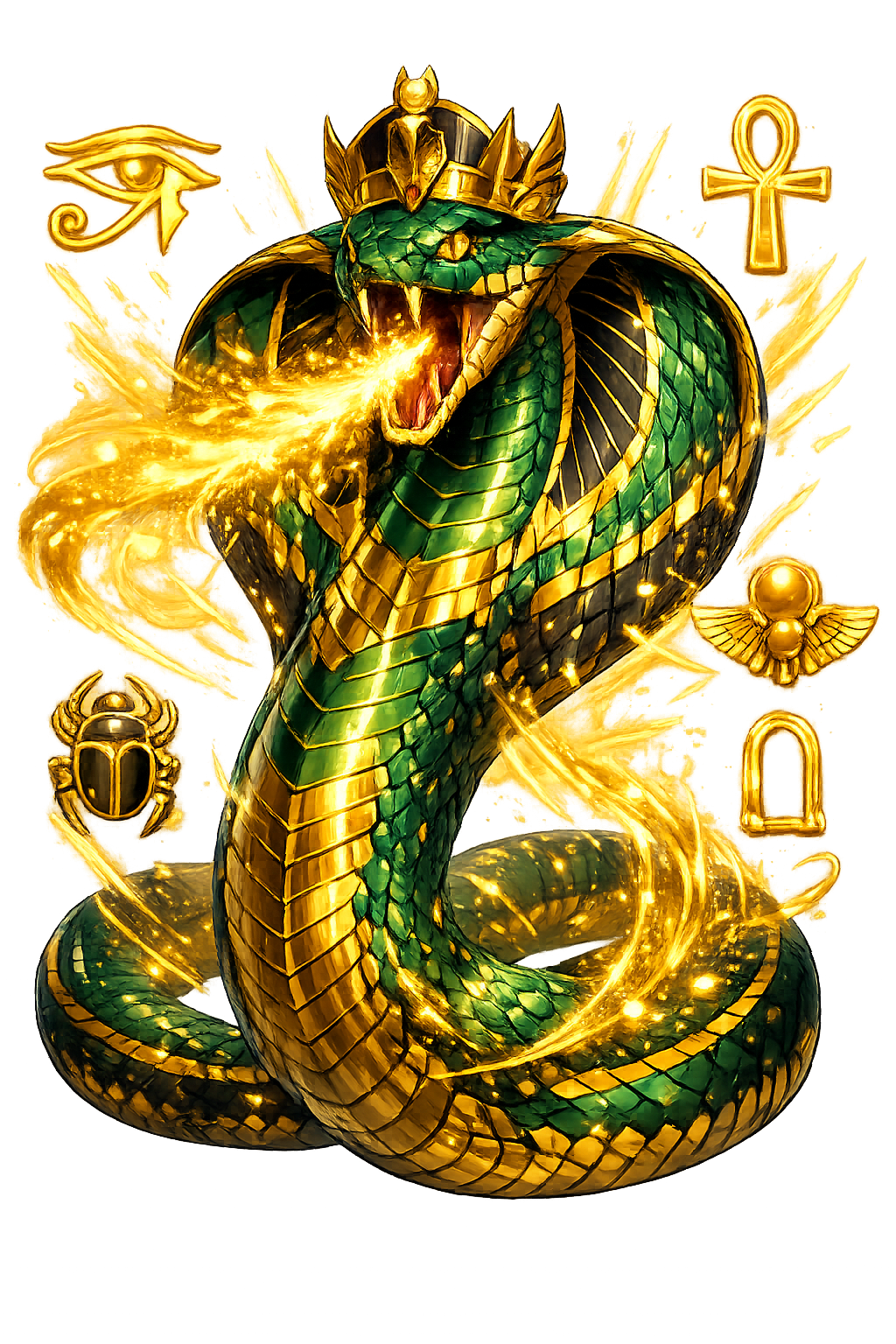
Wadjet's image is among the oldest royal portraits on earth: the rearing cobra. She stands beside Nekhbet the vulture on the Narmer Palette (Cairo JE 32169), where the First Dynasty king already processes beneath his protectors, and from King Den onward the pair frame the royal name inside the titulary. Recognition is instant — hood flared, body coiled, head rearing from the brow: the uraeus, 'the rearing one.' On the Deshret, the red crown of Lower Egypt, she is molded into the crown's very front. By the New Kingdom she usually appears doubled with the vulture above the king's brow — Tutankhamun's gold mask (Cairo JE 60697) wears both, cobra and vulture side by side. Her second portrait is ophthalmic: the sound Eye of Horus, the wedjat, bears her name. And the Late Period Horus cippi add a narrative role — above all the Metternich Stela (Metropolitan Museum), where the serpent of the Delta stands guard over the divine child hidden in the reeds.

06

Reception & Transformation

The name after its own age — transmission, translation, survival

Afterlives

Wadjet's journey is the journey of her image. The Greeks knew her city before her face: Herodotus carried reports of Buto's oracle into the manuscript tradition that schooled the ancient world, and Hellenistic writers folded the Delta goddess into their own pantheon. The iconography itself slept under the sand until modern times — Quibell's 1897–98 excavations at Hierakonpolis raised the Narmer Palette and gave her a datable first portrait, and the Description de l'Égypte's plates carried the uraeus to European designers before anyone could read the name beside it. Champollion's decipherment, followed by the great dictionaries — the Wörterbuch s.v. wꜣḏ, Faulkner's lexicon, Allen's grammar — returned Wꜣḏyt to speech, while the Buto excavations from the 1960s onward matched Herodotus' city to Tell el-Fara'in and reopened the oracle's own ground. Modern Egyptology has supplied the monographs her ancient ubiquity never bothered to write: Wilkinson's Complete Gods and Teeter's study of religion and ritual now stand where the temple archive would have. And the cobra on the crown never needed rediscovery — every pharaoh's portrait kept her on duty through all the centuries when no one could read a single word beside her.

Identifications Across Traditions

Wadjet is inseparable from Nekhbet; the Two Ladies form a single institution of kingship. She merges with the solar eye and therefore with Hathor, Sekhmet, Tefnut, and Mut as the goddess who departs and returns. Her uraeus becomes the emblem of Egyptian royalty and passes into Hellenistic and Roman iconography as the serpent of sovereign power — Cleopatra's asp was, in the end, only the oldest member of her household staff. Greek writers called her Buto and identified her city with Leto, mother of Apollo and Artemis, because both were protectors of divine children in reedy marshes. The Coptic name ⲟⲩⲱⲧ/ⲟⲩⲉⲧ preserves the root meaning 'green', the last breath of the word after the temples closed.

Modern Legacy

The uraeus never went out of style. It survives on crowns and crests from Ptolemaic queens to modern heraldry, a shorthand for divine authority and national unity. The Eye of Horus — the Wedjat — remains one of the most popular protective amulets in the world, worn as jewelry and tattooed as a symbol of wholeness. In modern Egyptology, Wadjet is a reminder that the king's power was not abstract: it was a rearing cobra with real flames. And her color lives on wherever the Delta still floods — in a word, wadjet, 'the green one', remains the oldest description of Egypt's renewal that anyone still speaks.

07

The Meditation

What Wꜣḏyt means — beyond the dictionary

Wadjet is vigilance made beautiful. The cobra on the crown is not decoration; it is the land's immune system, a living warning that the king is protected by something older and faster than any army. She asks us to notice how much sovereignty depends on the threat of defense, and how much protection depends on patience.

In her green aspect, Wadjet is also the color of return. The Delta after the inundation, the papyrus after the flood, the eye restored after injury — all these are her signatures. She teaches that protection and growth are not opposites. The same cobra that strikes the intruder also shelters the nest. To wear her image is to claim that the land and its people are worth both tenderness and venom.

08

Frequently Asked Questions

Common questions about Wꜣḏyt, Cobra, Protection, Lower Egypt, and Unicode restoration

01How do you pronounce Wꜣḏyt?

In reconstructed pronunciation, Wꜣḏyt is /waˈd͡ʒiːt/ — approximately 'WAD-jeet' — start like 'wad', then 'jeet' with a long 'ee' and a crisp final t. The middle consonant may also be pronounced as a sharp emphatic 't' in stricter reconstructions.

02What does Wꜣḏyt mean?

Wꜣḏyt means The green one in the egyptian tradition.

03What are the symbols of Wꜣḏyt?

Wꜣḏyt is associated with Uraeus cobra (The rearing serpent on crown and forehead, ready to strike the king's foes), Red Crown (Deshret) (The crown of Lower Egypt, guarded by Wadjet), Wedjat eye (Wholeness, restoration, and the sound eye of Horus), Papyrus column (The vegetation of the Delta and the flourishing green of her name), Malachite (The green mineral associated with her color and with protective eye paint).

04Why restore Wꜣḏyt in Unicode?

Plain ASCII wadjet strips the stress, length, and script that make the name specific. Unicode restoration returns the name to its original written dignity.

05What is the most important myth about Wꜣḏyt?

“The Two Ladies” — the Kingship story that anchors the mythology of Wꜣḏyt, told in full on the lore page.

09

Scholarly Sources

The philological foundations of this restoration

Every claim on this page is grounded in established scholarship. The orthographic restorations follow disciplinary convention. The etymological chain follows the best available reference works. This is not invention — it is resurrection through scholarship.

◈

Lexicography & Philology

  • Faulkner, R. O. A Concise Dictionary of Middle Egyptian. Oxford: Griffith Institute, 1962.
  • Wb
◎

Primary Texts

◉

Archaeology & Art History

  • Material evidence — iconography, inscriptions, and temple archaeology — for Wꜣḏyt and related cults.
✦

Religious Studies

  • Allen, Middle Egyptian (2014)
  • Faulkner, A Concise Dictionary of Middle Egyptian, s.v. wꜣḏ
  • Wörterbuch der ägyptischen Sprache I, s.v. wꜣḏ
  • Wilkinson, The Complete Gods and Goddesses of Ancient Egypt
  • Herodotus, Histories 2.59, 2.63
  • Teeter, Religion and Ritual in Ancient Egypt
Return

The Surface Awaits

You have traced the name from its earliest attestation to its Unicode restoration. Now return to the myth. The story is where the name lives.

Back to Lore
Wꜣḏyt mascot