Stories of Wꜣḏyt
Wadjet's mythology is woven into kingship from the first dynasties, present more as an institution than a protagonist. She has no single epic cycle; she has a thousand crowns, amulets, and royal names — and her stories cluster around four poles: the Two Ladies, the divine child, the wandering Eye, and the Delta oracle at Buto.
From the unification of the Two Lands, the cobra stood beside the vulture over every royal name: Wadjet of the Delta and Nekhbet of Elkab together were the nbty, the Two Ladies, and their pairing was the political theology of Egypt — two lands, two crowns, one body wearing both. On the Narmer Palette (Cairo JE 32169), the king of the First Dynasty already processes beneath the standards of his protectors, and the serekhs of his successors frame the royal name with the two beasts. By the reign of King Den the pair had entered the titulary itself as the title nbty, 'He of the Two Ladies' — the first element of the fivefold royal protocol. Every coronation oath for three thousand years was thus sworn in her presence, on the brow. The myth is a constitution written as heraldry: sovereignty is legitimate only when north and south, vulture and cobra, consent to share a single head.
In the Delta marshes, when Isis hid the infant Horus from Seth among the papyrus thickets of Chemmis, the snakes of the goddess stood guard. Wadjet is the serpent of the thicket — hood spread over the nursing god, flame ready for any scavenging demon. The protection was theologically exact: Horus was the king, so the Delta goddess guarded in myth what her uraeus guarded in fact, the brow of every living pharaoh, 'the nursling of Wadjet'. The scene's most beloved monument is the Metternich Stela and its kin, the Horus cippi of the Late Period (c. 360 BCE): on them the child-god, stung by scorpions in the reeds, is healed by his mother while the surrounding deities — Wadjet among them — contract to shield the cippi's owner from every crawling thing. The myth taught an Egyptian peasant of any century the same lesson the crown taught the court: in the reeds, as on the throne, survival depends on a serpent who has chosen you.
Like Sekhmet, Tefnut, and Hathor, Wadjet can act as the solar Eye that departs in rage and must be coaxed home. The cycle is set out in the great commentaries on Book of the Dead spell 17: the Eye of Horus is struck down and scattered — by Seth in one telling — and Thoth gathers and restores it, the sound, whole, 'wedjat' eye; restored, it burns from the king's brow as the uraeus, the healed eye that has become a weapon. When the Eye wanders far south as the Distant Goddess, the land withers; when it returns, the Delta greens. For Wadjet the return is literal: her name means 'the green one', and her homecoming is the inundation's fresh silt spreading over the fields. The theology binds protection to growth in a single image: the same eye that was broken and made whole now makes the land whole, and the cobra on the crown is the scar tissue of the cosmos — injury, restored, promoted to sentry.
Her ancient cult center was Pe-Dep — the twin towns of Pe and Dep in the western Delta, Greek Buto — where she was worshipped in a temple famed as an oracle; Herodotus (2.59) counts Buto among Egypt's great oracular shrines, and (2.63) describes its sanctuary with the respect he reserves for the old and uncanny. There, in the reeds of the deepest Delta, Egyptian theology placed the primordial mound where creation began and where Isis nursed Horus — Buto was the wet nurse of the world. Greek visitors, hearing that this goddess guarded a divine child in a marsh, identified her city with Leto, mother of Apollo and Artemis, two other children hidden in reeds — an interpretatio the sources themselves found almost too neat. Excavations at Tell el-Fara'in have uncovered the temple's Late Period and Ptolemaic remains above occupation layers reaching back into prehistory, confirming what the priests always claimed: Buto was old before Egypt had a name for old.
Protection, Sovereignty, and the Living Eye
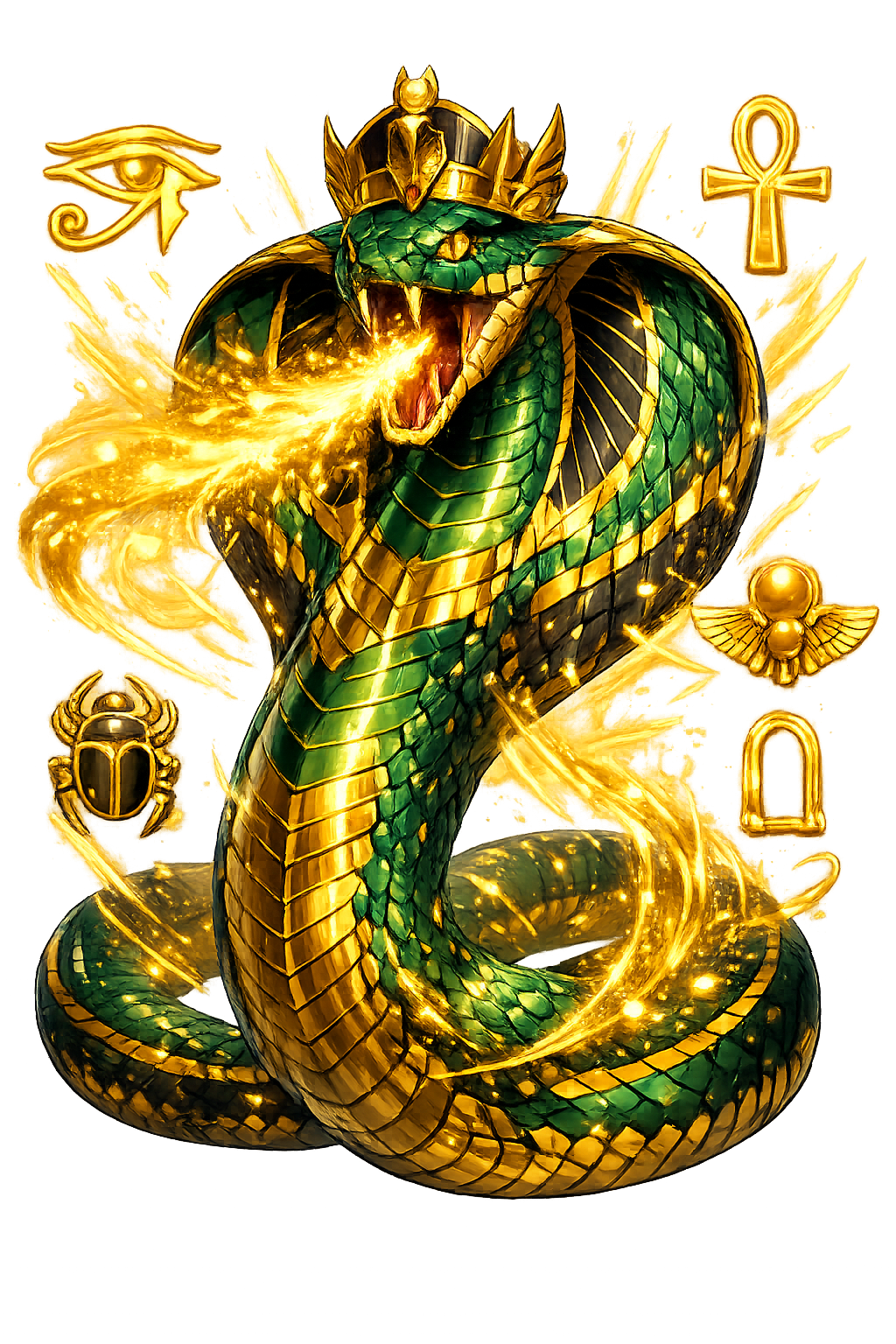
Wꜣḏyt is the cobra that rears from the king's brow. Patron goddess of Lower Egypt and protector of the living pharaoh, she strikes at enemies with flame and venom while shielding the land with her hooded vigilance. Her name means 'the green one' or 'the flourishing one,' the color of new growth, of malachite, and of the papyrus-filled Delta.
She is one half of the nbty, the Two Ladies, paired with Nekhbet the vulture of Upper Egypt. Together they bind the Two Lands into one kingship. Without Wadjet, the red crown has no fangs; without her, the uraeus is only jewelry.
The rearing cobra (iꜥrt) on the royal crown; she spits fire at the king's enemies.
She protects the red crown and the Delta, embodying the sovereignty of the north.
The sound, restored eye of Horus — also called the Eye of Wadjet — is her gift of wholeness.
Her name links her to vegetation, malachite, fertility, and the fresh Delta silt.
From the original script to the living URL
𓇅𓏏𓆗
The name in its original Egyptian form. Wꜣḏyt (𓇅𓏏𓆗) is attested in the source tradition — “The green one”. Its Egyptological ain and alef letters carry the full phonetic and orthographic weight of the source tradition.
wadjet
Reduced to plain wadjet, the name loses everything that made it specific: Egyptological ain and alef letters. What remains is an ASCII string that machines can parse but that no longer speaks with its original voice.
Wꜣḏyt
The Unicode restoration recovers what ASCII flattened. Wꜣḏyt restores Egyptological ain and alef letters, returning the name to its original written dignity. The domain encodes to Punycode, but the browser displays the truth.
Wꜣḏyt.com → xn--wyt-3yyt688f.com
The non-ASCII characters in Wꜣḏyt are encoded while the ASCII remains visible. To the DNS, it is Punycode. To humanity, it is Wꜣḏyt.
Owned, ideal, and ASCII forms of Wꜣḏyt
wꜣḏ
Restores 𓇅𓏏𓆗. The live temple domain — wꜣḏ.com.
wadjet
Flattens 𓇅𓏏𓆗. The plain ASCII fallback — what DNS and legacy systems see.
How Wꜣḏyt was spoken
How Wꜣḏyt travels from ancient script to the modern URL
Egyptian Wꜣḏyt “the green one"; the cobra-goddess of Lower Egypt and protectress of the king.
Cobra, Protection, Lower Egypt
The Unicode restoration Wꜣḏyt uses Egyptological characters registrable in .com; hieroglyphs are outside the .com IDN table.
The lore you have read is the living myth. Extended Lore opens the scholarly vault beneath it: the cult and its material remains, a history of the image, the name after antiquity, a meditation on what the name still means, and the full scholarly apparatus — etymology, orthography, sources.
Enter Extended Lore