
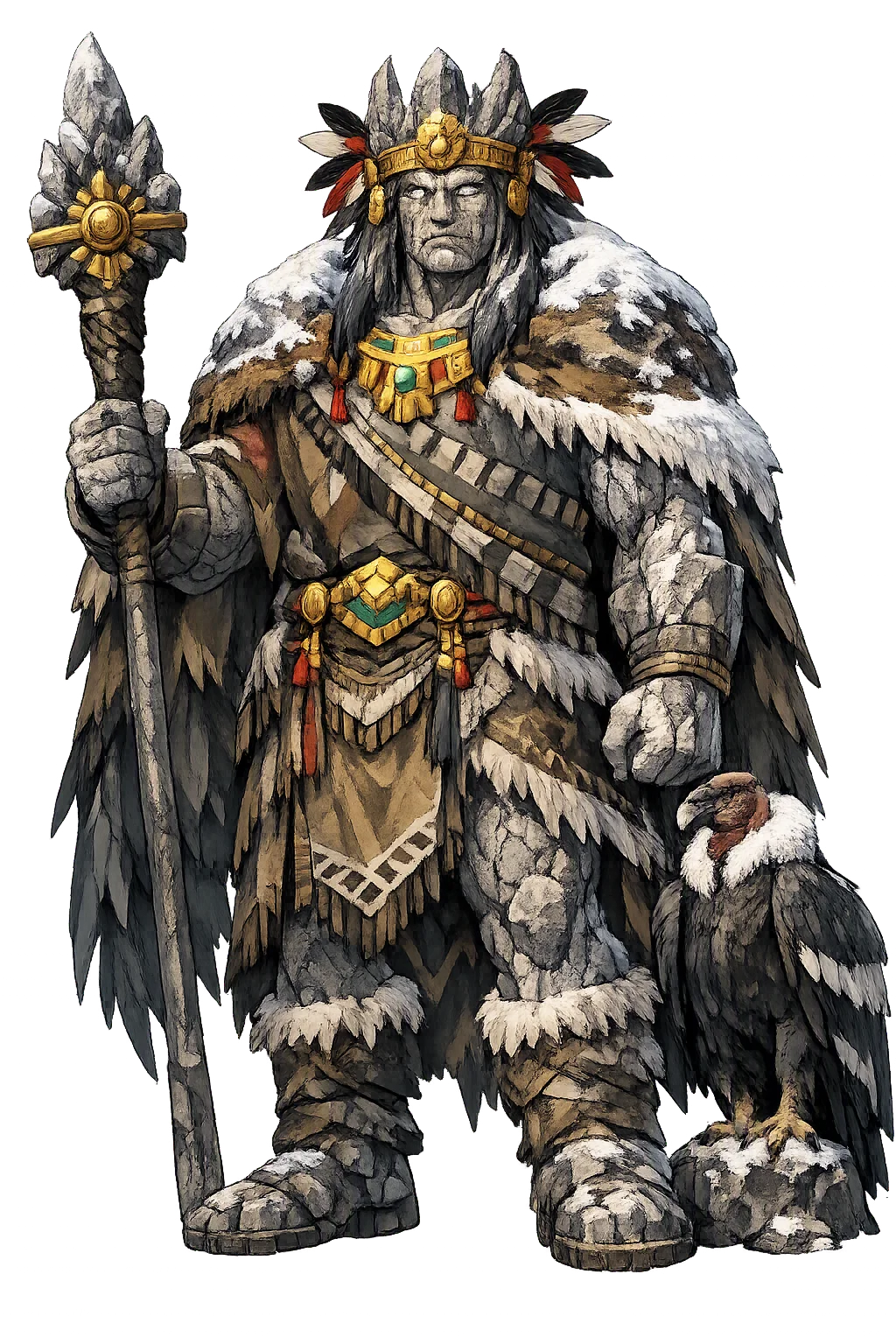
How Wamani was rebuilt, mark by mark
Bench notes, Wamani: what we found, what we rejected, and what we finally set down. Kept in the open, because a restoration you cannot audit is just a spelling with confidence.
What We Found
The attestation runs through the tradition's own sources: —. Meaning: "The falcon".
The figure behind the name: Wamani has no epic cycle: Andean mountain religion lives in ritual, pilgrimage, and origin story rather than narrative text.
What the Name Carried In
The Mountain that Gives Birth. Every Andean community once knew which mountain it came from. The colonial chronicles — Cobo's Historia del Nuevo Mundo (Book 13), Sarmiento de Gamboa's Historia Indica, and the now-lost Cusco paintings they copied — record a landscape dense with paqarina, 'emergence places,' from which founding ancestors rose to establish the ayllu.
Water for Offerings. The wamani's side of the covenant is water: from the snowfields the apu sends the springs that fill the terraces, and the people's side is the offering — coca leaves and maize beer poured on stone platforms, llamas driven to high pasture, prayers spoken to the peak by name. Cobo watched the rites; modern ethnography (Flores Ochoa) records their grammar: an offering is not a purchase but a greeting, the same exchange of coca and goodwill with which one honors an elder.
A spelling that has to carry stories like these is not a label. It is equipment.
Where It Stood Before Us
The wamani's evidence is the mountain itself. The great capacocha shrines have yielded the most spectacular finds in Andean archaeology: the three Llullaillaco children (excavated 1999 by Reinhard and Ceruti; Museum of High-Altitude Archaeology, Salta), the Ampato mummy ('Juanita,' found 1995), and more than a hundred high-altitude sites from Argentina to Ecuador. At Cusco, the Inca capital's ritual landscape — documented building by building in Bernabé Cobo's Book 13 before the colonial city erased it — was a mapped constellation of apus, anchored by the Coricancha's golden garden and the intihuatana stone. Machu Picchu's planners sited its sacred district by the same rule: the city is a wamani-cult in masonry, every window and altar answering a named peak. The bench inherits all of it — the web temple is the newest site, not the first.
What We Rejected
Any form invented for availability. The rule on the bench: if the evidence does not carry it, the domain does not get it — whatever the registrar has in stock.
What We Set Down
Wamani — One decisive feature survives — a single, honest mark — which places the restoration in Tier-2: exact, and exactly labeled.
For the voice: wa-MA-ni — three even syllables, the middle one weighted; every vowel pure and Spanish-like.
The temple stands at /wamani/ — the notes above are public in its Scholarly Edition, sources and all.
At a Glance
- Restored name: Wamani
- ASCII form: wamani
- Meaning: "The falcon"
- Domain of influence: Sacred Mountain
- Pantheon: Incan
- Classification: Tier 2
- Original script: —
- Series: The Restoration Files, No. 525 of 548
The File Continues
The temple's founding dispatch tells the name's story; its Resonance File reads the myths into the industries; the blog index holds the whole archive.
Continue the series — previous file: Wꜣḏyt (read it here) · next file: Wandjina (read it here).
The Restoration Files are written from the same canonical record as the temples themselves: the lexicon, the lore catalog, the pattern atlas, and the cited scholarly sources. If a file ever disagrees with its temple, the temple is right — tell us, and the file will be corrected.