
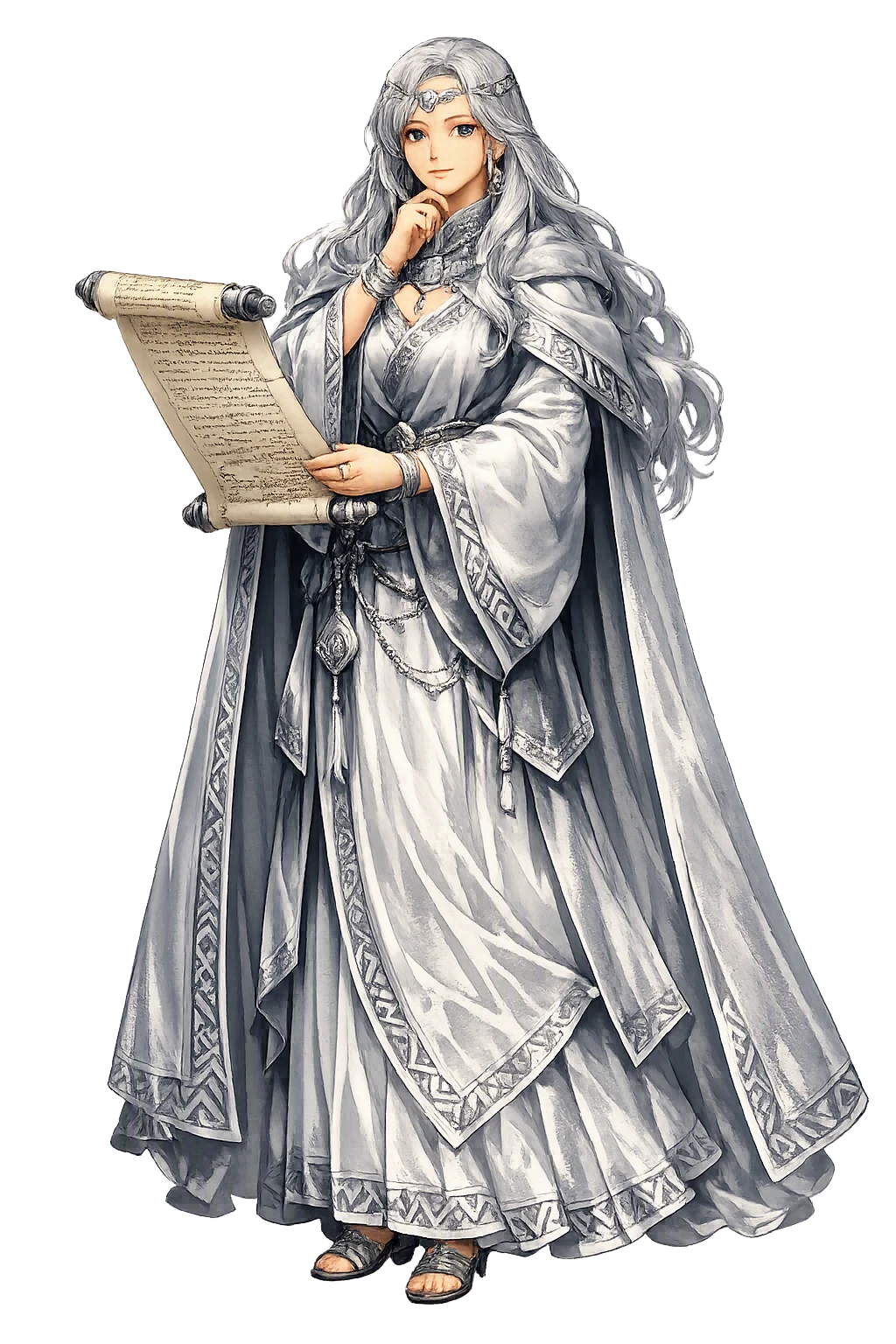
Why Vǫr belongs in your address bar
Every address bar is a choice. When you type Vǫr, you are not typing a novelty; you are restoring a name that the early DNS, built for English typewriters, could not carry. The plain ASCII form vor is a leftover of that constraint, not the name itself. This post is the long version of the restoration: where the name comes from, how the Younger Futhark tradition wrote it, how it is pronounced, what the myths and the material record preserve, and why its Unicode form now lives as a working domain. The claim throughout is simple — the original spelling is not decoration. It is the name.
At a Glance
- Restored name: Vǫr
- ASCII form: vor
- Meaning: "The careful one, oath-goddess"
- Domain of influence: Wisdom, Oaths, Knowledge
- Pantheon: Norse
- Classification: Tier 1
- Original script: ᚢᚢᚱ (Younger Futhark)
- Live domain: vǫr.com
Overview
Vǫr (vor) — The Careful One, Oath-Goddess · Goddess of Wisdom and Knowledge — belongs to the Norse tradition, where she is catalogued under the domain "Wisdom, Oaths, Knowledge". The name means "The careful one, oath-goddess".
Vǫr is one of the ásynjur, the female powers of the Norse pantheon, and is named in the Prose Edda as a goddess so wise that nothing can be concealed from her. Snorri explains her name as deriving from a word meaning 'the careful one' or 'she who is aware', and he adds that she is invoked by those who wish to know what has been hidden or what oaths have been broken. Her domain is therefore knowledge in its judicial and moral sense: the truth that cannot be evaded.
PuniCodex restores the name as Vǫr and serves its temple at vǫr.com. The restoration preserves the ǫ (o with ogonek) that the ASCII form loses, and exactly one historically valid Unicode restoration exists, which places the name in Tier 1. The plain ASCII form vor survives as a modern convenience imposed by the early domain-name system; the restoration, not the fallback, is the form the project defends as philologically complete.
The Name
The name is attested in Old Norse as Vǫr. Etymologically it means "The careful one, oath-goddess". The word vǫr is related to concepts of watchfulness, caution, and awareness; some scholars connect it to the verb vara, 'to be aware, to warn'. Snorri's etymology makes her the goddess from whom nothing is concealed, an interpretation that fits her role as a knower of oaths and hidden things.
The ASCII form vor survives only because the early domain-name system could not carry diacritics; it is a technological compromise, not an ancient spelling. The Unicode restoration Vǫr recovers the ǫ (o with ogonek) directly in the address bar. The original carries a distinctive vowel letter, and exactly one historically valid Unicode restoration exists, which places the name in Tier 1.
The letter-by-letter transformation runs:
- v → V — Same, capitalized
- o → ǫ — O with ogonek: nasalized vowel
- r → r — Same
The project holds the domain vǫr.com as the canonical home of this name.
Etymology & Roots
The recorded derivation reads: Old Norse Vǫr, goddess associated with wisdom and oaths; her name is related to vörðr "pledge, vow".
The root gloss is "oath, pledge."
The reconstruction is classed as uncertain.
The Original Script
The name is preserved in medieval Icelandic manuscripts in the Latin alphabet as Vǫr — Old Norse (North Germanic), attested 13th–14th c. CE in the codices of Snorri's Edda, recording material centuries older. Before the Latin bookhand, Old Norse names were carved in the Younger Futhark; no runic attestation of this name survives.
The scholarly rendering proceeds step by step:
- The normalized Old Norse spelling uses ǫ (o with ogonek) for the nasalized back rounded vowel.
- In the Younger Futhark the name would have been carved approximately ᚢᚬᛦ, although the exact runic spelling is hypothetical.
- The Unicode form Vǫr is a scholarly normalization that distinguishes the Norse vowel quality from the plain ASCII form.
Pronunciation
The reconstructed pronunciation of the name is /vɔr/ — Old Norse Reconstruction.
Phoneme by phoneme:
- V- — Voiced labiodental fricative [v]
- -ǫ- — The vowel [ɔ] rendered with ogonek, a nasalized back rounded vowel
- -r — Alveolar trill or tap [r]
For the modern speaker, the closest approximation is: 'VOR' — one syllable, with a rounded 'o' similar to the vowel in English 'or' but more open.
Kindred and historical forms of the name:
- Old Norse — Vǫr, the careful, all-knowing goddess
- Modern Icelandic — Vör, in modernized orthography
Vǫr is Tier 1 because the Norse form preserves the distinctive ǫ that ASCII loses. The restoration keeps that vowel visible in the domain name.
Mythology
Vǫr's mythology is brief; she is one of the many ásynjur whom Snorri catalogues rather than narrates. Yet her defining quality — that nothing can be hidden from her — gives her a significant place in the moral order of the Norse cosmos.
In the Prose Edda
In Gylfaginning 35 and in the þulur, Snorri lists Vǫr among the goddesses and explains her name: 'She is so wise and searching that nothing can be concealed from her'. He adds that wise people call upon her when they want to know what has been hidden. The passage is short but loaded: it makes Vǫr the divine guarantee that secrets will surface and that oaths will be judged.
The Oath-Goddess
Because she knows hidden things, Vǫr is naturally associated with oaths. In a society where verbal pledges were binding and where perjury could bring divine punishment, a goddess who sees through deception was a powerful moral figure. She is not a war-goddess but a judicial one, the inner witness against whom no lie can stand.
Modern Reception
Modern readers have found in Vǫr a figure for conscience and for the unblinking self-knowledge that refuses comforting falsehoods. Her name's association with watchfulness makes her an appealing symbol for truth-tellers, investigators, and anyone committed to seeing clearly.
The All-Seeing Goddess (Gylfaginning 35)
In Snorri's list of goddesses, Vǫr is described as wise and inquiring: "She is wise and enquiring, so that nothing can be concealed from her." Her name is given as the source of the adjective vǫrr, "careful, aware." The brief entry makes her a personification of attentiveness — the quality that turns mere seeing into knowledge.
Among the Wise Goddesses (Ásynjur lists)
Vǫr appears alongside Sága, Eir, Gefjun, and Fulla as one of Frigg's attendants. Unlike some Ásynjur who have individual myths, Vǫr is defined entirely by her attribute: she is the one who knows. In a pantheon where Óðinn seeks wisdom through sacrifice and deception, Vǫr represents a quieter, more constant form of knowledge.
The Careful Name (Etymology)
The name Vǫr is related to Old Norse words for being, awareness, and carefulness. It is not a common noun like Þrúðr ("strength") but an adjective made divine. She is carefulness personified — the virtue that notices before it judges and remembers before it forgives.
Symbols & Iconography
The iconography associated with Vǫr centers on perception, truth, and the judicial use of knowledge:
- The watchful eye — the open gaze from which nothing is hidden
- The scales or balance — the weighing of words and oaths, borrowed from later judicial imagery
- The mirror — reflection and the revelation of truth
- The key — access to what is concealed
- The scroll or rune-stave — the record of oaths and verdicts
- The seeing eye — Nothing hidden escapes her notice
- The open book — The record of oaths, laws, and hidden truths
Archaeology & Evidence
No cult site, votive deposit, or named image of Vǫr is known. Her attestation is entirely literary, confined to Snorri's Prose Edda. The relevant manuscripts are the principal codices of Snorri's Edda — the Codex Regius (GKS 2367 4to, early 14th c.), the Codex Wormianus, and the Uppsala Edda. The visual record is indirect: any image of a goddess associated with wisdom or oaths might evoke Vǫr, but no ancient image is labeled with her name.
Realm & Domain
Vǫr belongs to the Norse tradition as the goddess of knowledge, watchfulness, and the uncovering of hidden truths. Her domain is the mind that notices what others overlook and the oath that cannot be broken with impunity.
Wisdom
Snorri says that nothing can be concealed from Vǫr, making her a goddess of comprehensive knowledge.
Oaths
She is invoked in matters of broken or disputed oaths, because she knows the truth behind words.
Watchfulness
Her etymology connects her to vigilance and caution, the quality of mind that guards against deceit.
Hidden Things
Those who wish to discover what has been concealed pray to Vǫr, the one from whom secrets cannot be kept.
Nothing Hidden
Snorri says Vǫr is so wise that nothing can be concealed from her — the divine witness to every secret.
Oath-Keeper
She oversees sworn agreements and remembers the words spoken in haste or hope.
Wise Counselor
Among Frigg's attendants she is the one whose knowledge makes her counsel valuable.
Vǫr's Watchfulness
Her care is not anxiety but attention: the steady gaze that knows what is real.
Across Cultures
Vǫr has no direct foreign counterpart, but the goddess who knows all secrets has parallels in the Greek Hestia (who hears all oaths), the Roman Fides (faithfulness), and the Egyptian Maat (truth). Within the Norse tradition she is closest in function to Vár, the goddess of oaths and marriage agreements, and to Frigg, who also possesses hidden knowledge.
Kindred figures in the PuniCodex cross-tradition index include Vár and Frigg, linked through knowledge, oaths, and truth.
Cultural Legacy
Vǫr is a minor but resonant figure in modern Heathen and Ásatrú practice. She is sometimes invoked in rituals of truth-telling, oath-taking, and divination, because her ancient quality of all-seeing knowledge remains relevant to those who treat words as binding. The name Vǫr is rare as a personal name but recognized among readers of the Eddas. Her legacy is the idea that knowledge is not merely information but a moral force: the careful mind that uncovers what has been hidden and holds speakers accountable for their words.
The Scholarly Record
The account of Vǫr given in this edition rests on the witnesses and reference works listed below. The Prose Edda supplies the only extended narrative; the dictionaries and handbooks secure the form and meaning of the name.
- Snorri Sturluson, Prose Edda, Gylfaginning 35 / Skáldskaparmál, trans. Anthony Faulkes, Everyman / Viking Society for Northern Research, 1220. Full text
- Cleasby, Richard, and Guðbrandur Vigfússon, An Icelandic-English Dictionary, 2nd ed. (Oxford: Clarendon Press, 1957), s.v. Vǫr.
- Zoëga, Geir T., A Concise Dictionary of Old Icelandic (Oxford: Clarendon Press, 1910).
- Simek, Rudolf, Dictionary of Northern Mythology, trans. Angela Hall (Cambridge: D. S. Brewer, 1993), s.v. Vǫr.
- Lindow, John, Norse Mythology: A Guide to the Gods, Heroes, Rituals, and Beliefs (Oxford University Press, 2001), s.v. Vǫr.
- Gordon, E. V., An Introduction to Old Norse, 2nd ed. rev. A. R. Taylor (Oxford: Clarendon Press, 1957).
A Meditation
Vǫr is the mind that will not be lied to. She does not punish with thunder; she simply knows. In a world of carefully crafted narratives, she is the still voice that asks whether the story matches the facts. The restoration of her name in Unicode is a small act of recognition for the ancient idea that knowledge itself is a form of justice — and that the careful one sees what the hurried miss.
The Unicode Restoration
Vǫr is classified as Tier 1: the restoration preserves at least one distinctive feature — a diacritic or a distinctive letter — that the ASCII form loses. The ASCII fallback vor still resolves everywhere, but it is the restored form that carries the name's full information. Across the 3 characters of the name, the restoration adjusts 1: 1 further adjustment (ǫ). That is the whole thesis of this temple: the marks are the message.
Character by Character
The journey from vor to Vǫr, one character at a time:
- v → V — Same, capitalized
- o → ǫ — O with ogonek: nasalized vowel
- r → r — Same
The Domain Name
The restored name is live as a working domain: vǫr.com, which the DNS carries in punycode form as xn--vr-f5a.com — an ASCII-compatible encoding that lets a non-ASCII name travel the global network without breaking older infrastructure. The visitor sees Vǫr; the machines see the encoding. That duality is the engineering compromise on which the entire restoration rests, and it is why a name written the way its own tradition wrote it in Younger Futhark can now be typed into any browser on earth.
The Norse Pantheon
Vǫr is one of 101 entries the PuniCodex lexicon catalogues under the Norse pantheon. The Pantheon page gathers the tradition's major figures in one place, and the Lexicon lets you filter all 981 restorations by tradition, tier, or script — the fastest way to see where this name sits among its kin.
Frequently Asked Questions
What does Vǫr mean? The traditional gloss is "The careful one, oath-goddess."
Which tradition does Vǫr belong to? Vǫr is catalogued in the Norse pantheon of the PuniCodex lexicon.
Why is Vǫr classified as Tier 1? Because the restoration preserves at least one distinctive feature — a diacritic or a distinctive letter — that the ASCII form loses — and the marks in the restored spelling preserve exactly that evidence.
Is Vǫr a working domain? Yes — vǫr.com resolves today and routes to this temple.
What is the punycode for vǫr.com? The DNS encoding is xn--vr-f5a.com; browsers perform the translation automatically, so visitors only ever see the restored name.
Can I use Vǫr in a normal browser? Yes. The DNS resolves the punycode form automatically, and the type tool on this site converts vor to Vǫr for copying and pasting.
Where does the scholarly information come from? The entry is built from lexica, inscriptional evidence, and reviewed scholarly sources listed in the Scholarly Edition. Every claim is traceable to a canonical source.
Typing Vǫr
You do not need a special keyboard to use this restoration. The PuniCodex Type Tool converts the ASCII form vor into Vǫr as you type, and the browser extension offers the same conversion inside any text field. Copy the restored form, paste it into the address bar, and the DNS does the rest.
Sister Temples
Other temples in the Norse pantheon include Syn, and Týr — each with its own restoration story, its own scholarly record, and its own place in the lexicon.
Why This Restoration Matters
Restoring Vǫr is part of a larger effort to make the web multilingual by default. The PuniCodex project does not ask users to learn a new alphabet; it asks the infrastructure to respect the alphabets that already exist. Every section of this post — the script, the sound, the myths, the evidence — converges on the same point: the marks in Vǫr are information, and information deserves an address of its own. A single Unicode domain is a small proof, but it is a proof that scales: every name restored makes the next one easier, and every visit to vǫr.com is a vote for the restored form.
Explore Further
This post is one doorway into the temple. The home page carries the full character breakdown and the ambient canvas; the lore page tells the myths in long form; the Scholarly Edition preserves the sources, pronunciation data, and revision history; and the patron wall supports the restoration directly. For the wider map, browse the Lexicon, explore the Pantheon, or return to the PuniCodex blog.
A Closer Look at the Marks
A restored name is a small map. In Vǫr, the journey from the ASCII fallback vor to the Unicode form can be read letter by letter, and each letter tells a story. Of the 3 characters, 2 remain unchanged; they anchor the name to its modern shape. The remaining adjustments recover marks the source tradition used to distinguish this name from every other word built from the same letters.
The v stays as it is — Same, capitalized.
The o becomes ǫ — O with ogonek: nasalized vowel.
The r stays as it is — Same.
Together these changes are not decoration. They are the minimum set of marks needed to keep the name legible in its own tradition. Remove them and you still have a string of letters; you no longer have the name as it was written.
Related Names
Sources
The full scholarly apparatus — every citation, revision, and review — lives in the Scholarly Edition. Key references for this post:
- Snorri Sturluson, Prose Edda, Gylfaginning 35 / Skáldskaparmál, trans. Anthony Faulkes, Everyman / Viking Society for Northern Research, 1220.
- Cleasby, Richard, and Guðbrandur Vigfússon, An Icelandic-English Dictionary, 2nd ed. (Oxford: Clarendon Press, 1957), s.v. Vǫr.
- Lindow, John, Norse Mythology: A Guide to the Gods, Heroes, Rituals, and Beliefs (Oxford University Press, 2001), s.v. Vǫr.
- Snorri Sturluson, Prose Edda, Gylfaginning 35 / Skáldskaparmál, trans. Faulkes.
- Cleasby & Vigfússon, An Icelandic-English Dictionary, 2nd ed., s.v. Vǫr.
- Lexicon authorities for this entry: Prose Edda, Cleasby-Vigfusson.