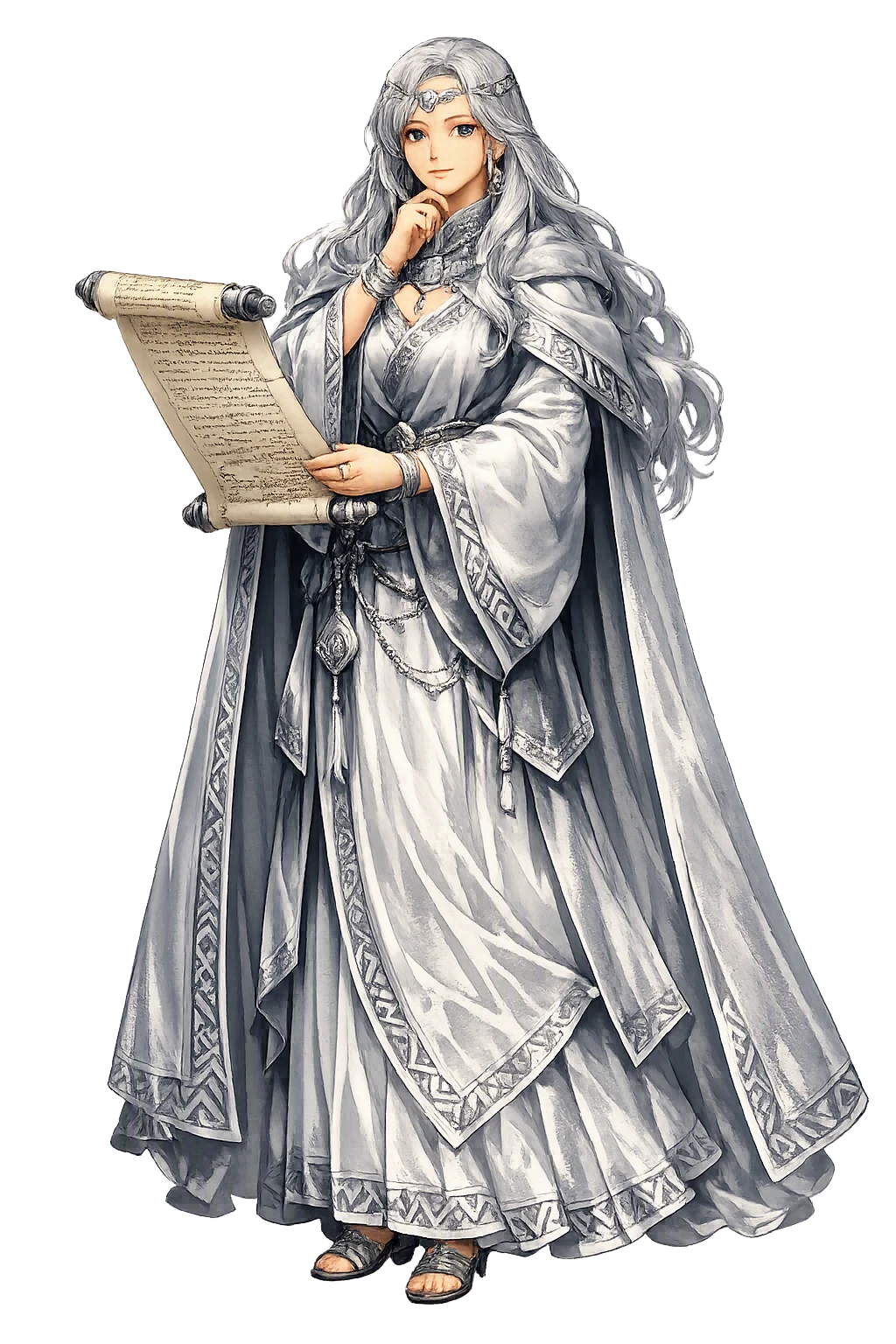
Stories of Vǫr
Vǫr's dossier is one of the thinnest in the Edda — a single entry in Snorri's catalogue of the Ásynjur, her name in the poets' name-lists, and nothing else. But the one thing the sources do say is striking: nothing can be hidden from her. She is the goddess of careful attention, and her whole surviving mythology is the study of what it means to truly notice.
Snorri's catalogue of the Ásynjur in Gylfaginning runs like a court roll — Frigg, Sága, Eir, Gefjun, Fulla, Freyja, Sjöfn, Lofn, Vár — and then, tenth, Vǫr: hon er vitr ok in spyrjanda, svá at hon vildi vita allt, 'she is wise and the questioning one, so that nothing can be concealed from her.' Snorri adds the etymology in his own voice: from her name, he says, comes the word vǫrr, 'watchful, aware' — a woman who is on the lookout for a thing is called vǫrr after the goddess. The notice is three lines long, but it is a complete theology of attention: the faculty by which nothing is hidden is named for her, and the adjective is her shrine.
The direction of the derivation matters. Snorri does not say the goddess was made from the word; he says the word is hers. The goddess of noticing is older than the language's own name for noticing — as if the quality itself, personified, were the ground the vocabulary stands on.
The two words Snorri chooses for Vǫr are worth weighing separately: vitr, wise, and in spyrjanda, the questioning one — the definite article making a title of it, 'the Inquirer.' Her knowledge is not passive sight, a lamp that happens to fall on things. It is active inquiry: she asks, probes, follows up, and will not let a matter close. The Prose Edda knows other ways of knowing. Óðinn hangs nine nights on the wind-rocked tree, pierced with a spear, to tear the runes up out of the depths (Hávamál 138–139); he trades an eye at Mímir's well for wisdom. That knowledge is bought in wounds. Vǫr's costs nothing, because she simply never stops asking — the cheap, unglamorous, undefeated method.
The contrast is the myth. The male god of the Edda acquires wisdom by sacrifice and disguise; the tenth ásynja holds hers by attention. A culture that tells both stories at once has described the whole economy of knowledge: what must be paid for, and what only has to be practised.
Vǫr's only other witness is the driest literature of the North: the þulur, the metrical name-lists that skalds memorized as working apparatus, preserved with manuscripts of the Prose Edda. There a Vǫr is counted among the valkyrie names, and her name joins the stock of goddess-heiti from which skalds built their woman-kennings — the handbooks of diction teach that any ásynja-name may stand for 'woman' in the periphrastic style. Whether the valkyrie of the þulur and the tenth ásynja of Gylfaginning are one figure wearing two offices or two bearers of a fine name, the sources do not say; the modern handbooks register the double attestation and leave the door open, as the cautious thing to do.
For a goddess of noticing, survival in a list is oddly fitting. She has no myth, no temple, no ship or mountain — only the memory of the professionals who needed her name at their fingertips. A name kept in working order by three centuries of poets is not dead, even where nothing else about its owner survives.
Snorri's catalogue places Vǫr immediately after Vár — and Vár is the goddess of oaths: her name is the common noun for a vow, Snorri says she punishes those who break their promises and perjure themselves, and she is so wise that no secret bargain escapes her. Two entries, neighbours in the list, form a matched pair: Vár hears what is sworn, Vǫr perceives what is true. The pairing is almost certainly Snorri's own editorial architecture — a learned Icelander arranging the minor goddesses by kinship of office rather than inherited story — but it is a revealing arrangement all the same, and one the handbooks have long noted.
Together the two neighbours sketch the Norse machinery of promise: the saying of it watched by one goddess, the truth of it watched by the other. An oath, the pairing implies, is only as strong as the attention behind it — which is why Vǫr, though she holds no single myth, stands in the catalogue where the myths of every broken oath would have put her.
Goddess of Oaths and Knowledge
Vǫr is one of the Ásynjur, the goddesses who attend the courts of Ásgarðr. Her name means "the careful one" or "the aware one," and Snorri says that nothing can be hidden from her. She is the goddess who sees through deception, remembers oaths, and knows the truth that others try to conceal.
Snorri says Vǫr is so wise that nothing can be concealed from her — the divine witness to every secret.
She oversees sworn agreements and remembers the words spoken in haste or hope.
Among the goddesses she is the one whose knowledge makes her counsel valuable — the one consulted before the deed, not after it.
Her care is not anxiety but attention: the steady gaze that knows what is real before it speaks.
From the original script to the living URL
ᚢᚢᚱ
The name in its original Norse form. Vǫr (ᚢᚢᚱ) is attested in the source tradition — “The careful one, oath-goddess”. Its original diacritics and script distinctions carry the full phonetic and orthographic weight of the source tradition.
vor
Reduced to plain vor, the name loses everything that made it specific: original diacritics and script distinctions. What remains is an ASCII string that machines can parse but that no longer speaks with its original voice.
Vǫr
The Unicode restoration recovers what ASCII flattened. Vǫr restores original diacritics and script distinctions, returning the name to its original written dignity. The domain encodes to Punycode, but the browser displays the truth.
Vǫr.com → xn--vr-f5a.com
The non-ASCII characters in Vǫr are encoded while the ASCII remains visible. To the DNS, it is Punycode. To humanity, it is Vǫr.
Owned, ideal, and ASCII forms of Vǫr
Vǫr
Restores ᚢᚢᚱ. The live temple domain — vǫr.com.
vor
Flattens ᚢᚢᚱ. The plain ASCII fallback — what DNS and legacy systems see.
How Vǫr was spoken
How Vǫr travels from ancient script to the modern URL
The lore you have read is the living myth. Extended Lore opens the scholarly vault beneath it: the cult and its material remains, a history of the image, the name after antiquity, a meditation on what the name still means, and the full scholarly apparatus — etymology, orthography, sources.
Enter Extended Lore