
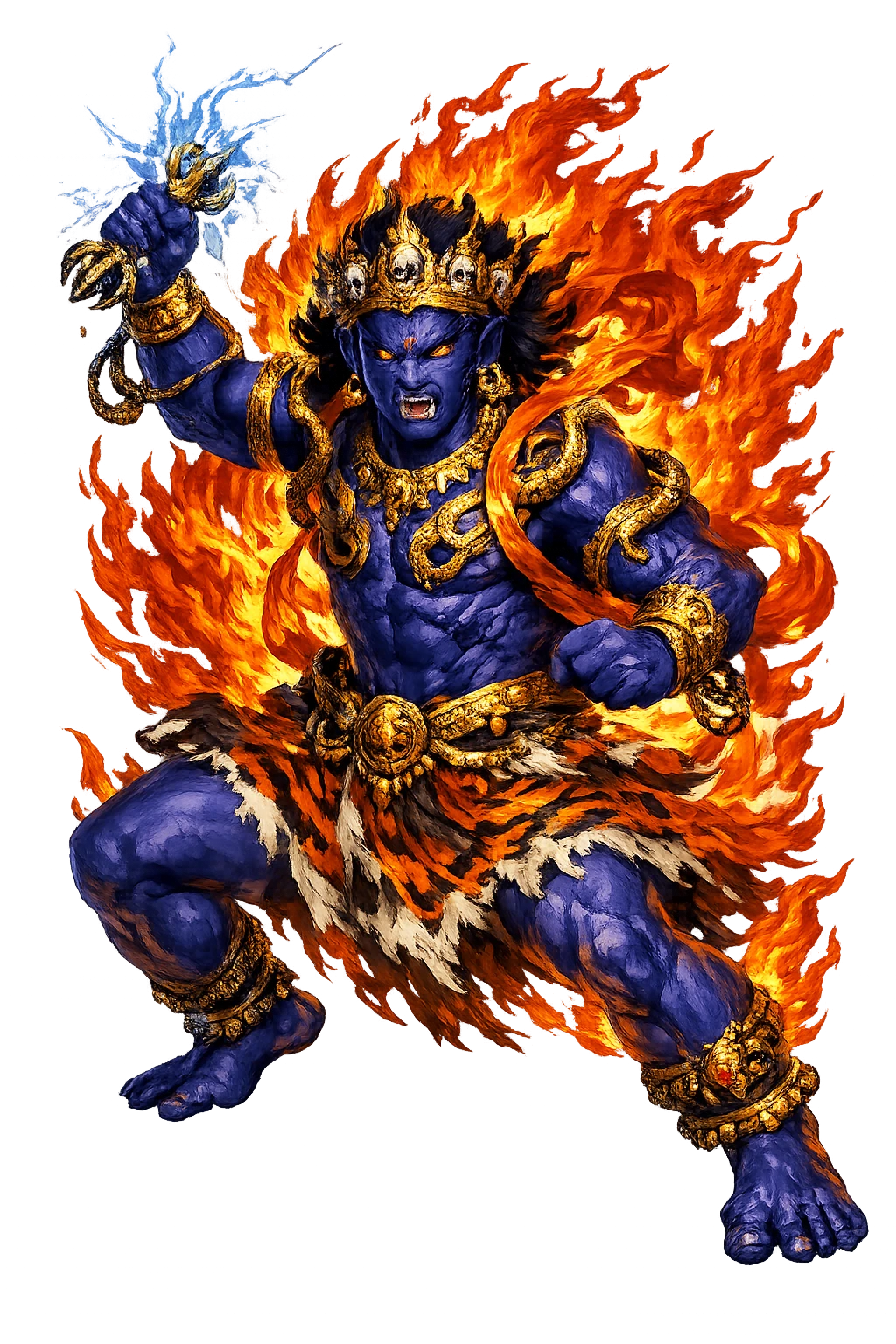
Vajrapāṇi: the stories first, then the spelling
Before the spelling, the story. Vajrapāṇi earns its restoration the old way — through what was actually told.
The Stories That Carry the Name
The Yakkha with the Blazing Club. His earliest certain appearance is already dramatic. In the Dīgha Nikāya's Ambaṭṭha Sutta, the proud young brahmin Ambaṭṭha, come to examine the Buddha, twice evades the Buddha's direct question about his ancestry. The Buddha warns him: refuse a third time, and your head will split into seven pieces on the spot.
Heracles at the Buddha's Side. When Gandhāran sculptors of the early centuries CE carved the Buddha's life in grey schist for the monasteries of the Peshawar valley — Takht-i-Bahi, Sahri Bahlol, the whole stūpa belt of the northwest — they faced a casting problem: the Buddha himself could not be shown acting in the old way, yet his scenes needed a protagonist. For the miracles and the confrontations they used a muscular attendant at the Master's shoulder, sometimes bearded, sometimes wearing the lion-skin: the Greek Heracles, imported whole from the art their patrons had grown up with, his club exchanged for a vajra. In the panels of the Buddha's bathing, the snakes' protection, the conversion of the Kāśyapas, it is this Heracles-body that acts while the Buddha stands composed — Vajrapāṇi in the dress of the strongest man the Mediterranean could imagine.
The Lord of Secrets. The esoteric tradition made him its archive. As Guhyakādhipati, Lord of the Guhyakas — the 'secret ones,' a class of yakshas — Vajrapāṇi is held to have received, compiled, and transmitted the tantras: when the hidden teachings were entrusted to a single guardian, the guardianship was his, and Tibetan historiography names him the compiler of whole classes of tantra belonging to his vajra family. The Tattvasaṃgraha, the great compendium of the early esoteric canon, keeps him at the center of its maṇḍala, asking the questions to which its deities are the answers; the Guhyasamāja cycle surrounds its secret assembly with the same thunderbolt presence.
And Here Is What the Spelling Preserves
The restoration keeps one feature the ASCII form vajrapani cannot show:
- a → ā — Long vowel: how long the vowel is held.
A storyteller pronouncing the name would restore every one of them by instinct. The file only writes down what the voice already knows.
At a Glance
- Restored name: Vajrapāṇi
- ASCII form: vajrapani
- Meaning: "The Vajra-Bearer — wielder of the thunderbolt, protector of the Buddha (vajra + pāṇi 'in the hand')"
- Domain of influence: Thunderbolt Holder, Protection
- Pantheon: Buddhist
- Classification: Tier 1
- Original script: वज्रपाणि
- Series: The Restoration Files, No. 509 of 546
The Name Travels
His lineage is a relay of weapons: Indra's vajra — the name is first Indra's epithet, as Monier-Williams records — passed to the Buddha's yakkha enforcer, then to the bodhisattva of power; and in East Asia the single figure split into the paired gate-guardians of every great temple: the Kongōrikishi or Niō of Japan, mouths open and closed, the alpha and omega of the spoken world, whose colossi at Tōdai-ji's Nandaimon (1203, Unkei and Kaikei) are national treasures. The Heracles parallel runs in both directions: as the Greeks lent him a body in Gandhāra, so scholarship reads him as the Buddha's answer to every culture's strong-armed sky-god — Zeus's bolt, Indra's club, Þórr's hammer — reassigned from storm to awakening.
The Address It Earned
The temple of Vajrapāṇi stands at /vajrapani/ — lore, scholars, patterns — because a name carrying this much story deserves more than a parking page. Tier-1 is not a compliment; it is a measurement. This restoration keeps something the ASCII form provably loses, and the measurement is repeatable.
The Sources Are Open
The myths above are retold from the temple's record; the primary voices are in the Sacred Texts: Lotus Sutra and Sukhāvatīvyūha Sūtras. Nothing in this file outranks them.
The File Continues
Read the founding dispatch for the name's full story, the Resonance File for the archetype at work — or the whole archive in one sitting.
Continue the series — previous file: Mahāvairocana (read it here) · next file: Valhǫll (read it here).
The Restoration Files are written from the same canonical record as the temples themselves: the lexicon, the lore catalog, the pattern atlas, and the cited scholarly sources. If a file ever disagrees with its temple, the temple is right — tell us, and the file will be corrected.