
Valhǫll: the stories first, then the spelling
You cannot weigh an accent without knowing what it carries. Here is what Valhǫll has been carrying.
The Stories That Carry the Name
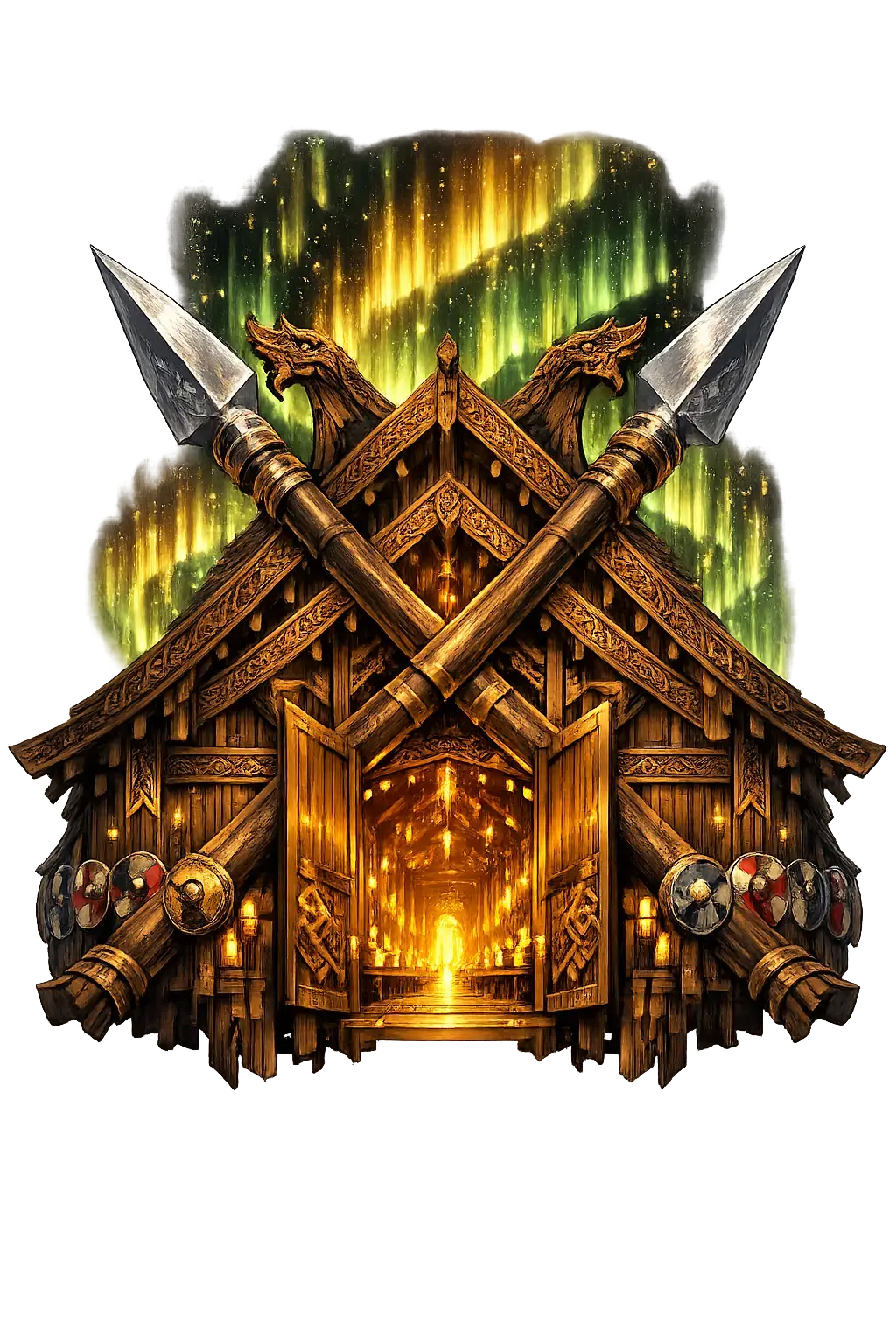
The Hall Described. In Grímnismál, Óðinn in disguise describes Valhǫll from within: its benches are strewn with mail coats, its rafters hung with spears, its roof thatched with golden shields, its benches tipped with bright breastplates — 'there a warrior would go glad within', the refrain runs, 'a man who comes to Odin's hall'. And it is vast beyond any earthly hall: five hundred and forty doors stand on its walls, and through each door eight hundred einherjar will march abreast at Ragnarök. The poem makes war into architecture — a mead-hall scaled to hold every battlefield death in the world, built so that on the last morning the whole host can pour out at once.
The Daily Combat and the Everlasting Feast. Snorri records the daily life of the einherjar in Gylfaginning: each day they don their armor, go out into the courtyard, and fight one another with joy, cutting each other down until the dinner hour. Then they ride home to Valhǫll and sit down to drink — and those who fell rise again whole and ride in with the rest. For food there is the boar Sæhrímnir, cooked every night by the cook Andhrímnir in the kettle Eldhrímnir and whole again by morning.
The Choosing of the Slain. In Völuspá the valkyries ride through the air and over the sea, their byrnies dark with blood, as they choose among the slain; the poem sees them in Valhǫll itself, bearing ale to the einherjar, and names them: Skuld, Skögul, Gunnr, Hildr, and Göndul. Snorri, in Gylfaginning 24, adds the famous division of the spoil — Freyja has first choice of the battle-slain, and half the fallen go with her to her field Fólkvangr, while Óðinn has what remains. 'Thus it is said that Óðinn deals out men to Freyja,' Snorri notes, and the two destinations together cover every warrior's death.
And Here Is What the Spelling Preserves
At a Glance
- Restored name: Valhǫll
- ASCII form: valholl
- Meaning: "Hall of the slain warriors"
- Domain of influence: Hall of the Slain
- Pantheon: Norse
- Classification: Tier 1
- Original script: ᚢᛅᛚᚼᚢᛚ
- Series: The Restoration Files, No. 510 of 546
The Name Travels
Valhǫll has often been compared to the warrior destinations of other Indo-European peoples — the Celtic Tech Duinn, the House of Donn, or the Germanic comitatus ideal of the lord's hall continued after death. Some scholars have seen Christian influence in its structure — the hall of the divine king, the everlasting feast — while others argue that the lord's mead-hall was already the central social institution of Germanic life and needed no borrowing to become an afterlife.
The Address It Earned
The temple of Valhǫll stands at /valholl/ — lore, scholars, patterns — because a name carrying this much story deserves more than a parking page. What survives here cannot be shown in ASCII: a feature of the original that the fallback alphabet flattens. That is the Tier-1 test, and this name passes it without argument.
The Sources Are Open
The myths above are retold from the temple's record; the primary voices are in the Sacred Texts: Poetic Edda and Prose Edda. Nothing in this file outranks them.
The File Continues
Read the founding dispatch for the name's full story, the Resonance File for the archetype at work — or the whole archive in one sitting.
Continue the series — previous file: Vajrapāṇi (read it here) · next file: Váli (read it here).
The Restoration Files are written from the same canonical record as the temples themselves: the lexicon, the lore catalog, the pattern atlas, and the cited scholarly sources. If a file ever disagrees with its temple, the temple is right — tell us, and the file will be corrected.