
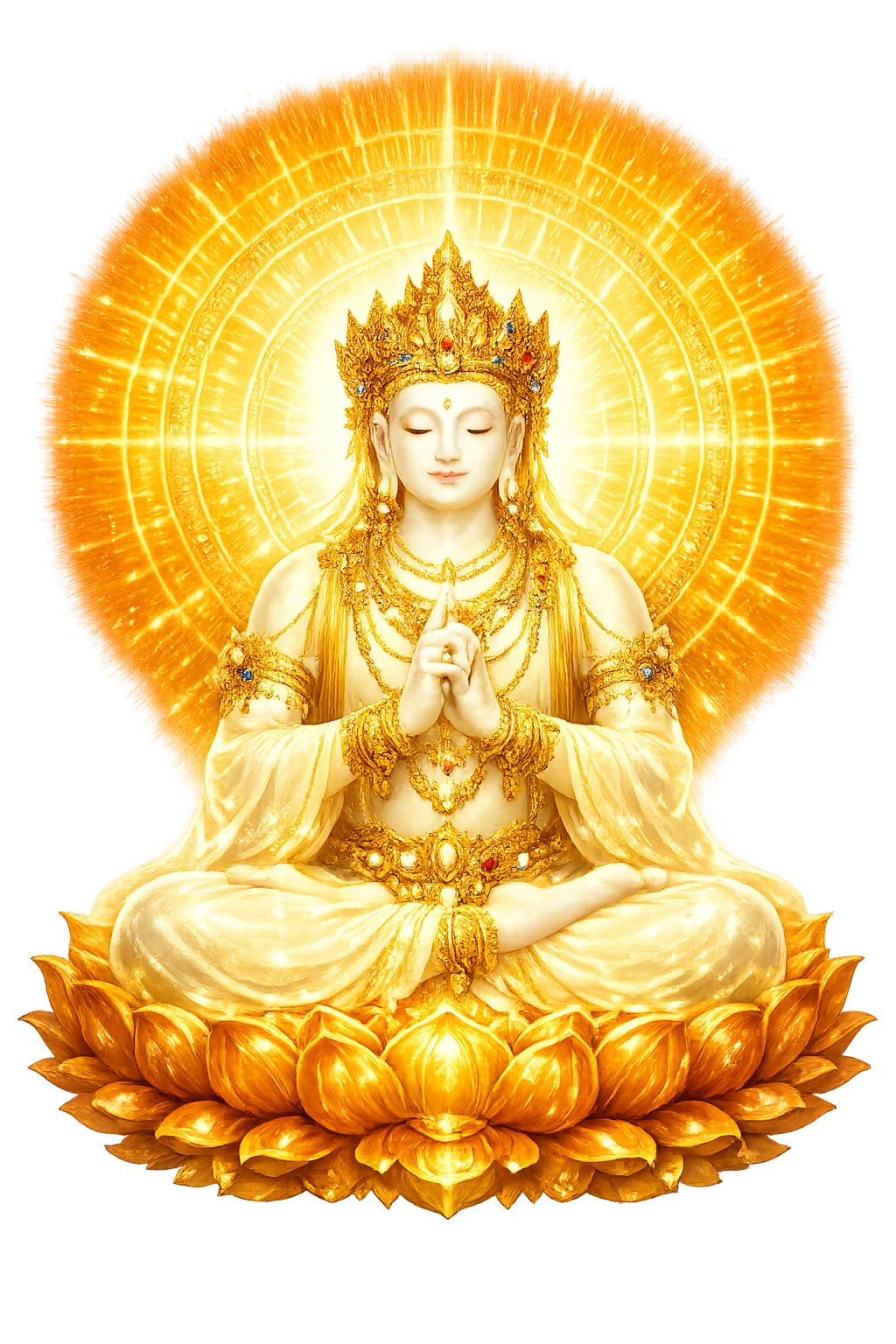
Mahāvairocana: the stories first, then the spelling
The marks in Mahāvairocana make the most sense standing next to the myths they have to carry. So the myths come first.
The Stories That Carry the Name
The Buddha Whose Body Is the Cosmos. The Avataṃsaka Sūtra — the Flower Garland, first translated into Chinese by Buddhabhadra in 420 CE — opens on a scale no other scripture attempts: Vairocana enthroned not in a grove but in the dharmadhātu itself, the Dharma-realm, every pore of his body a world-system, every atom of every world containing all the others, the whole interpenetrating without confusion like the chambers of Indra's net, where a jewel at every crossing mirrors every other jewel, and each mirrored jewel mirrors the rest to infinity. The sūtra's visions are not allegories but descriptions: the cosmos is the Buddha's body, and the Buddha's body is the cosmos explaining itself. The Huayan masters drew the conclusion that became Chinese Buddhism's deepest contribution — li shih wu ai, the unobstructed interpenetration of principle and phenomena.
The Sun That Preaches Without Words. The esoteric tradition's own charters, the Mahāvairocana Sūtra and its twin the Tattvasaṃgraha — translated into Chinese in 724–725 by the Indian master Śubhakarasiṃha with the commentary of the Chinese astronomer-monk Yixing — present the cosmic Buddha not as a person among persons but as the dharmakāya, the Dharma-body, whose sermon is reality's ongoing act of existing. The sūtra's root metaphor is the sun: as the sun illuminates all things without discriminating among them, the Buddha's wisdom shines on all beings without choosing favorites — and the moon's light, borrowed and returned, stands for the teaching as beings receive it. Kūkai gave the idea its boldest Japanese formula: hosshin seppō, the dharmakāya itself preaches.
Kūkai and the Two Maṇḍalas. In 804 the monk Kūkai sailed to Tang China; at Qinglong monastery in Chang'an the patriarch Huiguo, recognizing him on sight as his destined successor, transmitted to him the Womb and Diamond maṇḍalas — the two great maps of Mahāvairocana's body and wisdom — in the space of a few months, and in 806 Kūkai carried them home. In 816 he vowed a mountain monastery on Kōya-san, high in the cedar forests of Kii, consecrated 819; in 823 the court granted him Tō-ji in Kyoto as the esoteric school's capital seat; and there he built a school in which ritual, art, calligraphy, and philosophy are one act — to move through the maṇḍala in ceremony is to remember that one is made of the same light as its center. The tradition holds that Kūkai never died: he sits in eternal meditation in his tomb on Kōya-san, awaiting Maitreya.
And Here Is What the Spelling Preserves
Against those stories, the attestation: महावैरोचन, as Avataṃsaka Sūtra (Buddhabhadra's translation, 420 CE) and Mahāvairocana Sūtra (Śubhakarasiṃha and Yixing, 724–725) record. The name means "‘the Great Illuminator’, the cosmic Buddha at the centre of the Avataṃsaka Sūtra and the Shingon school (mahā ‘great’ + vairocana ‘shining forth’, from vi-√ruc ‘to shine’), MW.".
The restoration keeps one feature the ASCII form mahavairocana cannot show:
- a → ā — Macron: long /aː/: how long the vowel is held.
A storyteller pronouncing the name would restore every one of them by instinct. The file only writes down what the voice already knows.
At a Glance
- Restored name: Mahāvairocana
- ASCII form: mahavairocana
- Meaning: "‘the Great Illuminator’, the cosmic Buddha at the centre of the Avataṃsaka Sūtra and the Shingon school (mahā ‘great’ + vairocana ‘shining forth’, from vi-√ruc ‘to shine’), MW."
- Domain of influence: Universal Illumination, Cosmic Buddha
- Pantheon: Buddhist
- Classification: Tier 1
- Original script: महावैरोचन
- Series: The Restoration Files, No. 508 of 546
The Name Travels
The name itself is an old loan from the sun: Monier-Williams lists Vairocana as a solar epithet and even as a Dānava king, the son of Prahlāda and father of Bali — Buddhism took the word for light and made it the light-source of the Dharma. In Japan the identification ran both ways: medieval honji-suijaku thought read Dainichi as the true face of Amaterasu, the sun goddess of Ise, fusing the two great suns of the archipelago's religions, and medieval Shinto-Buddhist combinatory cults installed Dainichi as the inner truth of shrine after shrine.
The Address It Earned
The temple of Mahāvairocana stands at /vairocana/ — lore, scholars, patterns — because a name carrying this much story deserves more than a parking page. The restoration preserves more than the ASCII form can express — stress, length, or a letter the Latin keyboard lost — which places it, mechanically, in Tier-1.
The Sources Are Open
The myths above are retold from the temple's record; the primary voices are in the Sacred Texts: Lotus Sutra and Sukhāvatīvyūha Sūtras. Nothing in this file outranks them.
The File Continues
Read the founding dispatch for the name's full story, the Resonance File for the archetype at work — or the whole archive in one sitting.
Continue the series — previous file: Vāc (read it here) · next file: Vajrapāṇi (read it here).
The Restoration Files are written from the same canonical record as the temples themselves: the lexicon, the lore catalog, the pattern atlas, and the cited scholarly sources. If a file ever disagrees with its temple, the temple is right — tell us, and the file will be corrected.