
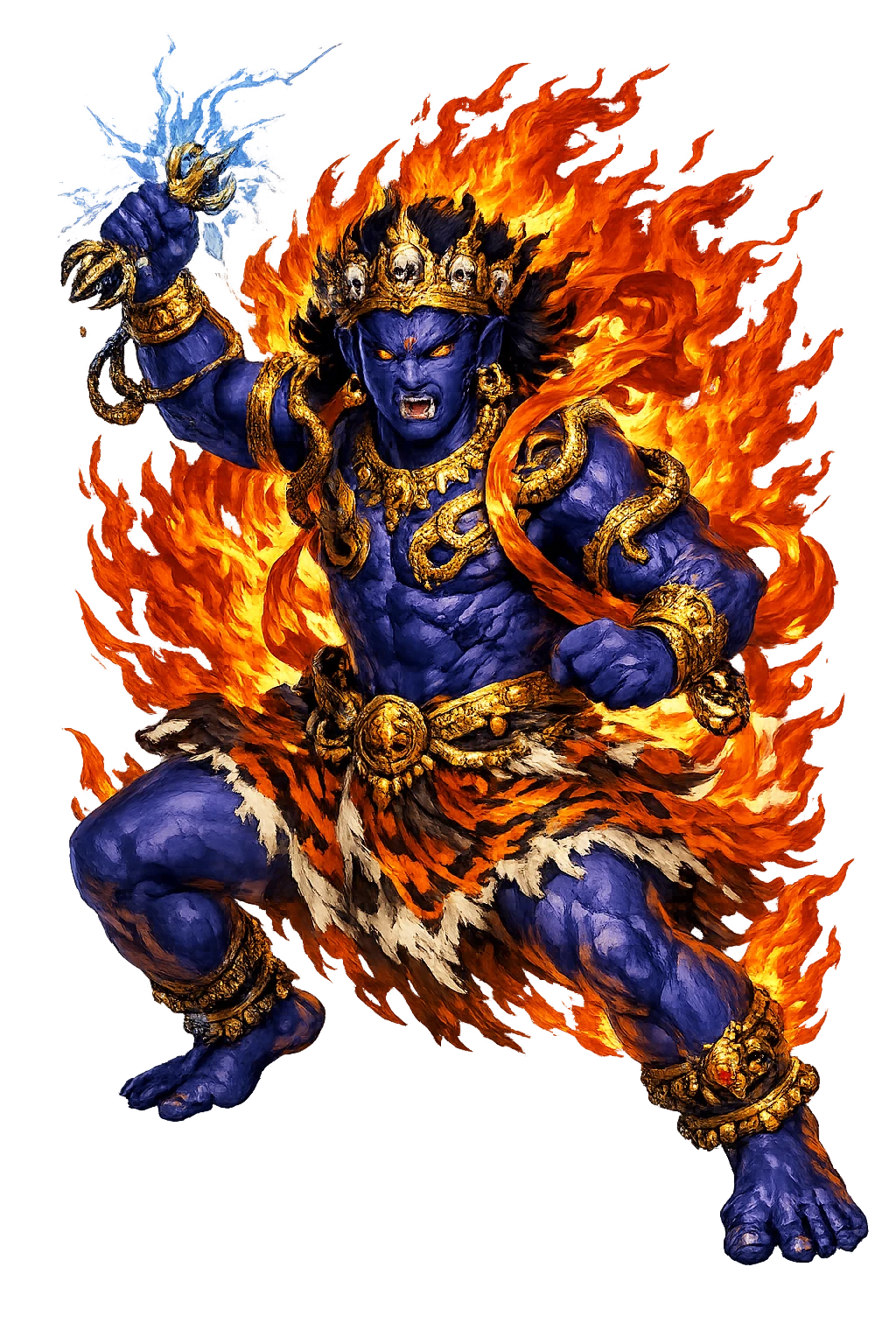
The name Vajrapāṇi and the world it opens
A name is a door. Vajrapāṇi opens onto an entire world: the domain of thunderbolt holder, protection, a Buddhist tradition, and centuries of storytelling, worship, and scholarship. This post walks through that world room by room — the name and its roots, the original script, the sound of it, the myths, the symbols, the sites, the afterlife across cultures — and ends at the newest room of all: a Unicode domain that makes the whole structure addressable. vajrapani gets you to the same building, but only the restored form tells you why it was built.
At a Glance
- Restored name: Vajrapāṇi
- ASCII form: vajrapani
- Meaning: "The Vajra-Bearer — wielder of the thunderbolt, protector of the Buddha (vajra + pāṇi 'in the hand')"
- Domain of influence: Thunderbolt Holder, Protection
- Pantheon: Buddhist
- Restoration: Preserves vowel length
- Original script: वज्रपाणि (Devanagari)
- Live domain: vajrapāṇi.com
Overview
Vajrapāṇi (vajrapani) — Thunderbolt Holder, Protection · The Vajra-Bearer, Lord of Secret Power — is the bodhisattva of power: the vajra-wielding guardian who began as the Buddha's personal protector in the earliest texts and grew into the lord of the tantric mysteries, keeper of the thunderbolt and of every secret the tradition ever whispered.
The name is a bahuvrīhi: vajra-pāṇi, ‘in whose hand is the vajra’ — the thunderbolt-sceptre that is at once Indra's weapon, the diamond of unbreakable truth, and the ritual implement of the Vajrayāna. The word is older than Buddhism: Monier-Williams records vajrapāṇi as an epithet of Indra in the Brāhmaṇas and the Mahābhārata, the storm-god ‘with the bolt in hand’. Buddhism took the title and made it a biography: the Pāli canon knows Vajirapāṇi the yakṣa who guards the Buddha's debates; Gandhāran art gives him Herakles' own body beside the master; the Mahāyāna enthrones him with Mañjuśrī and Avalokiteśvara as one of the three great protectors — wisdom, power, and compassion; and the tantras make him Guhyakādhipati, Lord of the Secret Ones, the compiler and keeper of the esoteric canon.
PuniCodex restores the name as Vajrapāṇi and serves its temple at vajrapāṇi.com. The restoration keeps the long ā and the retroflex ṇ; the plain ASCII vajrapani is a modern convenience of the early domain-name system, not an attested ancient spelling.
The Name
The name is attested in Sanskrit as वज्रपाणि (IAST vajrapāṇi; Pāli Vajirapāṇi): a bahuvrīhi compound of vajra, ‘thunderbolt, diamond’, and pāṇi, ‘hand’ — ‘the vajra-handed one’. The title is inherited from Vedic religion, where it belongs to Indra, wielder of the bolt that splits the dragon Vṛtra; the Brāhmaṇas and the Mahābhārata use vajrapāṇi as Indra's standing epithet. Buddhism's adoption is a conscious transfer of power: the thunderbolt passes from the storm-god to the Buddha's own protector, and the weapon is re-read as the diamond of the indestructible teaching.
The ASCII form vajrapani survives only because the early domain-name system could not carry diacritics; it is a technological compromise, not an ancient spelling. The Unicode restoration Vajrapāṇi recovers the long ā of pāṇi and the retroflex ṇ directly in the address bar. Because the restoration preserves vowel length and a distinctive letter the ASCII form loses, the name is a full restoration.
The letter-by-letter transformation runs:
- v → V — Same, capitalized
- a → a — Same
- j → j — Same
- r → r — Same
- a → a — Same
- p → p — Same
- a → ā — Long vowel ā
- n → ṇ — Retroflex ṇ
- i → i — Same
The project holds the domain vajrapāṇi.com (xn--vajrapi-x3a0658d.com) as the canonical home of this name.
The Original Script
The name is preserved in Devanagari as वज्रपाणि — Brahmic abugida, attested Vedic and Classical Sanskrit (as Indra's epithet) and Buddhist Sanskrit (as the bodhisattva); the script is written left-to-right.
The scholarly transliteration is Vajrapāṇi (IAST), giving the normalized reading /ʋə.dʑrə.ˈpaː.ɳi/.
The rendering proceeds step by step:
- Sanskrit Vajrapāṇi is written वज्रपाणि in Devanagari: वज्र (vajra) + पाणि (pāṇi), ‘thunderbolt’ + ‘hand’.
- The compound is a bahuvrīhi: ‘in whose hand is the vajra’ — an epithet inherited from the Vedic Indra.
- IAST encodes the long ā with the macron and the retroflex nasal with the underdotted ṇ.
- The Unicode restoration Vajrapāṇi is registrable in .com; the Devanagari form is not supported in the .com IDN table.
Pronunciation
The reconstructed pronunciation of the name is /ʋə.dʑrə.ˈpaː.ɳi/ — Sanskrit Reconstruction.
Phoneme by phoneme:
- Va- — Labial approximant [ʋ] (between English v and w) with short [ə]
- -jra- — Voiced palatal stop [dʑ] with trilled [r] and short [ə]: the thunderbolt, vajra
- -pā- — Voiceless bilabial [p] with long [aː]; the stressed syllable, ‘hand’
- -ṇi — Retroflex nasal [ɳ] with short [i], tongue curled back
For the modern speaker, the closest approximation is: ‘vuj-ruh-PAH-nih’ — stress the pā, curl the final n.
Kindred and historical forms of the name:
- Sanskrit — वज्रपाणि (vajrapāṇi), ‘vajra-in-hand’
- Pāli — Vajirapāṇi, the yakṣa guardian of the canon
- Tibetan — Phyag na rdo rje (Chana Dorjé), ‘the Vajra in the Hand’
- Japanese — Shūkongōjin / Kongōshu, the vajra-bearing guardians (the Niō of the temple gates)
Vajrapāṇi preserves both features because the long ā and the retroflex ṇ are both lost in ASCII.
Mythology
Vajrapāṇi's mythology is the transformation of a bodyguard into a cosmic officer, traceable stage by stage through the texts.
The Enforcer of the Canon (Pāli Nikāyas)
In the Ambaṭṭha Sutta (Dīgha Nikāya 3), when the young brahmin Ambaṭṭha thrice refuses the Buddha's question, the yakṣa Vajirapāṇi appears overhead with an iron bolt blazing, ready to split the stubborn man's head into seven pieces; Ambaṭṭha answers. The Pāli commentaries identify the vajra-bearer with Sakka (Indra) himself — the old thunderer still serving the new dispensation, enforcing not doctrine but honesty in dialogue.
The Attendant of Gandhāra
In the art of Gandhāra (1st–3rd c. CE), Vajrapāṇi becomes the Buddha's constant companion in stone: a muscular attendant at the master's shoulder, rendered with the physique, club, and sometimes the lion-skin of Herakles — the clearest case of a Greek god's body entering the Buddhist pantheon, carrying the hero's strength into the teacher's service.
The Third Protector (Mahāyāna)
The Mahāyāna raised him to the triad of great bodhisattvas: Mañjuśrī of wisdom, Avalokiteśvara of compassion, Vajrapāṇi of power — the Lords of the Three Families (Tibetan rigs gsum mgon po), a grouping so stable it structures iconography from Nepal to Mongolia.
Lord of the Mysteries (Tantra)
The esoteric tradition made him the keeper of its whole canon: as Guhyakādhipati, ‘Lord of the Secret Ones’, he is the being to whom the Buddha entrusts the tantras, the interlocutor of the Guhyasamāja cycle, and the compiler who preserves the esoteric teaching between revelations. His wrathful forms — Caṇḍa-Vajrapāṇi, the serpent-garlanded Nīlāmbaradhara — guard the threshold of every maṇḍala: the mysteries have a doorkeeper, and he is it.
The Yakkha with the Blazing Club (Ambaṭṭha Sutta (DN 3))
His earliest certain appearance is already dramatic. In the Dīgha Nikāya's Ambaṭṭha Sutta, the proud young brahmin Ambaṭṭha, come to examine the Buddha, twice evades the Buddha's direct question about his ancestry. The Buddha warns him: refuse a third time, and your head will split into seven pieces on the spot. And there, in the air above the youth's head, appears the yakkha Vajirapāṇi, holding aloft a great blazing iron club — an ayoguḷa, a bolt of iron — burning, glowing, ready. Ambaṭṭha glances up, sees it, and answers. The scene then turns inside out: the Buddha reveals that the Kaṇhāyan lineage Ambaṭṭha is so proud of descends, by the brahmins' own genealogy, from a slave-girl of the very Sakyans the young man has been insulting — the thunderbolt merely opens the door to the humiliation that does the real work.
The episode is the whole doctrine in miniature. The thunderbolt exists not to strike but to make truth the easier choice; it is raised, blazing, where it can be seen, and the text never once says it was swung. In the only sūtta where a yakkha enforces debate-manners, Buddhism defined its relationship to force: present, luminous, and permanently unspent.
Heracles at the Buddha's Side (Gandhāra)
When Gandhāran sculptors of the early centuries CE carved the Buddha's life in grey schist for the monasteries of the Peshawar valley — Takht-i-Bahi, Sahri Bahlol, the whole stūpa belt of the northwest — they faced a casting problem: the Buddha himself could not be shown acting in the old way, yet his scenes needed a protagonist. For the miracles and the confrontations they used a muscular attendant at the Master's shoulder, sometimes bearded, sometimes wearing the lion-skin: the Greek Heracles, imported whole from the art their patrons had grown up with, his club exchanged for a vajra. In the panels of the Buddha's bathing, the snakes' protection, the conversion of the Kāśyapas, it is this Heracles-body that acts while the Buddha stands composed — Vajrapāṇi in the dress of the strongest man the Mediterranean could imagine.
It is the most candid syncretism in ancient art: the thunderbolt-bearer wearing another culture's power, because power was the job description. Within a few centuries the Heracles-body would be refined away into the princely bodhisattva the Mahāyāna preferred, but the Gandhāran panels preserve the moment when the Buddha's bodyguard was literally the strongest figure in someone else's pantheon, hired by iconography.
The Lord of Secrets (Tattvasaṃgraha / Tantras)
The esoteric tradition made him its archive. As Guhyakādhipati, Lord of the Guhyakas — the 'secret ones,' a class of yakshas — Vajrapāṇi is held to have received, compiled, and transmitted the tantras: when the hidden teachings were entrusted to a single guardian, the guardianship was his, and Tibetan historiography names him the compiler of whole classes of tantra belonging to his vajra family. The Tattvasaṃgraha, the great compendium of the early esoteric canon, keeps him at the center of its maṇḍala, asking the questions to which its deities are the answers; the Guhyasamāja cycle surrounds its secret assembly with the same thunderbolt presence. The bodyguard had become the librarian of the lightning.
The promotion makes doctrinal sense. A teaching that can destroy the careless must have a keeper who can also protect it: the same being who once raised the club against a lying brahmin now stands at the door of the texts themselves, keeping the tradition's most dangerous literature from the unprepared. Power, having guarded the person, graduates to guarding the word.
Symbols & Iconography
The iconography of Vajrapāṇi is a single object and its force:
- The vajra — The thunderbolt-sceptre, held aloft or at the hip: symmetrical prongs closed around a central axis, Indra's weapon become the diamond of unbreakable wisdom
- The wrathful body — In his fierce forms (Caṇḍa-Vajrapāṇi, Nīlāmbaradhara): dark blue, fanged, garlanded with serpents, standing in the warrior's pose — protection wears a frightening face
- The serpents — His ornaments are nāgas, the serpent spirits he subdued and now wears as trophies
- The club-bearing attendant — In Gandhāran art he stands beside the Buddha in the very body of Herakles, club or vajra in hand: the earliest Buddhist bodhisattva image, and the clearest Greco-Buddhist fusion on record
- The wrestler's build — His physique is the strongman's: the temple-guardian body that Japan would split into the two Niō kings at every monastery gate
Archaeology & Evidence
Vajrapāṇi's material record is among the oldest of any bodhisattva's. The Gandhāran schist reliefs of the 1st–3rd centuries CE repeatedly show the vajra-bearing attendant at the Buddha's side — in the Miraculous Birth, the Great Departure, the assault of Māra, and the parinirvāṇa — rendered, as Foucher first demonstrated, on the model of Herakles: the earliest securely identifiable bodhisattva figure in Buddhist art.
The type then diffused along the Silk Road into the Central Asian cave temples and East Asia, where the guardian's body became the Niō pair: the Tōdai-ji gate statues of Unkei and Kaikei (1203 CE) are the supreme surviving examples, designated National Treasures of Japan. In the Himalayan world, his wrathful bronze forms — Caṇḍa-Vajrapāṇi and the serpent-garlanded protectors — fill the temple treasuries of Nepal and Tibet, the threshold-keepers of a thousand maṇḍala halls.
Realm & Domain
Vajrapāṇi is the bodhisattva of śakti — power, force, might — the strong arm of the Buddhist pantheon.
The Buddha's Protector
From the Pāli canon onward he is the guardian at the teacher's shoulder: the power that enforces the space in which teaching can happen.
Lord of the Secret Ones
As Guhyakādhipati he is master of the guhyakas, the secret beings, and keeper of the tantric canon — the esoteric tradition's patron and gatekeeper.
The Vajra Itself
He embodies the implement he carries: the diamond that breaks all things and is broken by none — the figure of an indestructible mind.
One of the Three Protectors
With Mañjuśrī (wisdom) and Avalokiteśvara (compassion) he completes the triad of the Lords of the Three Families: the bodhisattva's full equipment of insight, power, and love.
Across Cultures
Vajrapāṇi is one of the great cross-cultural transfers in religious history. His title is Indra's own — the Vedic thunderer's epithet inherited and re-employed — and his body in the earliest Buddhist art is Herakles': the Gandhāran workshops gave the Buddha a Greek hero for a bodyguard, and the type was so successful it travelled the whole Silk Road. East Asia then split him in two at the temple gate: the Niō kings of Japan (Agyō with open mouth, Ungyō with closed — the alpha and omega of speech) are Vajrapāṇi divided into a pair, the strongest men of the pantheon posted at every threshold.
In Tibet he is Chana Dorjé, third of the Three Lords and one of the most invoked protectors of the Vajrayāna, his dark wrathful forms flanking every maṇḍala's entrance. Kindred figures in the PuniCodex index include Mañjuśrī (his brother-protector) and Śiva (the Indic tradition's other great lord of the vajra-club world of guardians).
Cultural Legacy
Vajrapāṇi's most visible legacy stands at the gates of East Asian Buddhism: the two colossal Niō guardians — the Kongōrikishi — whose Nara-period masterpieces at Tōdai-ji (by the sculptors Unkei and Kaikei, 1203) are among the most famous wooden statues in the world, thunderbolt bodies in permanent mid-shout. Every Japanese child who has passed a temple gate has met him twice.
The deeper legacy is ritual. The vajra he carries became the Vajrayāna's very name and its central implement — the bell-and-bolt pair (vajra and ghaṇṭā) of every Tibetan altar — so that the bodhisattva's attribute became a whole branch of Buddhism's identity. As Chana Dorjé he remains, with Avalokiteśvara and Mañjuśrī, one of the three most practised protector-deities of the Himalayan world.
The Scholarly Record
The account of Vajrapāṇi given in this edition rests on the witnesses and reference works listed below. The lexica secure the name; the Pāli canon supplies the earliest narrative; the Gandhāra scholarship documents the iconography; the tantric tradition the esoteric office.
- Monier-Williams, Monier, A Sanskrit-English Dictionary (Oxford: Clarendon Press, 1899), s.v. vajrapāṇi, vajra, pāṇi.
- Edgerton, Franklin, Buddhist Hybrid Sanskrit Grammar and Dictionary, vol. 2 (New Haven: Yale University Press, 1953), s.v. Vajrapāṇi.
- Dīgha Nikāya 3 (Ambaṭṭha Sutta), trans. Maurice Walshe, The Long Discourses of the Buddha (Boston: Wisdom, 1995).
- Foucher, Alfred, L'art gréco-bouddhique du Gandhāra, 2 vols. (Paris: Ernest Leroux, 1905–22).
- Getty, Alice, The Gods of Northern Buddhism (Oxford: Clarendon Press, 1914).
- Lamotte, Étienne, ‘Vajrapāṇi en Inde’, in Mélanges de sinologie offerts à Monsieur Paul Demiéville II (Paris: Presses Universitaires de France, 1966).
- Buswell, Robert E., ed., Encyclopedia of Buddhism (New York: Macmillan Reference, 2004), s.v. ‘Vajrapāṇi’, ‘Gandhāra’, ‘Buddhist Art’.
A Meditation
Every tradition needs one figure who is allowed to be strong. Buddhism, which distrusts force as a first principle, still kept Vajrapāṇi at the Buddha's shoulder — because the space for gentleness has to be defended, and honesty, in the Ambaṭṭha Sutta's hard lesson, sometimes needs a blazing bolt overhead before it will speak.
His secrecy is the deeper teaching. The Lord of the Secret Ones does not hide power to hoard it; he holds it until it can be wielded without harm. The vajra's two natures are his whole psychology: the thunderbolt that breaks everything, and the diamond that nothing breaks. He asks of anyone who would be strong: which of the two are you practising today?
The Unicode Restoration
Vajrapāṇi preserves vowel length. The ASCII fallback vajrapani still resolves everywhere, but it is the restored form that carries the name's full information. Across the 9 characters of the name, the restoration adjusts 2: 1 mark of length (ā); 1 further adjustment (ṇ). That is the whole thesis of this temple: the marks are the message.
The Domain Name
The restored name is live as a working domain: vajrapāṇi.com, which the DNS carries in punycode form as xn--vajrapi-x3a0658d.com — an ASCII-compatible encoding that lets a non-ASCII name travel the global network without breaking older infrastructure. The visitor sees Vajrapāṇi; the machines see the encoding. That duality is the engineering compromise on which the entire restoration rests, and it is why a name written the way its own tradition wrote it in Devanagari can now be typed into any browser on earth.
Why This Restoration Matters
A door only matters if people walk through it. vajrapāṇi.com is open, and everything behind it — the myths, the scholarship, the canvas, the patrons — hangs on the restored spelling. The PuniCodex project bets that the web will make room for names as they were actually written, and Vajrapāṇi is one of its standing proofs. Visit, share, cite, type it yourself: each use is a small rehearsal for a web where no name has to hide its marks to be found.
Explore Further
This post is one doorway into the temple. The home page carries the full character breakdown and the ambient canvas; the lore page tells the myths in long form; the Scholarly Edition preserves the sources, pronunciation data, and revision history; and the patron wall supports the restoration directly. For the wider map, browse the Lexicon, explore the Pantheon, or return to the PuniCodex blog.
Related Names
Sources
The full scholarly apparatus — every citation, revision, and review — lives in the Scholarly Edition. Key references for this post:
- Buswell, Robert E., ed., Encyclopedia of Buddhism (New York: Macmillan Reference, 2004), s.v. ‘Vajrapāṇi’.
- Monier-Williams, Monier, A Sanskrit-English Dictionary (Oxford: Clarendon Press, 1899), s.v. vajrapāṇi, vajra, pāṇi.
- Monier-Williams, Monier, A Sanskrit-English Dictionary (Clarendon Press, 1899), s.v. vajrapāṇi.
- Edgerton, Franklin, Buddhist Hybrid Sanskrit Grammar and Dictionary, vol. 2 (New Haven: Yale University Press, 1953), s.v. Vajrapāṇi.
- Lexicon authorities for this entry: Vajrayana texts, Buddhist texts.