PuniCodex

Extended Lore

वज्रपाणि Vajrapāṇi

Etymology · Orthography · Cult · Iconography · Reception · Sources

Tier 1 Vajrapāṇi.com
Vajrapāṇi — Thunderbolt Holder, Protection
01

Quick Facts

Essential information about Vajrapāṇi, Thunderbolt Holder, Protection

Original Scriptवज्रपाणि
Unicode RestorationVajrapāṇi
Reconstructed Pronunciation/ʋɐdʒ.rɐ.ˈpaː.ɳi/
PantheonBuddhist
DomainThunderbolt Holder, Protection
MeaningThe Vajra-Bearer — wielder of the thunderbolt, protector of the Buddha (vajra + pāṇi 'in the hand')
ClassificationTier 1
Primary DomainVajrapāṇi.com
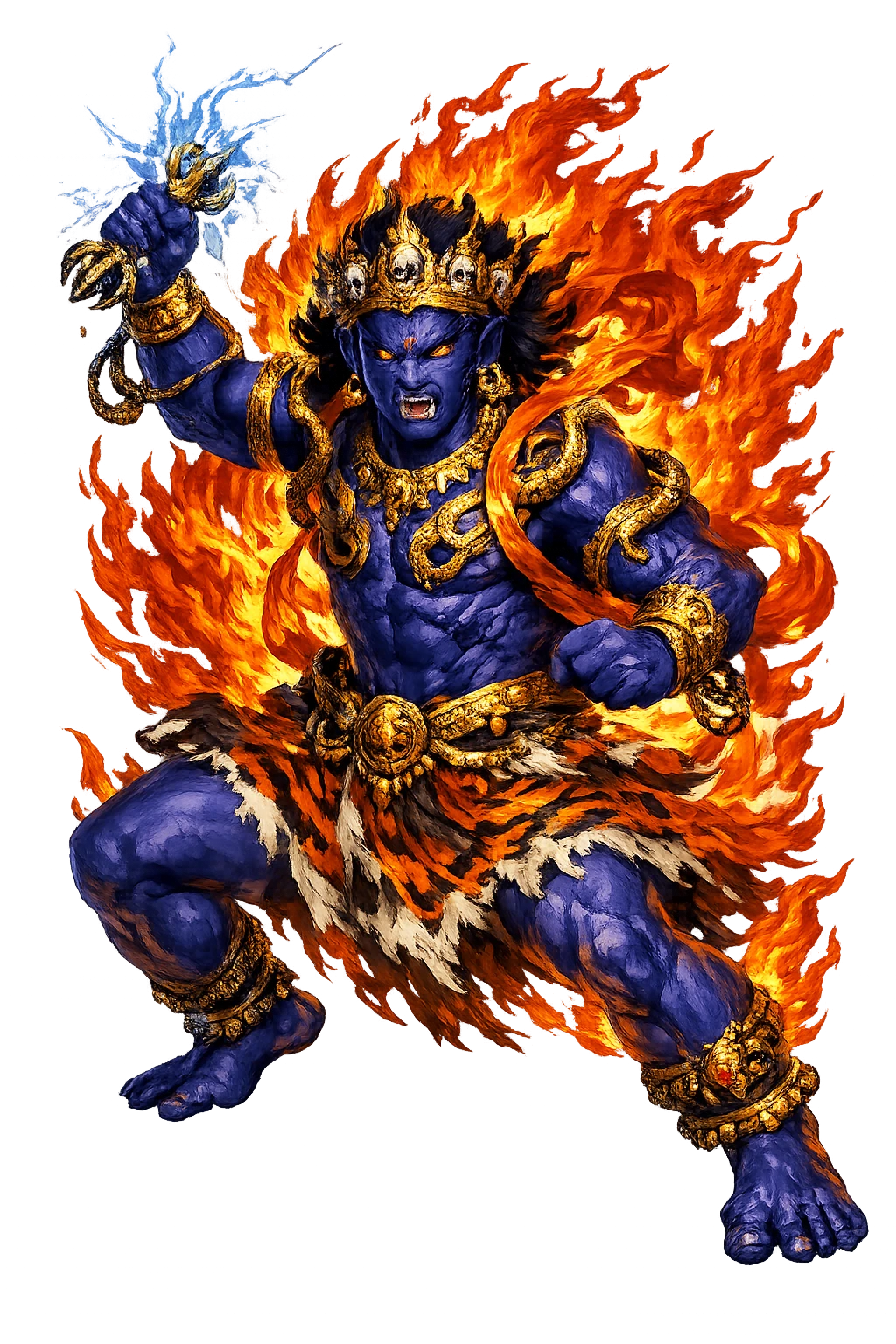
Sacred SymbolsThe vajra, The wrathful stance, The serpent ornaments, The blazing club, The blue-black body
02

Etymology & Word Family

From original script to Unicode restoration

Original Script वज्रपाणि Vajrapāṇi — "The Vajra-Bearer — wielder of the thunderbolt, protector of the Buddha (vajra + pāṇi 'in the hand')"
Unicode Restoration Vajrapāṇi Restored stress, length, and script
Modern ASCII vajrapani Plain-ASCII fallback

The name Vajrapāṇi carries the orthographic signature of the buddhist tradition: वज्रपाणि. Unicode restoration recovers what ASCII flattens.

03

Unicode Character Breakdown

Character-by-character philological analysis

CharacterUnicodeNameBlockPhonetic Role
VU+0056Latin Capital Letter VBasic LatinSame, capitalized
aU+0061Latin Small Letter ABasic LatinSame
jU+006ALatin Small Letter JBasic LatinSame
rU+0072Latin Small Letter RBasic LatinSame
aU+0061Latin Small Letter ABasic LatinSame
pU+0070Latin Small Letter PBasic LatinSame
āU+0101Latin Small Letter A with MacronLatin Extended-ALong vowel
ṇU+1E47Latin Small Letter N with Dot BelowUnknownSpecial character
iU+0069Latin Small Letter IBasic LatinSame

The Tier 1 classification reflects how much of the original phonology this restoration preserves — stress and vowel length for Greek names, distinctive letters and diacritics for every other tradition.

04

Cult & Worship

How the sacred was kept — rites, sanctuaries, remains

The Cult

Vajrapāṇi's cult begins as the Buddha's yakṣa attendant in early Buddhist narrative and expands into the fierce guardian of monasteries and maṇḍalas in Mahāyāna and Vajrayāna practice. His protective role is enacted in the gate-guardian rituals of East Asian Zen temples and the dharmapāla cults of Tibet, where wrathful forms guard doctrine and community. Initiation lineages in the Guhyasamāja and Tattvasaṃgraha tantras invoke him as interlocutor and oath-bound protector. Pilgrimage sites from Gandhāra to Japan preserve his image at thresholds, embodying the transition from mundane danger to sacred space.

In the Earth

His material record begins with Gandhāra: schist panels of the second and third centuries CE — now divided among Peshawar, Lahore, the British Museum, and the Musée Guimet — show the Heracles-bodied attendant at the Buddha's shoulder, the first datable images of a bodhisattva-protector. The type traveled: the paired gate-guardians descend from him — the Niō or Heng-Ha pairs of Japan and the Korean Geumgang yeoksa, mouths open and closed, culminating in the Nandaimon colossi of Tōdai-ji (1203, Unkei and Kaikei workshops). Himalayan art fixed his wrathful blue form by the Pāla period, and the three-lords triad became the standard threshold of Tibetan sacred painting. In the Swat valley, pilgrims were still being shown the cleft of the Apalāla legend into modern times.

05

Iconography

How Vajrapāṇi was imaged across the ages

The Image

Gandhāran schist reliefs of the second and third centuries CE show Vajrapāṇi as a muscular, bearded attendant modeled on Heracles, clutching a thunderbolt (vajra) — the earliest datable bodhisattva-protector type. By the Pāla and Sena periods he appears in fierce blue or black wrathful forms, wreathed in flames, crowned with skulls, and trampling obstacles. East Asian Buddhist art transforms him into the Niō, the paired gate guardians of Japanese temples, and into the Heng-Ha generals of Chinese monasteries. Tibetan thangkas preserve his one-face two-arm and multi-arm tantric forms, each distinguished by vajra, bell, and wrathful ornaments.

06

Reception & Transformation

The name after its own age — transmission, translation, survival

Afterlives

Vajrapāṇi's trajectory mirrors the broader Buddhist absorption of yakṣa, nāga, and Greek visual vocabularies into a single protective archetype. The Heracles-bodied type created in Gandhāra under Kushan patronage became the template for the bodhisattva-protector across Central Asia and East Asia. In East Asia his form split into the Niō guardian pair, while in Tibet he was absorbed into the dharmapāla and vidyārāja pantheons. Modern art historians trace his iconography as an index of Greco-Buddhist exchange, and his wrathful form remains central to Vajrayāna initiation and temple protection worldwide.

Identifications Across Traditions

His lineage is a relay of weapons: Indra's vajra — the name is first Indra's epithet, as Monier-Williams records — passed to the Buddha's yakkha enforcer, then to the bodhisattva of power; and in East Asia the single figure split into the paired gate-guardians of every great temple: the Kongōrikishi or Niō of Japan, mouths open and closed, the alpha and omega of the spoken world, whose colossi at Tōdai-ji's Nandaimon (1203, Unkei and Kaikei) are national treasures. The Heracles parallel runs in both directions: as the Greeks lent him a body in Gandhāra, so scholarship reads him as the Buddha's answer to every culture's strong-armed sky-god — Zeus's bolt, Indra's club, Þórr's hammer — reassigned from storm to awakening. The comparison is functional rather than historical, but it is the comparison every borderland of the old world kept making: one pantheon after another met the Buddha and reached for its strongest figure to walk beside him.

Modern Legacy

Vajrapāṇi gave the third turning of Buddhism its very name: Vajrayāna, the diamond-thunderbolt vehicle, is the way of his implement. The paired Niō still loom in the gates of Japanese temples; the wrathful krodha protectors of Himalayan art inherit his stance, his serpents, and his color; and the three-lords triad remains the standard threshold of Tibetan sacred painting. In Tibet his mantra-function is so basic that wrathful deities are addressed in his person, and Mongolian and Buryat Buddhism inherited the blue figure whole. His is the oldest continuously employed job in Buddhist art: someone has to hold the thunderbolt. Every school agrees on the job description even where they redraw the uniform — guardian at the shoulder in Gandhāra, archivist of the tantras in the monasteries, door-god in Japan and Korea, ferocious blue lord on the Himalayan walls — five costumes, one office, twenty centuries of employment.

07

The Meditation

What Vajrapāṇi means — beyond the dictionary

Vajrapāṇi is the reminder that gentleness without power is only politeness: the Dharma keeps a bodyguard because the truth, like the Buddha before Ambaṭṭha's question, is sometimes one evasion away from being talked to death. His thunderbolt is never swung in the texts — it is held, blazing, where it can be seen. The discipline he guards is the one every practitioner knows: the strength to make honesty the path of least resistance, first of all in oneself.

There is also a subtler teaching in his career. He begins as a yakkha, a local spirit with a club; he ends as the keeper of the religion's most sophisticated literature. Power, Buddhism suggests, is not abolished by enlightenment but educated by it — promoted from the door of the person to the door of the doctrine, given more dangerous material to protect and, so far, trusted with all of it. The vajra means both thunderbolt and diamond: irresistible force, unbreakable thing. Vajrapāṇi is the argument that in a disciplined hand they are the same object.

08

Frequently Asked Questions

Common questions about Vajrapāṇi, Thunderbolt Holder, Protection, and Unicode restoration

01How do you pronounce Vajrapāṇi?

In reconstructed pronunciation, Vajrapāṇi is /ʋɐdʒ.rɐ.ˈpaː.ɳi/ — approximately vuj-ruh-PAH-nih — the j is as in 'jam'; the ṇ is the retroflex n; the ā of pāṇi is long.

02What does Vajrapāṇi mean?

Vajrapāṇi means The Vajra-Bearer — wielder of the thunderbolt, protector of the Buddha (vajra + pāṇi 'in the hand') in the buddhist tradition.

03What are the symbols of Vajrapāṇi?

Vajrapāṇi is associated with The vajra (The weapon that gives Vajrayāna its very name: the diamond vehicle is his vehicle), The wrathful stance (Pratyālīḍha, the warrior's lunge: compassion with its patience spent), The serpent ornaments (The nāga girdle of the wrathful form: the powers of the deep enlisted as jewelry), The blazing club (The ayoguḷa of the Ambaṭṭha Sutta, raised but never swung — deterrence as the highest use of force), The blue-black body (Nīlambaradhara, the Blue-Clad: the wrathful color of the vajra family, wrath that is fidelity in another register).

04Why restore Vajrapāṇi in Unicode?

Plain ASCII vajrapani strips the stress, length, and script that make the name specific. Unicode restoration returns the name to its original written dignity.

05What is the most important myth about Vajrapāṇi?

“The Yakkha with the Blazing Club” — the Ambaṭṭha Sutta (DN 3) story that anchors the mythology of Vajrapāṇi, told in full on the lore page.

09

Scholarly Sources

The philological foundations of this restoration

Every claim on this page is grounded in established scholarship. The orthographic restorations follow disciplinary convention. The etymological chain follows the best available reference works. This is not invention — it is resurrection through scholarship.

◈

Lexicography & Philology

  • Vajrayana texts
  • Buddhist texts
◎

Primary Texts

  • The Larger Sukhāvatī-vyūha Sūtra; the Smaller Sukhāvatī-vyūha Sūtra; the Amitāyurdhyāna Sūtra; the Lotus Sūtra.
◉

Archaeology & Art History

  • Material evidence — iconography, inscriptions, and temple archaeology — for Vajrapāṇi and related cults.
✦

Religious Studies

  • Dīgha Nikāya 3, Ambaṭṭha Sutta (the yakkha Vajirapāṇi and the blazing iron club)
  • Tattvasaṃgraha Tantra and Guhyasamāja Tantra (Vajrapāṇi as guardian and interlocutor of the esoteric canon)
  • Divyāvadāna (the conversion of the nāga Apalāla); Xuanzang, Records of the Western Regions
  • Edgerton, Buddhist Hybrid Sanskrit Dictionary, s.v. vajrapāṇi
  • Monier-Williams, Sanskrit-English Dictionary, s.v. vajrapāṇi
  • Getty, The Gods of Northern Buddhism (1914); Snellgrove, Indo-Tibetan Buddhism (1987)
Return

The Surface Awaits

You have traced the name from its earliest attestation to its Unicode restoration. Now return to the myth. The story is where the name lives.

Back to Lore
Vajrapāṇi mascot