PuniCodex

Extended Lore

Týr — The Deeper Record

Etymology · Orthography · Cult · Iconography · Reception · Sources

Preserves stress Týr.com
Týr — War, Law, Oaths
01

At a Glance

Týr — every fact links to its home

PantheonNorse
DomainWar, Law, Oaths
Original Scriptᛏᚢᚱ →
Primary Sources4 cited →
02

Etymology & Word Family

From original script to Unicode restoration — the full etymology page →

Original Script ᛏᚢᚱ Týr — "God (cognate with Greek Zeus, Latin Jove)"
Unicode Restoration Týr Restored stress, length, and script
Modern ASCII tyr Plain-ASCII fallback

God (cognate with Greek Zeus, Latin Jove)

03

Unicode Character Breakdown

Character-by-character philological analysis

CharacterUnicodeNameBlockPhonetic Role
TU+0054Latin Capital Letter TBasic LatinSame
ýU+00FDLatin Small Letter Y with AcuteLatin-1 SupplementAcute on y
rU+0072Latin Small Letter RBasic LatinSame

The restoration of Týr preserves what it can of the original phonology — stress and vowel length for Greek names, distinctive letters and diacritics for every other tradition.

04

Cult & Worship

How the sacred was kept — rites, sanctuaries, remains

The Cult

Týr's cult has to be triangulated, because no temple, priesthood, or festival in the Norse sources bears his name. The clearest signal is topographic: Týrsbergi in Sweden, Norway's Tysnes, and a scatter of Scandinavian place-names in Tis-/Tyr- mark spots where sanctuaries or assemblies once carried him. Roman Britain gives the one hard inscription: the third-century altars at Housesteads on Hadrian's Wall dedicated to Mars Thincsus — 'Týr of the thing', the assembly — set up by Germanic soldiers, the only stones that certainly named him. Tacitus adds the rite behind the name: among the early Germans, gods received stallions sacrificed in sealed enclosures to settle oaths and treaties — precisely Týr's portfolio. And the weekday names keep a heartbeat: English Tuesday from Tīwesdæg, Norse týsdagr — his day fossilized into the week itself. A god of the binding promise, worshipped wherever words were made unbreakable.

In the Earth

The name Týr is attested in runic inscriptions, including the early Viking-Age Ribe skull fragment. The Romano-Germanic altar at Housesteads (Vercovicium) on Hadrian's Wall names Mars Thincsus, the interpretatio romana of Týr as god of the thing. Place-names such as Týrsbergi in Sweden and the widespread Scandinavian Tis-/Tir- names suggest a cultic footprint broader than the literary record implies.

05

Iconography

How Týr was imaged across the ages

The Image

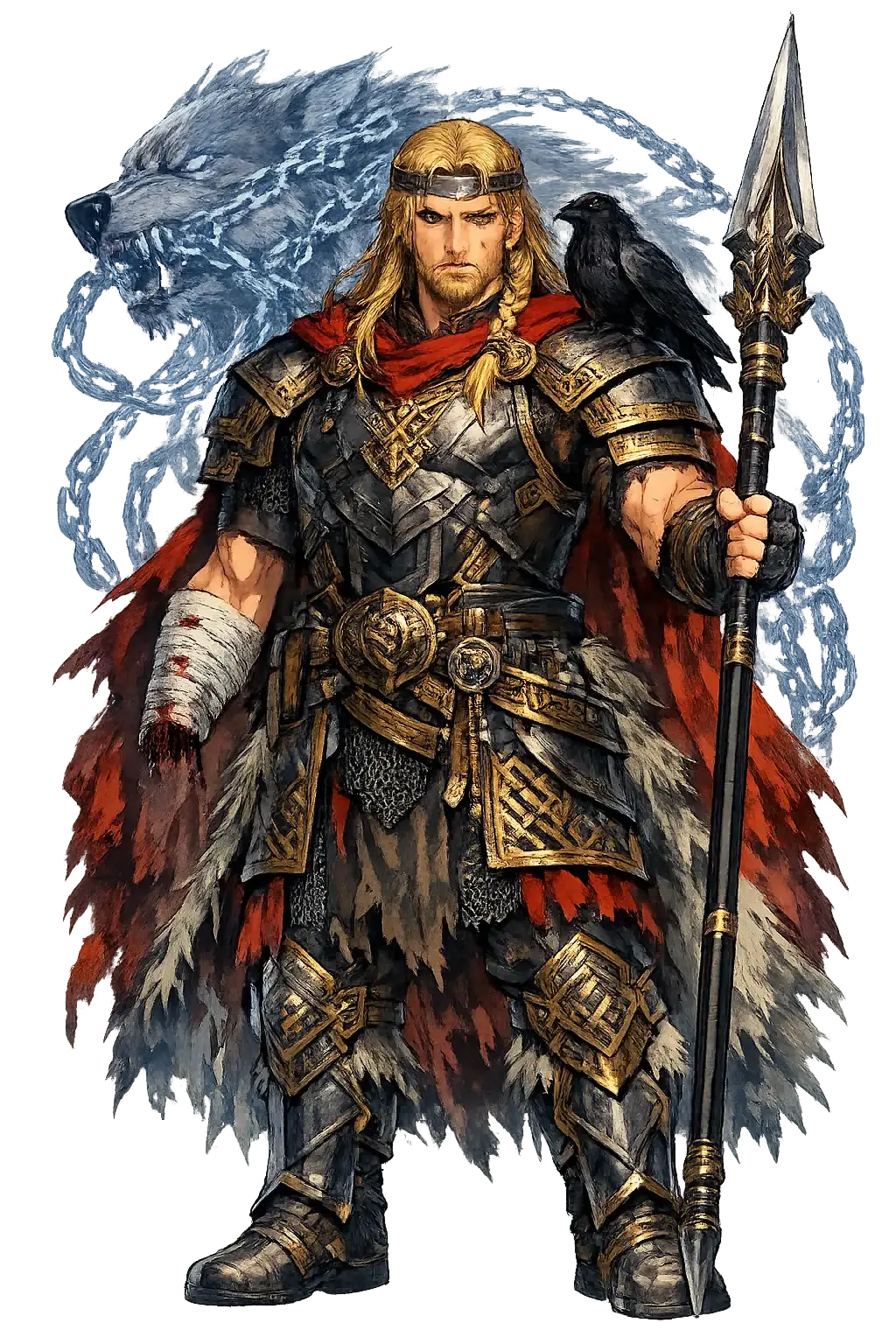
Týr is the one Norse god instantly recognizable by an absence. His attribute is the missing right hand, lost in the wolf's mouth — so complete is the type that Snorri can introduce him simply as 'the one-handed god'. No surviving image carries his name, but stone sculpture keeps his scene: the tenth-century Gosforth Cross in Cumbria shows the bound wolf, jaws closed on the severed wrist, in one of the most studied panels of Viking-Age art — an identification argued, like most Gosforth readings, rather than certain. Roman Britain named him without picturing him for us: the Housesteads altars survive, their carved figures lost. Textually he carries the spear and sword of a war-god, but his most widely traveled portrait is a letter: the rune ᛏ named after him, cut on bracteates and amulets across the Germanic world — the god reduced to his initial, and still legible.

06

Reception & Transformation

The name after its own age — transmission, translation, survival

Afterlives

Týr's reception is the biography of a name that outgrew its god. Linguists can watch it happen in real time: his name is the Germanic word for 'god' itself, which means that at some point — probably before the Migration Age — speakers stopped invoking him by name and kept the noun. The Romans met the god early and filed him under Mars: Tacitus' age and the third-century Housesteads altars name Mars Thincsus, god of the assembly, and Old High German glosses still equate Ziu with Mars in monasteries. The weekday carried him through Christian centuries — Tīwesdæg, Ziostag, Tuesday — a fossil no reform could remove from the week. The Icelandic manuscripts then saved his one great story: the Codex Regius (c. 1270) preserves the binding of Fenrir, Snorri glosses it, and seventeenth-century antiquarians brought the text into print, crowned by the 1665 editio princeps. Jacob Grimm, in the Deutsche Mythologie of 1835, made him the case history of a sky-god's decline into a war-god; the *dyēw- equation — Týr with Zeus, with Jupiter, with Sanskrit Dyáuṣ — became one of nineteenth-century philology's flagship demonstrations, and it still frames every handbook that calls his name the oldest god-word in the family.

Identifications Across Traditions

Roman writers equated the Germanic war god with Mars, especially as Mars Thingsus, the patron of the thing assembly. The Romano-Germanic altar at Housesteads on Hadrian's Wall invokes 'Mars Thincsus' alongside the Alaisiagae, a pair of Germanic goddesses. In the interpretatio romana of Tacitus, the highest Germanic god was Mercury (Óðinn), but Mars remained the god of war and the assembly. The Anglo-Saxon name Tīw and the day-name Tuesday preserve Týr's memory in English. His name — cognate with Zeús, Iuppiter, and Sanskrit Dyáuṣ — is the old Indo-European word for the sky god, and some scholars argue that *Tīwaz, not Óðinn, was the original chief god of early Germanic religion, later eclipsed in the literary record. If so, the one-handed god of the Edda is the last, diminished portrait of a deity who once stood at the head of the pantheon.

Modern Legacy

Týr survives most visibly in the English word Tuesday ('Tīw's day'), a faint echo of a once-major deity. In modern Heathenry and Norse-inspired fantasy, he is honored as the god of law, honor, and self-sacrifice — the deity who keeps oaths even at terrible cost. His one-handed image has become a symbol of integrity, and the binding of Fenrir remains one of the most retold scenes in the entire Norse corpus. For military ethicists and legal historians, Týr represents the idea that law requires sacrifice and that the guarantor of order must sometimes pay the price personally.

09

The Original Script Note

What the written record preserves — and what it does not

Original Script

The god's name is guaranteed by the alphabet itself: the ᛏ rune is named for him — Týr in the Icelandic rune poem, Tiw in Old English — so the Younger Futhark row carries his name in its very ordering. As a theonym he is transmitted chiefly in the Latin-script Eddas; the specimen ᛏᚢᚱ is a normalization consistent with that rune-name. The restored form Týr carries the acute of the long vowel, the one feature ASCII flattens. The name is ancient beyond the North: cognate with Greek Zeus and Latin Iuppiter from Proto-Indo-European *dyēus — the sky-father's name worn down to a god of law and the sword. The registrable form is týr.com (punycode xn--tr-0ka.com), held in the PuniCodex collection.

10

The Meditation

What Týr means — beyond the dictionary

Týr is the god of the kept word. In a world of shifting alliances and clever speech, he stands for the promise that cannot be broken without breaking the promiser. His hand is not lost in battle; it is lost in diplomacy, in the necessary lie that binds a monster for the good of all.

There is something austere about Týr. He does not joke like Loki, scheme like Óðinn, or thunder like Þórr. He simply does what must be done and accepts the cost. In an age of broken contracts and disposable commitments, his mutilated hand is a quiet rebuke: the law is only as strong as those willing to suffer for it.

11

Screen & Culture

Where Týr echoes through film, television, and games — and how

12

Frequently Asked Questions

Deep-dives into the cult, attestation, reception, and sources of Týr

01How do we know how Týr was worshipped?

The name Týr is attested in runic inscriptions, including the early Viking-Age Ribe skull fragment. The full cult record →

02Where do the earliest attestations of Týr come from?

The record rests on Snorri Sturluson, Prose Edda: Gylfaginning (the binding of Fenrir; the death of Týr and Garmr), Poetic Edda: Lokasenna (Loki's taunt and Týr's reply), Poetic Edda: Hymiskviða (Týr as son of Hymir), among 9 cited works. The full source apparatus →

03How did later traditions reinterpret Týr?

Týr's reception is the biography of a name that outgrew its god. Reception & transformation →

04What do the surviving images of Týr actually show?

Týr is the one Norse god instantly recognizable by an absence. The iconography →

05What does the written record of Týr actually preserve?

The god's name is guaranteed by the alphabet itself: the ᛏ rune is named for him — Týr in the Icelandic rune poem, Tiw in Old English — so the Younger Futhark row carries his name in its very ordering. The Original Script note →

13

Scholarly Sources

The philological foundations of this restoration

Every claim on this page is grounded in established scholarship. The orthographic restorations follow disciplinary convention. The etymological chain follows the best available reference works. This is not invention — it is resurrection through scholarship.

◈

Lexicography & Philology

  • Cleasby-Vigfusson
  • Zoëga
◎

Primary Texts

  • Snorri Sturluson, Prose Edda: Gylfaginning (the binding of Fenrir; the death of Týr and Garmr)
  • Poetic Edda: Lokasenna (Loki's taunt and Týr's reply)
  • Poetic Edda: Hymiskviða (Týr as son of Hymir)
  • Poetic Edda: Völuspá (the world renewed)
◉

Archaeology & Art History

  • Foote, P., & Wilson, D. M. The Viking Achievement; Graham-Campbell, J. Viking Art.
✦

Religious Studies

  • Tacitus, Germania (interpretatio romana of Germanic gods)
  • Cleasby & Vigfusson, An Icelandic-English Dictionary (1874), s.v. Týr
  • de Vries, Jan, Altgermanische Religionsgeschichte
  • Simek, Rudolf, Dictionary of Northern Mythology
  • Lindow, John, Norse Mythology: A Guide to the Gods, Heroes, Rituals, and Beliefs
Return

The Surface Awaits

You have traced the name from its earliest attestation to its Unicode restoration. Now return to the myth. The story is where the name lives.

Back to Lore
Týr mascot