
The provenance file on Typhōn
Catalogue entry — Typhōn. Every claim below carries its chain of custody.
Provenance
1. The attestation. Τυφῶν — "Whirlwind, smoke". On record: Hesiod, Theogony 306–319, 820–868, Apollodorus, Library 1.6.3; 2.3.1; 3.5.8, Pindar, Pythian Ode 1.15–28 (Typhon under Etna), Ovid, Metamorphoses 5.319–331.
2. The preserved evidence. o → ō (Macron: long omega) — absent from the ASCII form typhon, present in the restoration, verifiable against the sources above.
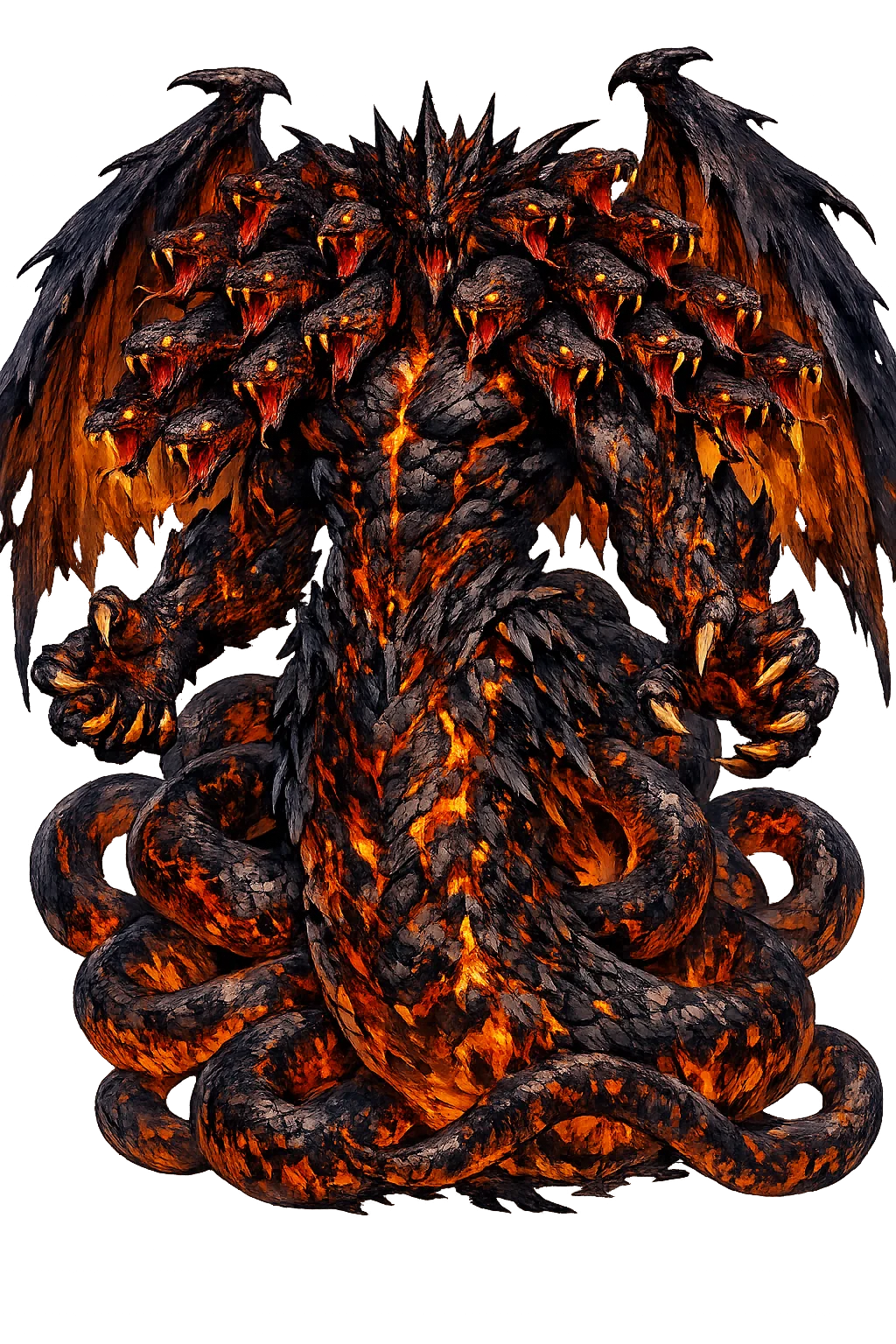
3. The narrative record. Son of Earth and Abyss — Hesiod writes that after Zeus drove the Titans from heaven, Gaia lay with Tártaros — 'through golden Aphrodité', the Theogony says — and bore her last and most terrible child: Typhōn, 'the mind-baffling' monster 'who would have ruled over mortals and immortals' had Zeus not acted first (Hesiod, Theogony 820–835). Apollodorus adds the motive: Gaia conceived him in anger at the destruction of her other brood, the Giants, so that the final challenger of the new order is literally the earth's revenge (Apollodorus, Library 1. The Typhonomachy — The battle shook the cosmos. Hesiod piles up the horror: a hundred serpent heads grew from Typhōn's shoulders, each speaking with a different voice — the speech of gods, the bellowing of bulls, the roars of lions, the baying of hounds, the hissing of serpents — while fire blazed from his eyes and 'a flaming monster' boiled the sea and scorched the earth beneath the thunder of Zeus's reply (Theogony 820–868).
4. The physical record. Typhon is best attested in mythic art rather than cult. The sixth-century BCE Chalcidian hydria in the Louvre shows Zeus battling Typhon. The Pergamon Altar's Gigantomachy includes snaky-legged opponents evoking the monster. Sicily's volcanic Mount Etna and the caves near Catania were identified as Typhon's prison. Apulian and South Italian vases depict the defeated Typhon beneath Etna or in the underworld.
5. The current holding. The temple at /typhon/, classified Tier 1. What survives here cannot be shown in ASCII: a feature of the original that the fallback alphabet flattens. That is the Tier-1 test, and this name passes it without argument.
6. The documented resonances. Meteorology & Weather Intelligence, Disaster Resilience & Recovery, Gaming, Fantasy & Entertainment IP — seats argued and weighted in the pattern atlas, read through the myths in this temple's Resonance File.
7. The primary sources. Theogony, Homeric Hymns, Works and Days — the library this file answers to, open at the Sacred Texts collection.
8. The continuing record. Typhōn gave his name to the typhoon, one of the most feared words in meteorology — though the route may run through Arabic ṭūfān and Chinese taifeng as well as Greek, and scholars still argue the etymology. In fantasy, 'Typhon' names ancient dragons, sea monsters, and final bosses; Dungeons & Dragons, video games, and anime have made him a staple of world-ending antagonists.
At a Glance
- Restored name: Typhōn
- ASCII form: typhon
- Meaning: "Whirlwind, smoke"
- Domain of influence: Monster, Father of Monsters, Storms
- Pantheon: Greek
- Classification: Tier 1
- Original script: Τυφῶν
- Series: The Restoration Files, No. 501 of 546
The File Continues
Read the founding dispatch for the name's full story, the Resonance File for the archetype at work — or the whole archive in one sitting.
Continue the series — previous file: Týchē (read it here) · next file: Týr (read it here).
The Restoration Files are written from the same canonical record as the temples themselves: the lexicon, the lore catalog, the pattern atlas, and the cited scholarly sources. If a file ever disagrees with its temple, the temple is right — tell us, and the file will be corrected.