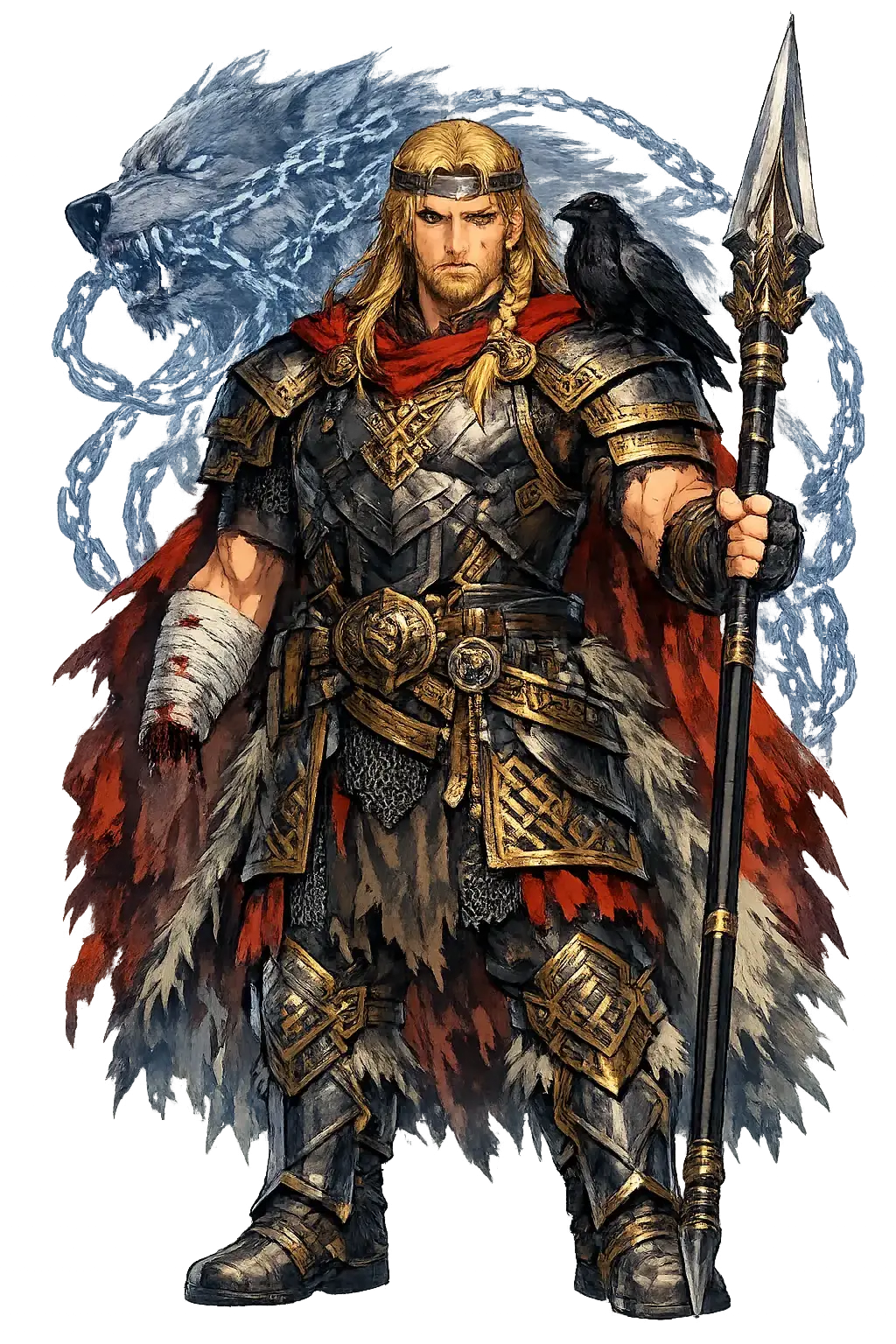
Stories of Týr
Týr's mythology is narrower than that of Óðinn or Þórr, but it turns on a single, unforgettable scene: a god who pays for the common good with his own body. His stories are stories of pledges kept, monsters bound, and the law that outlasts the hand that swore it.
Snorri tells the scene in Gylfaginning with terrible calm. The wolf Fenrir — Loki's child, raised among the Æsir because no one dared refuse him — grew huge, and only Týr had the courage to feed him. The gods forged a fetter, Gleipnir, from six impossible things: the footfall of a cat, the roots of a mountain, the sinews of a bear, the breath of a fish, the spittle of a bird, and one more unnamed. They invited the wolf to test his strength against it, flattering his pride, and Fenrir accepted on one condition: that a god place a hand in his jaws as a pledge of release. Only Týr stepped forward. The binding held; Fenrir snapped his jaws shut; the hand was gone. 'Then all the gods laughed,' Snorri says, 'except Týr: he lost his hand.' The myth made Týr the living price of the community's safety — the pledge-giver pays personally for what the group gains, and the laughter of the saved is not his to share.
At the feast of Ægir, Loki turned his venom on every god in turn, and Týr drew one of the poem's sharpest passages. Loki mocked him for losing his hand to the wolf — and then twisted the knife with the obscenity that Týr's own wife had borne Loki a son. Týr's reply is among the most dignified moments of the flyting: the loss of his hand he counts openly, set against the loss Loki must bear — the bound wolf Fenrir, who waits in chains until the end of the world, when he will rise and swallow Óðinn. The exchange is a duel of two kinds of sacrifice. Loki gave nothing and lost everything through his own acts; Týr gave his hand freely and wears the loss as an honor. The Lokasenna poet, whose sympathies are plainly with the gods, uses Týr to draw the moral line of the whole poem: real courage does not need to win the argument — it needs only to be seen standing still while the accuser rages.
In Hymiskviða, Týr appears under a different genealogy: not the son of Óðinn but the son of the giant Hymir — 'my father is the fierce-souled one, Hymir by name.' He guides Þórr to Jötunheimr to win the giant's mile-wide cauldron, in which ale is brewed for all the gods, and at the giant's hall he nearly dies when a crystal goblet is hurled at him, saved only by Þórr's intervention. The poem is usually read as preserving an older stratum of the tradition, in which Týr moved between the worlds of gods and giants and stood nearer the center of the mythology than he does in Snorri's Edda. That the boldest of the Æsir should have a giant for a father is itself suggestive: courage, in the Germanic view, may be an inheritance from the enemy, and the hand Týr later offered to a wolf is the hand of someone who never fully belonged to either side of the great divide.
The binding bought time, not victory. Snorri's account of Ragnarök foretells that in the final winter the hound Garmr — chained before the cave at Gnipahellir, howling since the world was young — will break his bonds at last, 'the fetters will snap and the wolf run free.' In the last battle Týr and Garmr find each other, and they kill one another. The pairing is exact: the god who pledged his hand to bind one wolf dies by the fangs of another, and the law that outlasted his hand does not outlast the world. Yet the myth is not wholly dark. After the fire, Snorri says, the surviving gods will sit together on the renewed grass and speak of what is past; and the Völuspá promises that Baldr will come back to dwell with Hǫðr in the halls of the gods. Týr's death is a price already known and, in a sense, already paid in part — his whole mythology is one long account of how much a pledge can cost, and why it must be paid anyway.
War, Law, and the Price of Oaths
Týr is the god who keeps his word even when it costs him his hand. In a pantheon famous for cunning and force, he stands for something older: the binding power of oath and law. His very name is the Germanic word for 'god' — he may once have been the greatest of them — and he is remembered in the Norse sources chiefly for the binding of Fenrir, the great wolf who will devour Óðinn at Ragnarök.
His name is invoked when men swear binding oaths; he is the guarantor of public law and solemn promise.
He alone dared place his hand in the wolf's mouth as pledge; the gods gained a chained monster and Týr gained the name 'one-handed'.
Snorri calls him the boldest and most valiant of the Æsir, a god of single combat and battlefield honor.
The Germanic assembly of free men gathered under his protection; Mars Thingsus was his Roman face.
From the original script to the living URL
ᛏᚢᚱ
The name in its original Norse form. Týr (ᛏᚢᚱ) is attested in the source tradition — “God (cognate with Greek Zeus, Latin Jove)”. Its original diacritics and script distinctions carry the full phonetic and orthographic weight of the source tradition.
tyr
Reduced to plain tyr, the name loses everything that made it specific: original diacritics and script distinctions. What remains is an ASCII string that machines can parse but that no longer speaks with its original voice.
Týr
The Unicode restoration recovers what ASCII flattened. Týr restores original diacritics and script distinctions, returning the name to its original written dignity. The domain encodes to Punycode, but the browser displays the truth.
Týr.com → xn--tr-0ka.com
The non-ASCII characters in Týr are encoded while the ASCII remains visible. To the DNS, it is Punycode. To humanity, it is Týr.
Owned, ideal, and ASCII forms of Týr
Týr
Restores ᛏᚢᚱ. The live temple domain — týr.com.
tyr
Flattens ᛏᚢᚱ. The plain ASCII fallback — what DNS and legacy systems see.
How Týr was spoken
How Týr travels from ancient script to the modern URL
Old Norse Týr; from Proto-Germanic *Tīwaz, cognate with Greek Zeus and Latin Juppiter; the one-handed god of law and war.
War, Law, Oaths
The Unicode restoration Týr uses registrable Thorn and vowel accents; the runic form is not used because runic TLD support is impractical.
The lore you have read is the living myth. Extended Lore opens the scholarly vault beneath it: the cult and its material remains, a history of the image, the name after antiquity, a meditation on what the name still means, and the full scholarly apparatus — etymology, orthography, sources.
Enter Extended Lore