
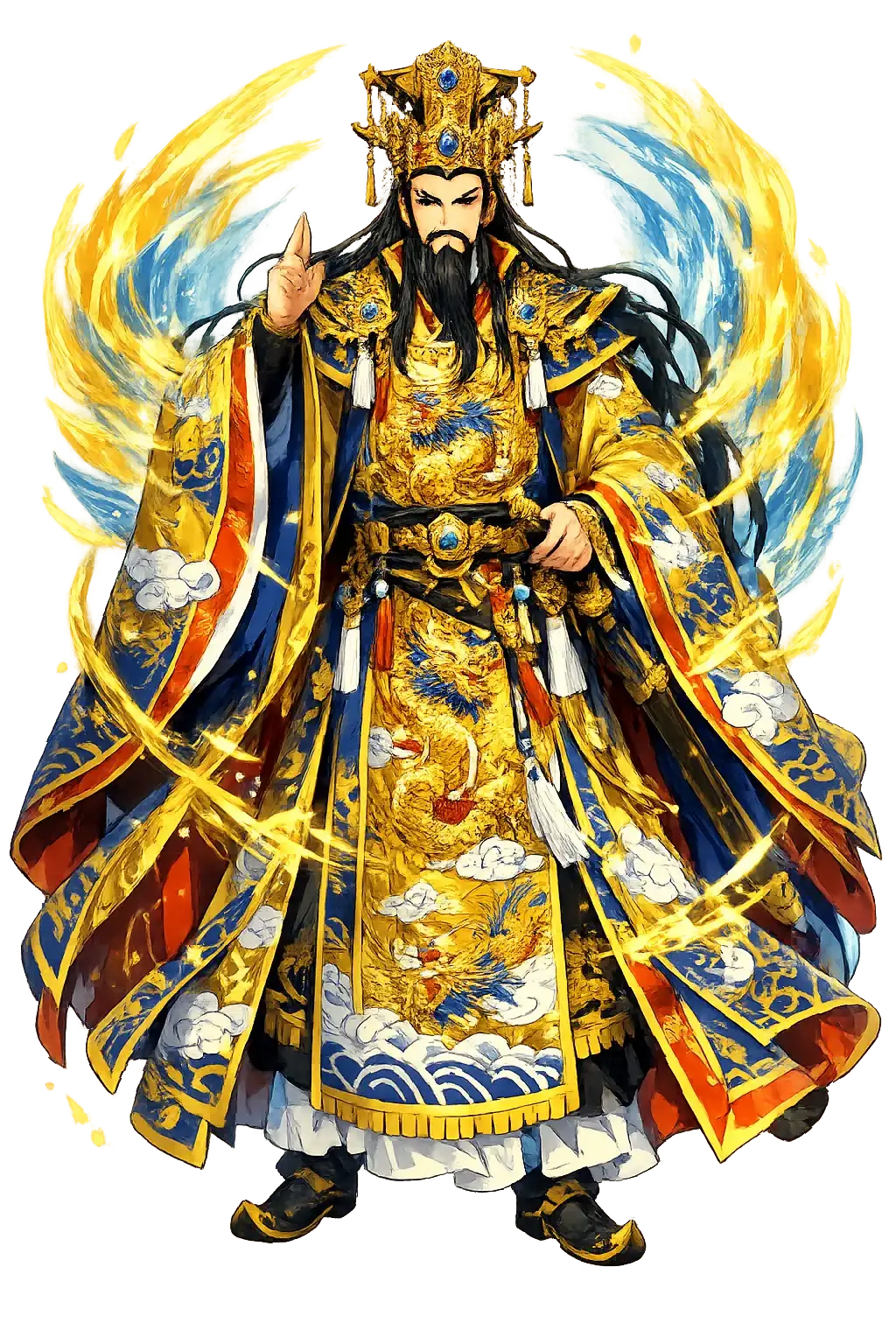
Tiān: the stories first, then the spelling
The marks in Tiān make the most sense standing next to the myths they have to carry. So the myths come first.
The Stories That Carry the Name
From Shàngdì to Tiān. In Shang times the supreme power was Shàngdì 上帝, the High Lord or high ancestor-deity above, who commanded wind and rain and received the Shang king's sacrifices in person. The oracle bones of Anyang are his archive: diviners cracked turtle shell and ox bone to learn his will on harvest, war, and the royal health. When the Zhou — a western people — overthrew the Shang at Mùyě c.
The Duke of Zhou and the Mandate. The Duke of Zhou, brother of the conquering King Wu and regent for the boy King Cheng, is credited with formulating the Mandate as a check on arbitrary power — the tradition makes the statesman a theologian. When rebellion shook the young dynasty, the Duke's response in the documents preserved in the Shàngshū (the 'Great Announcement' 大誥 and 'Establishment of Government' 立政) is consistent: Heaven's charge is hard to keep, won by the virtue of former kings and lost through drunkenness and cruelty. The Shǐjì 史記 of Sima Qian adds the human drama: the Duke is slandered into exile, and returns only when a great storm uproots the royal grain and the frightened king opens the sealed archive that proves his loyalty beyond doubt.
The Border Sacrifice. At the winter solstice the emperor performed the jiàojì 郊祭, the border sacrifice to Heaven, the rite that hinged the imperial year. From the Ming Yongle emperor's rebuilding of Beijing (from 1420) its stage was the Temple of Heaven complex in the southern suburbs: the emperor fasted three days in the Palace of Abstinence, then alone — the one man in the empire permitted to worship Heaven directly — ascended the round, three-tiered Altar of Heaven beneath the open sky, bearing jade bi disks, silk, and a bull. Heaven alone received the sacrifice; the emperor's own ancestors were honoured separately, at the rectangular Imperial Vault.
And Here Is What the Spelling Preserves
Against those stories, the attestation: 天, as Shangshu 尚書 (Book of Documents) and Shiji 史記 (Records of the Grand Historian) preserve it. The name means "The supreme celestial force and moral order of the cosmos".
The restoration keeps one feature the ASCII form tian cannot show:
- a → ā — Macron: first tone: how long the vowel is held.
A storyteller pronouncing the name would restore every one of them by instinct. The file only writes down what the voice already knows.
At a Glance
- Restored name: Tiān
- ASCII form: tian
- Meaning: "The supreme celestial force and moral order of the cosmos"
- Domain of influence: Heaven, Sky, Cosmic Order
- Pantheon: Chinese
- Classification: Tier 1
- Original script: 天
- Series: The Restoration Files, No. 488 of 546
The Name Travels
Tiān absorbed and was absorbed by later traditions. Confucians spoke of Tiān as moral destiny; Daoists located it within a larger cosmos of qi and the Dao; Chinese Buddhists translated the Sanskrit deva with Tiān.
The Address It Earned
The temple of Tiān stands at /tian/ — lore, scholars, patterns — because a name carrying this much story deserves more than a parking page. The restoration preserves more than the ASCII form can express — stress, length, or a letter the Latin keyboard lost — which places it, mechanically, in Tier-1.
The Sources Are Open
The myths above are retold from the temple's record; the primary voices are in the Sacred Texts: Tao Te Ching. Nothing in this file outranks them.
The File Continues
Read the founding dispatch for the name's full story, the Resonance File for the archetype at work — or the whole archive in one sitting.
Continue the series — previous file: Tiāmat (read it here) · next file: Tiāndì (read it here).
The Restoration Files are written from the same canonical record as the temples themselves: the lexicon, the lore catalog, the pattern atlas, and the cited scholarly sources. If a file ever disagrees with its temple, the temple is right — tell us, and the file will be corrected.