
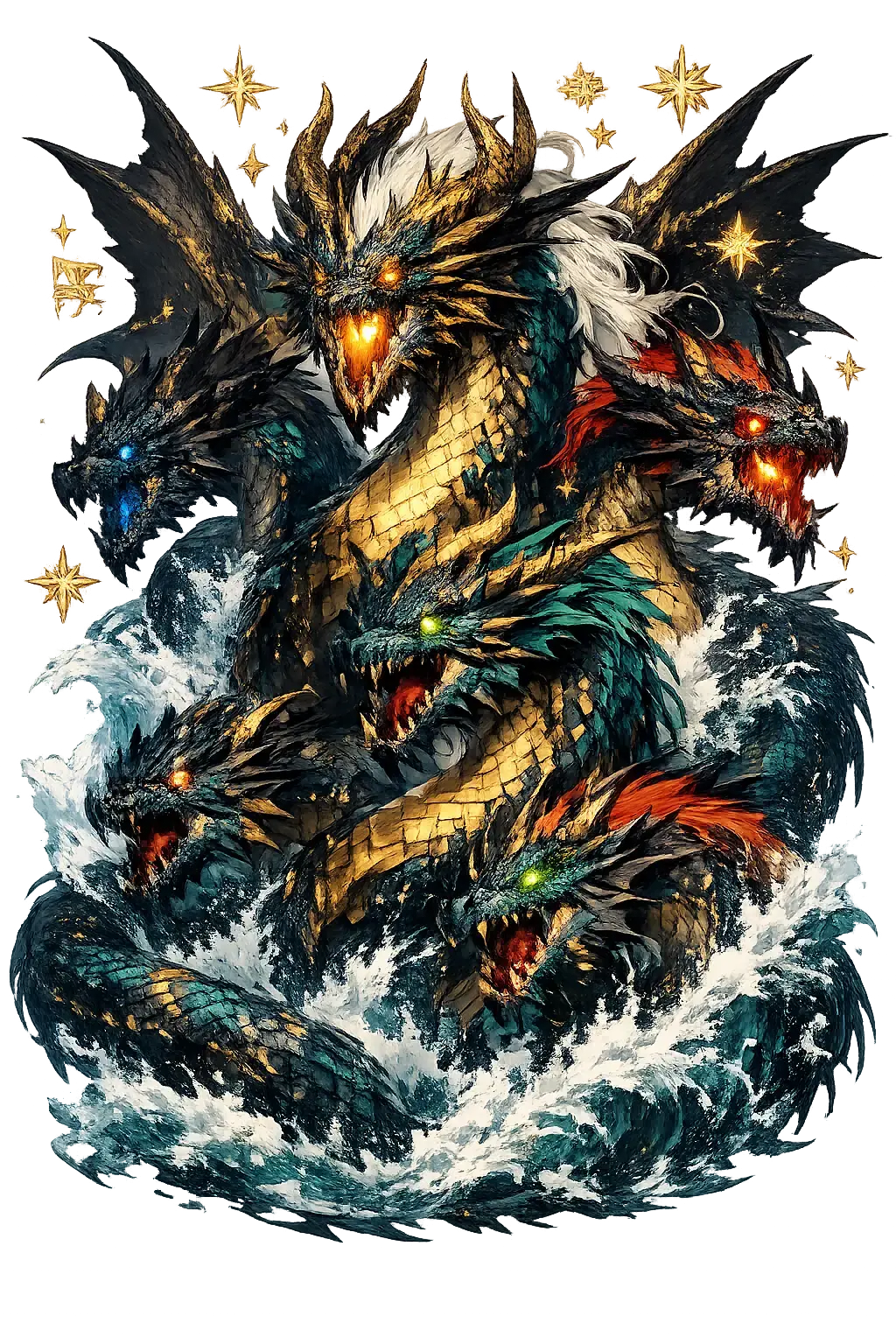
Tiāmat: the stories first, then the spelling
You cannot weigh an accent without knowing what it carries. Here is what Tiāmat has been carrying.
The Stories That Carry the Name
The Salt-Water Mother. Before the gods existed there was no heaven and no earth, only Apsû, the freshwater abyss, and Tiāmat, the salt sea, 'their waters mingled as a single body' (Enuma Elish I. 1–20). From their mingling the divine generations rose like silt from a river's meeting: first Lahmu and Lahamu, then Anshar and Kishar, then the sky-god Anu, and finally Ea, the wisest of all.
The War of the Gods. When the younger gods' noise disturbed Apsû's rest, he resolved to destroy them — and Tiāmat alone said no (Enuma Elish I. 44–59). Ea struck first: he cast the slumber-spell on Apsû, slew him, and built his own house upon the corpse of the abyss.
Marduk Splits Tiāmat. Marduk of Babylon accepted the challenge on one condition: that the assembly grant him supreme kingship, so that his word would bind the gods as Tiāmat's once had (Enuma Elish IV. 3–26). Armed with the winds, the hurricane, the whirlwind and the seven winds, he rode out against her; when she opened her mouth to swallow him whole, Marduk loosed the evil wind to hold it open, drove in an arrow that pierced her heart, and 'extinguished her life' (IV.
And Here Is What the Spelling Preserves
The restoration keeps one feature the ASCII form tiamat cannot show:
- a → ā — Long vowel: how long the vowel is held.
A storyteller pronouncing the name would restore every one of them by instinct. The file only writes down what the voice already knows.
At a Glance
- Restored name: Tiāmat
- ASCII form: tiamat
- Meaning: "Sea"
- Domain of influence: Phonological Reconstruction, Salt Water, Chaos
- Pantheon: Mesopotamian
- Classification: Tier 1
- Original script: 𒀭𒋾𒊩𒆳
- Series: The Restoration Files, No. 487 of 546
The Name Travels
Tiāmat's influence radiates across ancient Near Eastern and later mythologies. The Unicode form Tiāmat is a reconstruction node: standard Assyriology writes Tiamat or Tiāmat, and the macron makes visible the open question of first-vowel length.
The Address It Earned
The temple of Tiāmat stands at /tiamat/ — lore, scholars, patterns — because a name carrying this much story deserves more than a parking page. What survives here cannot be shown in ASCII: a feature of the original that the fallback alphabet flattens. That is the Tier-1 test, and this name passes it without argument.
The Sources Are Open
The myths above are retold from the temple's record; the primary voices are in the Sacred Texts: Enūma Eliš and The Epic of Gilgamesh. Nothing in this file outranks them.
The File Continues
Read the founding dispatch for the name's full story, the Resonance File for the archetype at work — or the whole archive in one sitting.
Continue the series — previous file: Þrúðr (read it here) · next file: Tiān (read it here).
The Restoration Files are written from the same canonical record as the temples themselves: the lexicon, the lore catalog, the pattern atlas, and the cited scholarly sources. If a file ever disagrees with its temple, the temple is right — tell us, and the file will be corrected.