PuniCodex

Extended Lore

天 Tiān

Etymology · Orthography · Cult · Iconography · Reception · Sources

Tier 1 Tiān.com
Tiān — Heaven, Sky, Cosmic Order
01

Quick Facts

Essential information about Tiān, Heaven, Sky, Cosmic Order

Original Script天
Unicode RestorationTiān
Reconstructed Pronunciation/tʰjɛn˥/
PantheonChinese
DomainHeaven, Sky, Cosmic Order
MeaningThe supreme celestial force and moral order of the cosmos
ClassificationTier 1
Primary DomainTiān.com
Sacred SymbolsAzure Dragon, Jade disk (bi 璧), North celestial pole, Sacrificial bull
02

Etymology & Word Family

From original script to Unicode restoration

Original Script 天 Tiān — "The supreme celestial force and moral order of the cosmos"
Unicode Restoration Tiān Restored stress, length, and script
Modern ASCII tian Plain-ASCII fallback

The name Tiān carries the orthographic signature of the chinese tradition: 天. Unicode restoration recovers what ASCII flattens.

03

Unicode Character Breakdown

Character-by-character philological analysis

CharacterUnicodeNameBlockPhonetic Role
TU+0054Latin Capital Letter TBasic LatinSame, capitalized
iU+0069Latin Small Letter IBasic LatinSame
āU+0101Latin Small Letter A with MacronLatin Extended-AMacron: first tone
nU+006ELatin Small Letter NBasic LatinSame

The Tier 1 classification reflects how much of the original phonology this restoration preserves — stress and vowel length for Greek names, distinctive letters and diacritics for every other tradition.

04

Cult & Worship

How the sacred was kept — rites, sanctuaries, remains

The Cult

Heaven's cult had one priest and no church: the Son of Heaven alone could sacrifice to Tiān. The core rite was the Suburban Sacrifice, offered at the round altar south of the capital on the winter solstice — Heaven round, matched by the square Earth-altar to the north at summer solstice — a rule codified in the Book of Rites and enacted with growing splendor: Han Wudi's five-altar complex at Ganquan, Emperor Cheng's southern suburb of 31 BCE. The victim was the highest there is, a single bull, with round jade bi discs laid out as Heaven's image. At Beijing, Yongle's Temple of Heaven (1406–1420) gave the rite permanent architecture, the emperor fasting three days before he ascended. The oracle bones of Anyang write the earlier chapter: the Shang supreme god Shangdi receiving sacrifice with exactly this kind of anxious solicitude, the direct predecessor of Heaven's cult.

05

Iconography

How Tiān was imaged across the ages

The Image

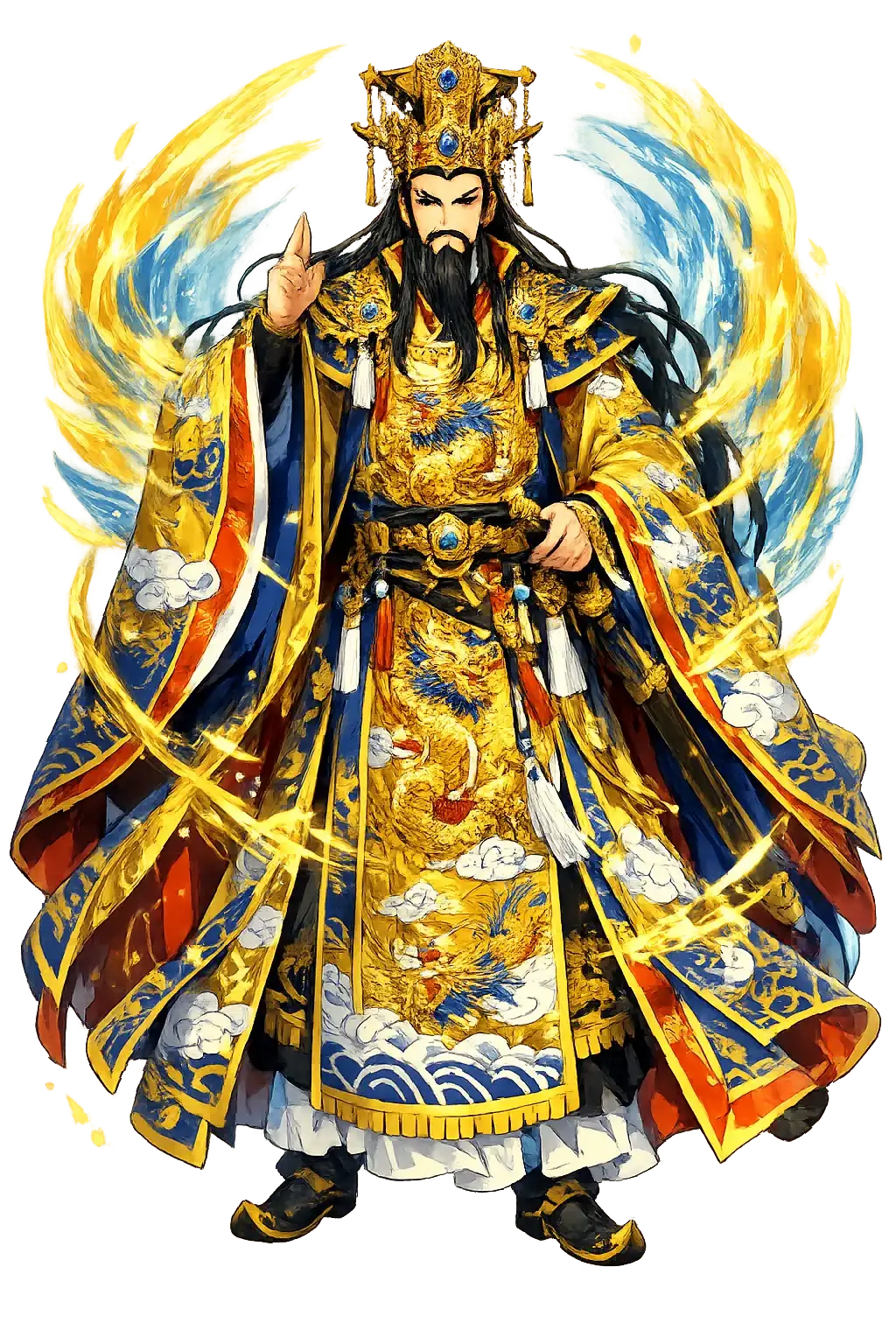
Tiān refused a face. State religion never gave Heaven an anthropomorphic cult statue — at the altar the spirit tablet bore the name, not a body — so Chinese art imaged Heaven by proxy. The oracle-bone graph itself shows a person with an enlarged head, or the dome above; Han tomb ceilings became star-maps, the painted sky of the Bu Qianqiu tomb at Luoyang ringed with sun, moon, and constellations, for Heaven's throne was the still pole around which everything turned. The round jade bi — round like Heaven — was its portable image, paired with the square cong for Earth. Its grandest portrait is architectural: the Hall of Prayer for Good Harvests, a triple-eaved circle of blue tiles on three marble tiers at Beijing — Heaven rendered as geometry, color, and emptiness at the center.

06

Reception & Transformation

The name after its own age — transmission, translation, survival

Afterlives

Tiān's reception is the history of Chinese political thought wearing a theological mask. The Zhou conquest canonized the Mandate in the Shijing and Shangshu; Confucius made Heaven personal again — 'Heaven begot the virtue in me' — while Mozi argued Heaven's will like a lawyer and Xunzi demoted the same Heaven to the ceaseless operations of nature, fixing the tension that ran through every later dynasty. Dong Zhongshu sealed the imperial version, portents serving as Heaven's memoranda to the throne, and Song philosophers relocated Heaven into principle itself, drawing Qing evidential scholars such as Dai Zhen into open rebellion against that displacement. Europe entered the debate with the Jesuits, whose equation of God with the Lord of Heaven collapsed into the Rites Controversy, condemned by Rome in 1704 and finally in 1742, while Legge's nineteenth-century translations carried 'Heaven' into English with all its ambiguity intact. Twentieth-century scholarship — from Creel's studies of the Mandate to Pankenier's cosmo-political readings — now treats the theology as China's founding political theory.

Identifications Across Traditions

Tiān absorbed and was absorbed by later traditions. Confucians spoke of Tiān as moral destiny; Daoists located it within a larger cosmos of qi and the Dao; Chinese Buddhists translated the Sanskrit deva with Tiān. Jesuit missionaries of the late Ming identified the Christian God with Tiānzhǔ 天主, 'Lord of Heaven', sparking centuries of debate about whether Heaven was a personal deity or an impersonal order.

Modern Legacy

The Mandate of Heaven remains one of the most consequential ideas in Chinese political thought, invoked by rebels and regimes alike. The Temple of Heaven in Beijing, a UNESCO World Heritage site, still stands as its architectural signature. Modern Chinese uses Tiān in dozens of compounds—tiānkōng 天空 (sky), tiānqì 天气 (weather), tiānxià 天下 (all under Heaven)—so thoroughly that the word is almost invisible, yet everywhere present.

07

The Meditation

What Tiān means — beyond the dictionary

Tiān asks us to imagine authority without a face. Unlike Olympian gods who quarrel and love, Heaven is a judgement rendered in drought or rain, in the fall of a dynasty or the quiet order of the stars. To meditate on Tiān is to meditate on responsibility: the ruler is answerable not to human contract but to the moral structure of the cosmos itself.

In an age of ecological crisis, Tiān also returns as a reminder that legitimacy is not merely human. A government that fouls the rivers and skies it claims to harmonise with has already, in the old language, lost the Mandate. The sky is still watching.

08

Frequently Asked Questions

Common questions about Tiān, Heaven, Sky, Cosmic Order, and Unicode restoration

01How do you pronounce Tiān?

In reconstructed pronunciation, Tiān is /tʰjɛn˥/ — approximately 'tyehn' — say 't-yeh-n' in one crisp syllable, on a high, level pitch like a sustained musical note.

02What does Tiān mean?

Tiān means The supreme celestial force and moral order of the cosmos in the chinese tradition.

03What are the symbols of Tiān?

Tiān is associated with Azure Dragon (The eastern quadrant of the sky, guardian of spring and imperial auspice.), Jade disk (bi 璧) (Ritual object offered to Heaven, the circular sky matching the square earth.), North celestial pole (The still centre of the turning sky, the astral throne of Tiān.), Sacrificial bull (The highest offering, presented at the border sacrifice to honour Heaven.).

04Why restore Tiān in Unicode?

Plain ASCII tian strips the stress, length, and script that make the name specific. Unicode restoration returns the name to its original written dignity.

05What is the most important myth about Tiān?

“From Shàngdì to Tiān” — the Cosmogony story that anchors the mythology of Tiān, told in full on the lore page.

09

Scholarly Sources

The philological foundations of this restoration

Every claim on this page is grounded in established scholarship. The orthographic restorations follow disciplinary convention. The etymological chain follows the best available reference works. This is not invention — it is resurrection through scholarship.

◈

Lexicography & Philology

  • I Ching
  • Shiji
  • Chinese classics
◎

Primary Texts

  • Primary sources in the chinese tradition for Tiān.
◉

Archaeology & Art History

  • Material evidence — iconography, inscriptions, and temple archaeology — for Tiān and related cults.
✦

Religious Studies

  • Shangshu 尚書 (Book of Documents)
  • Shiji 史記 (Records of the Grand Historian)
  • I Ching / Yijing 易經
  • Analects of Confucius
  • Pankenier, 'The Cosmo-Political Background of Heaven's Mandate'
Return

The Surface Awaits

You have traced the name from its earliest attestation to its Unicode restoration. Now return to the myth. The story is where the name lives.

Back to Lore
Tiān mascot