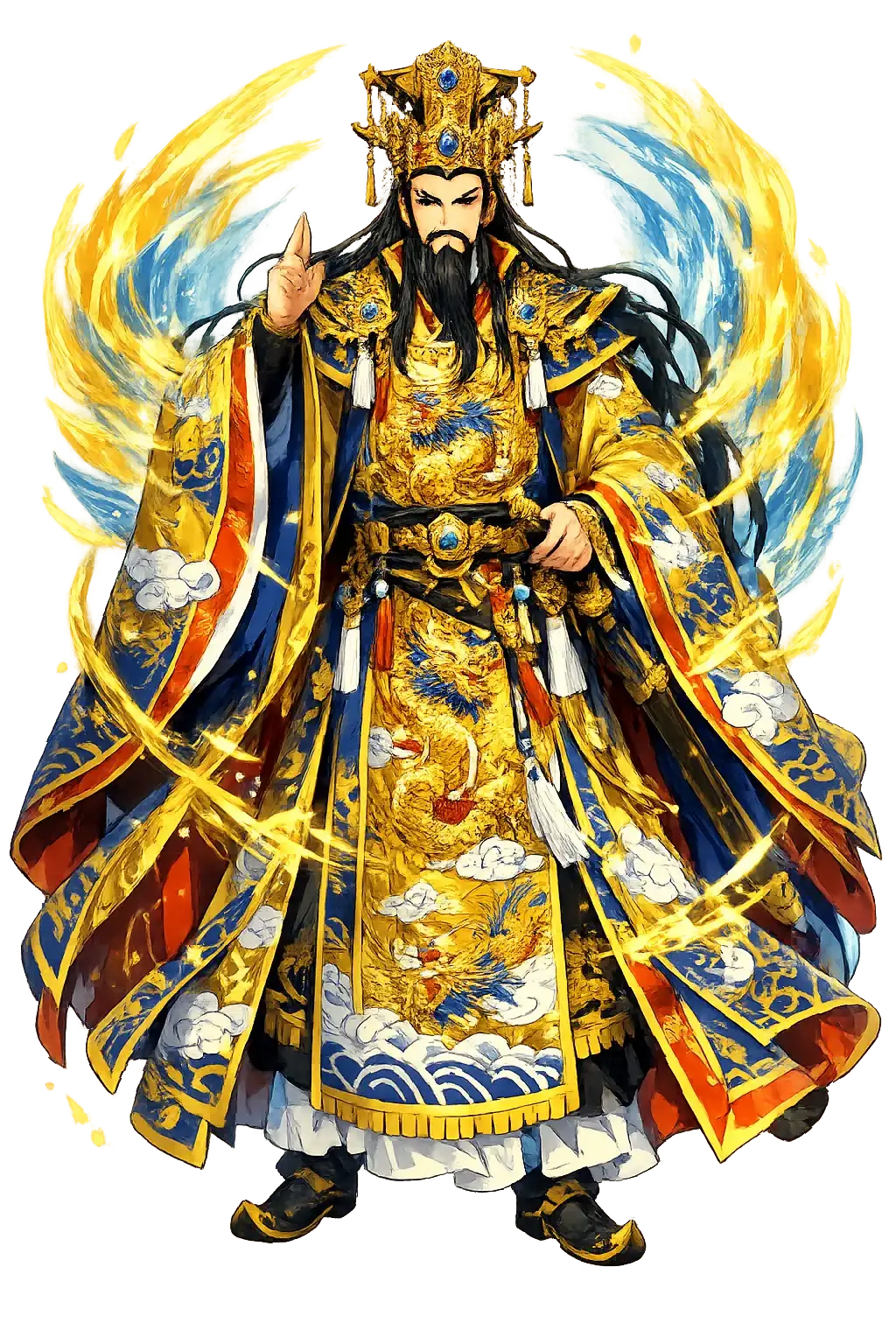
Stories of Tiān
The mythology of Tiān is inseparable from the history of Chinese kingship: less a corpus of tales than a cosmology in which Heaven speaks through weather, eclipse, dynasty, and the virtue of the ruler. Its central text is political — the Mandate of Heaven (tiānmìng 天命), which made every reign a moral verdict.
In Shang times the supreme power was Shàngdì 上帝, the High Lord or high ancestor-deity above, who commanded wind and rain and received the Shang king's sacrifices in person. The oracle bones of Anyang are his archive: diviners cracked turtle shell and ox bone to learn his will on harvest, war, and the royal health. When the Zhou — a western people — overthrew the Shang at Mùyě c. 1046 BCE, they faced a theological problem: how could a lesser house displace the anointed? Their answer, canonized in the Shàngshū 尚書 (Book of Documents) and the Dà Yǎ odes of the Shījīng 詩經, reframed supreme authority as Tiān 天, 'Heaven' — a moral order rather than a clan ancestor. The Zhou king ruled as tiānzǐ 天子, Son of Heaven, because Heaven's Mandate (tiānmìng 天命) had passed from the dissolute Shang.
Victory was thereby rewritten as verdict: Heaven does not favour blood, it favours virtue. The conquest myth of China is a change of pronouns — from 'my ancestor' to 'the sky' — and three millennia of Chinese politics lived inside that change.
The Duke of Zhou, brother of the conquering King Wu and regent for the boy King Cheng, is credited with formulating the Mandate as a check on arbitrary power — the tradition makes the statesman a theologian. When rebellion shook the young dynasty, the Duke's response in the documents preserved in the Shàngshū (the 'Great Announcement' 大誥 and 'Establishment of Government' 立政) is consistent: Heaven's charge is hard to keep, won by the virtue of former kings and lost through drunkenness and cruelty. The Shǐjì 史記 of Sima Qian adds the human drama: the Duke is slandered into exile, and returns only when a great storm uproots the royal grain and the frightened king opens the sealed archive that proves his loyalty beyond doubt.
The story fixed the Mandate's logic for three millennia: Heaven speaks through portent — storm, eclipse, flood, defeat — and portent demands moral repair, not merely ritual repair. No figure in Chinese tradition did more to make the sky a constitutional court.
At the winter solstice the emperor performed the jiàojì 郊祭, the border sacrifice to Heaven, the rite that hinged the imperial year. From the Ming Yongle emperor's rebuilding of Beijing (from 1420) its stage was the Temple of Heaven complex in the southern suburbs: the emperor fasted three days in the Palace of Abstinence, then alone — the one man in the empire permitted to worship Heaven directly — ascended the round, three-tiered Altar of Heaven beneath the open sky, bearing jade bi disks, silk, and a bull. Heaven alone received the sacrifice; the emperor's own ancestors were honoured separately, at the rectangular Imperial Vault. Round altar, square city: the architecture enacted the cosmology of the round sky above the square earth.
The rite's exclusivity was its meaning. Where every subject worshipped through the emperor, the emperor worshipped through no one — and even he approached as a supplicant, barefoot on a night of solstice cold.
The most radical development of the Mandate came from the philosophers. Mozi, in his three 'Will of Heaven' (Tiānzhì 天志) chapters, made Heaven an explicit moral agent that rewards the just and punishes the cruel — and argued that Heaven's will is known through the people's will. Mencius pushed the logic further: asked how Heaven grants the empire, he answers that Heaven gives no audible charge but shows it through deeds and their reception — 'Heaven sees as my people see; Heaven hears as my people hear' (Mèngzǐ 孟子 5A.5). A ruler whose people starve has, whatever the altars say, already lost the Mandate.
The conclusion was incendiary: if Heaven's judgement is legible in the people's condition, then revolt can be obedience — the very argument that legitimated every later dynastic founder from Liu Bang to the Ming Hongwu emperor. Tiān became the supreme court of the Chinese constitution, sitting in the sky and reachable by rebellion.
Cosmic Sovereignty and Moral Order
Tiān 天 is not a creator god in the Western sense. It is Heaven as supreme moral authority: the sky that watches, judges, and withdraws its favour from unworthy kings. From the Shang oracle bones to the Temple of Heaven, Tiān binds political legitimacy to cosmic virtue.
The unmoving axis around which the heavens revolve; Tiān dwells at the northern celestial pivot.
Political legitimacy granted only to virtuous rulers; famine, flood, or defeat signal its loss.
Successor to the Shang supreme deity Shàngdì 上帝, the celestial ancestor who receives royal sacrifice.
The Temple of Heaven in Beijing, where the emperor prayed as the Son of Heaven for cosmic harmony.
From the original script to the living URL
天
The name in its original Chinese form. Tiān (天) is attested in the source tradition — “The supreme celestial force and moral order of the cosmos”. Its macron-length vowels carry the full phonetic and orthographic weight of the source tradition.
tian
Reduced to plain tian, the name loses everything that made it specific: macron-length vowels. What remains is an ASCII string that machines can parse but that no longer speaks with its original voice.
Tiān
The Unicode restoration recovers what ASCII flattened. Tiān restores macron-length vowels, returning the name to its original written dignity. The domain encodes to Punycode, but the browser displays the truth.
Tiān.com → xn--tin-2oa.com
The non-ASCII characters in Tiān are encoded while the ASCII remains visible. To the DNS, it is Punycode. To humanity, it is Tiān.
Owned, ideal, and ASCII forms of Tiān
Tiān
Restores 天. The live temple domain — tiān.com.
tian
Flattens 天. The plain ASCII fallback — what DNS and legacy systems see.
How Tiān was spoken
How Tiān is preserved in writing
A bespoke provenance study for Tiān is being prepared by the PUNICODEX scholarly team.
Contribute scholarly provenance →The lore you have read is the living myth. Extended Lore opens the scholarly vault beneath it: the cult and its material remains, a history of the image, the name after antiquity, a meditation on what the name still means, and the full scholarly apparatus — etymology, orthography, sources.
Enter Extended Lore