
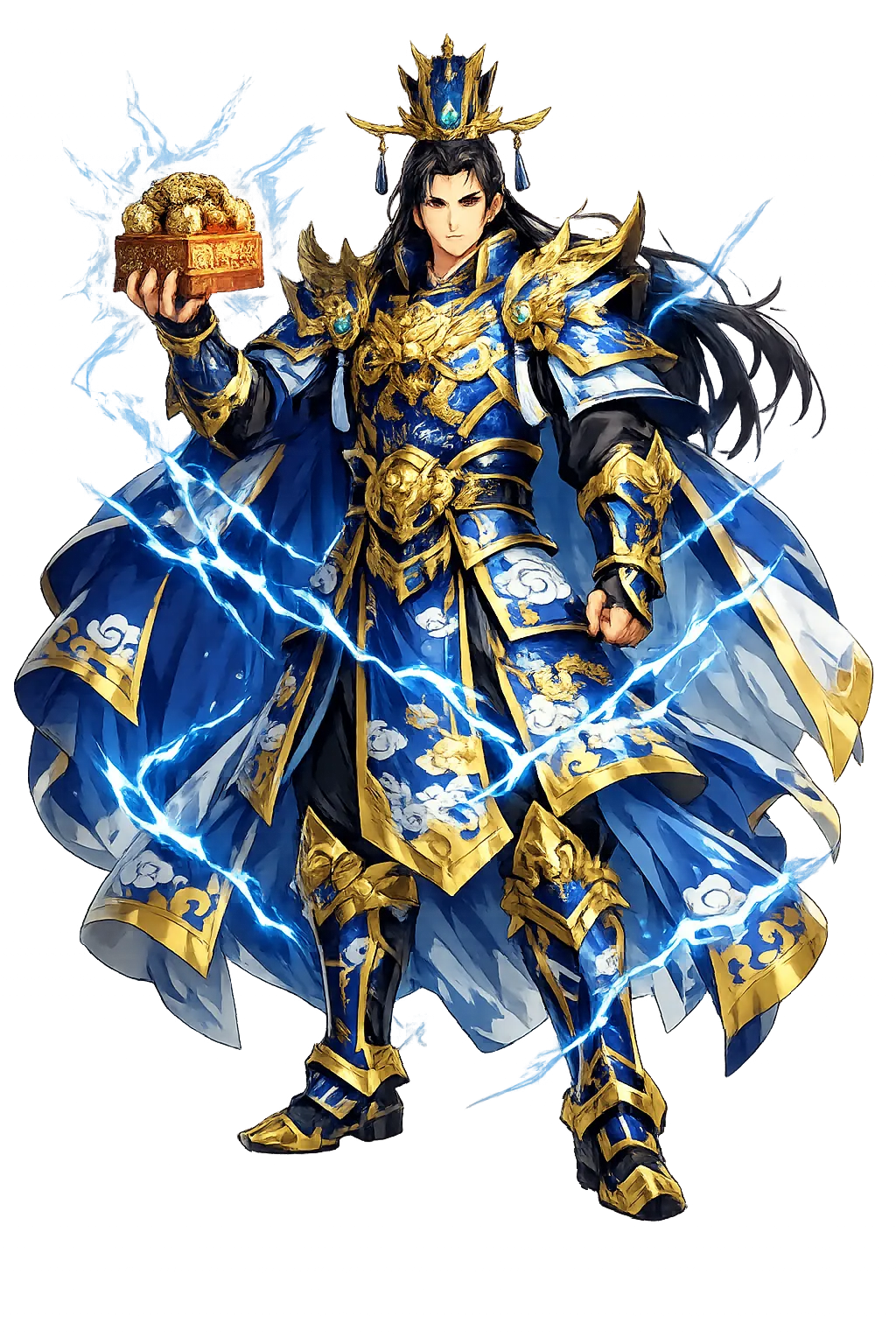
How Tiāndì was rebuilt, mark by mark
Bench notes, Tiāndì: what we found, what we rejected, and what we finally set down. Kept in the open, because a restoration you cannot audit is just a spelling with confidence.
What We Found
The attestation, as Yijing, Xici zhuan (Great Commentary) and Laozi, Daodejing ch. 42 preserve it: 天地. Meaning: "Heaven and Earth; the natural order of the cosmos".
The figure behind the name: Tiāndì is not a mythic protagonist but the setting within which Chinese myths unfold.
What the Name Carried In
Pangu Separates Heaven and Earth. The earliest full telling of Pangu's story survives in fragments of Xu Zheng's Sanwu liji (三五曆記, Records of the Three and Five, Three Kingdoms period, 3rd century CE), quoted in later encyclopedias, with a parallel in his Wuyun linian ji. In the beginning, heaven and earth were one chaos, like an egg, and inside it Pangu slept and grew for eighteen thousand years.
The Son of Heaven at the Altars. Shang dynasty oracle bones already record sacrifice to Dì, the high lord who governed harvest and victory; the Zhou recast him as Tiān, Heaven, whose Mandate (Tiānmìng) passed to rulers who governed rightly and withdrew from those who did not — the doctrine thundered in the Great Declaration chapters of the Shujing. The Liji and later ritual codices organized the response: the emperor, Son of Heaven (Tiānzǐ), sacrificed to Heaven at the winter solstice and to Earth at the summer solstice, in round and square enclosures at the southern and northern suburbs.
A spelling that has to carry stories like these is not a label. It is equipment.
Where It Stood Before Us
The cult of Heaven and Earth is materialized in China's imperial ritual landscape, above all the Temple of Heaven (Tiāntán) and the Altar of Earth (Dìtán) in Beijing, rebuilt under Yongle (1406–1420) on Ming cosmological principles — round for heaven, square for earth, blue glaze for the sky, yellow for the soil. Oracle-bone inscriptions from the Shang dynasty record sacrifices to Dì, the high lord of harvest and victory, and Zhou bronze inscriptions consolidate the dyad of Tiāndì as the foundation of political legitimacy. Han stone reliefs and Mawangdui silk paintings map the cosmography the rites addressed — heaven round above, earth square below, the human world set precisely between. The bench inherits all of it — the web temple is the newest site, not the first.
What We Kept
The evidence, mark by mark — 2 features the keyboard form tiandi cannot hold:
- a → ā — Macron: first tone. Kept.
- i → ì — Grave: fourth tone. Kept.
What We Rejected
Any form invented for availability. The rule on the bench: if the evidence does not carry it, the domain does not get it — whatever the registrar has in stock.
What We Set Down
Tiāndì — Tier-1 is not a compliment; it is a measurement. This restoration keeps something the ASCII form provably loses, and the measurement is repeatable.
For the voice: tYEHN-DEE — 'tian' high and level, like a held note; 'di' sharp and falling, like a command.
The temple stands at /tiandi/ — the notes above are public in its Scholarly Edition, sources and all.
At a Glance
- Restored name: Tiāndì
- ASCII form: tiandi
- Meaning: "Heaven and Earth; the natural order of the cosmos"
- Domain of influence: Cosmology, Heaven and Earth, Order
- Pantheon: Chinese
- Classification: Tier 1
- Original script: 天地
- Series: The Restoration Files, No. 489 of 546
The File Continues
The temple's founding dispatch tells the name's story; its Resonance File reads the myths into the industries; the blog index holds the whole archive.
Continue the series — previous file: Tiān (read it here) · next file: Tjinimin (read it here).
The Restoration Files are written from the same canonical record as the temples themselves: the lexicon, the lore catalog, the pattern atlas, and the cited scholarly sources. If a file ever disagrees with its temple, the temple is right — tell us, and the file will be corrected.