PuniCodex

Extended Lore

𒀭𒋾𒊩𒆳 Tiāmat

Etymology · Orthography · Cult · Iconography · Reception · Sources

Tier 1 Tiāmat.com
Tiāmat — Phonological Reconstruction, Salt Water, Chaos
01

Quick Facts

Essential information about Tiāmat, Phonological Reconstruction, Salt Water, Chaos

Original Script𒀭𒋾𒊩𒆳
Unicode RestorationTiāmat
Reconstructed Pronunciation/tiˈaːmat/
PantheonMesopotamian
DomainPhonological Reconstruction, Salt Water, Chaos
MeaningSea
ClassificationTier 1
Primary DomainTiāmat.com
Sacred SymbolsSalt water, Dragon body, Monster army, The Tablet of Destinies
02

Etymology & Word Family

From original script to Unicode restoration

Original Script 𒀭𒋾𒊩𒆳 Tiāmat — "Sea"
Unicode Restoration Tiāmat Restored stress, length, and script
Modern ASCII tiamat Plain-ASCII fallback

The name Tiāmat carries the orthographic signature of the mesopotamian tradition: 𒀭𒋾𒊩𒆳. Unicode restoration recovers what ASCII flattens.

03

Unicode Character Breakdown

Character-by-character philological analysis

CharacterUnicodeNameBlockPhonetic Role
TU+0054Latin Capital Letter TBasic LatinSame, capitalized
iU+0069Latin Small Letter IBasic LatinSame
āU+0101Latin Small Letter A with MacronLatin Extended-ALong vowel
mU+006DLatin Small Letter MBasic LatinSame
aU+0061Latin Small Letter ABasic LatinSame
tU+0074Latin Small Letter TBasic LatinSame

The Tier 1 classification reflects how much of the original phonology this restoration preserves — stress and vowel length for Greek names, distinctive letters and diacritics for every other tradition.

04

Cult & Worship

How the sacred was kept — rites, sanctuaries, remains

The Cult

No one ever sacrificed to Tiāmat. No temple, altar, festival or priesthood bearing her name is attested anywhere in the cuneiform record: the primordial sea was a theological figure, constructed and contemplated by the scholar-priests of Babylon rather than worshipped by the populace. Her nearest approach to a liturgy was the annual recitation of the Enuma Elish at the Akitu New Year festival, when Marduk's combat and creation were performed before the city. Lexical lists and god lists register her as Apsû's consort and the gods' ancestress, while diviners kept her name alive in the ordinary vocabulary of salt water, tiāmtu. The cultic world otherwise passed her by: cities built their temples to Marduk, who conquered her, not to the mother he conquered. Any worship of Tiāmat is modern — a devotional current of the twentieth and twenty-first centuries without ancient warrant, however moving its reclaiming of the defeated mother.

In the Earth

Archaeological evidence for Tiāmat centers on cuneiform copies of the Enuma Elish from Nineveh, Sippar, Babylon, and Assur, where the myth of Marduk's defeat of Tiāmat was recited at the New Year (Akitu) festival. The Babylonian Esagila temple and its ziggurat Etemenanki embodied the cosmic order established by Marduk's victory. Representations of chaos dragons and composite monsters in glazed bricks, cylinder seals, and reliefs — notably from the Ishtar Gate at Babylon — give visual form to the creatures born from Tiāmat's body.

05

Iconography

How Tiāmat was imaged across the ages

The Image

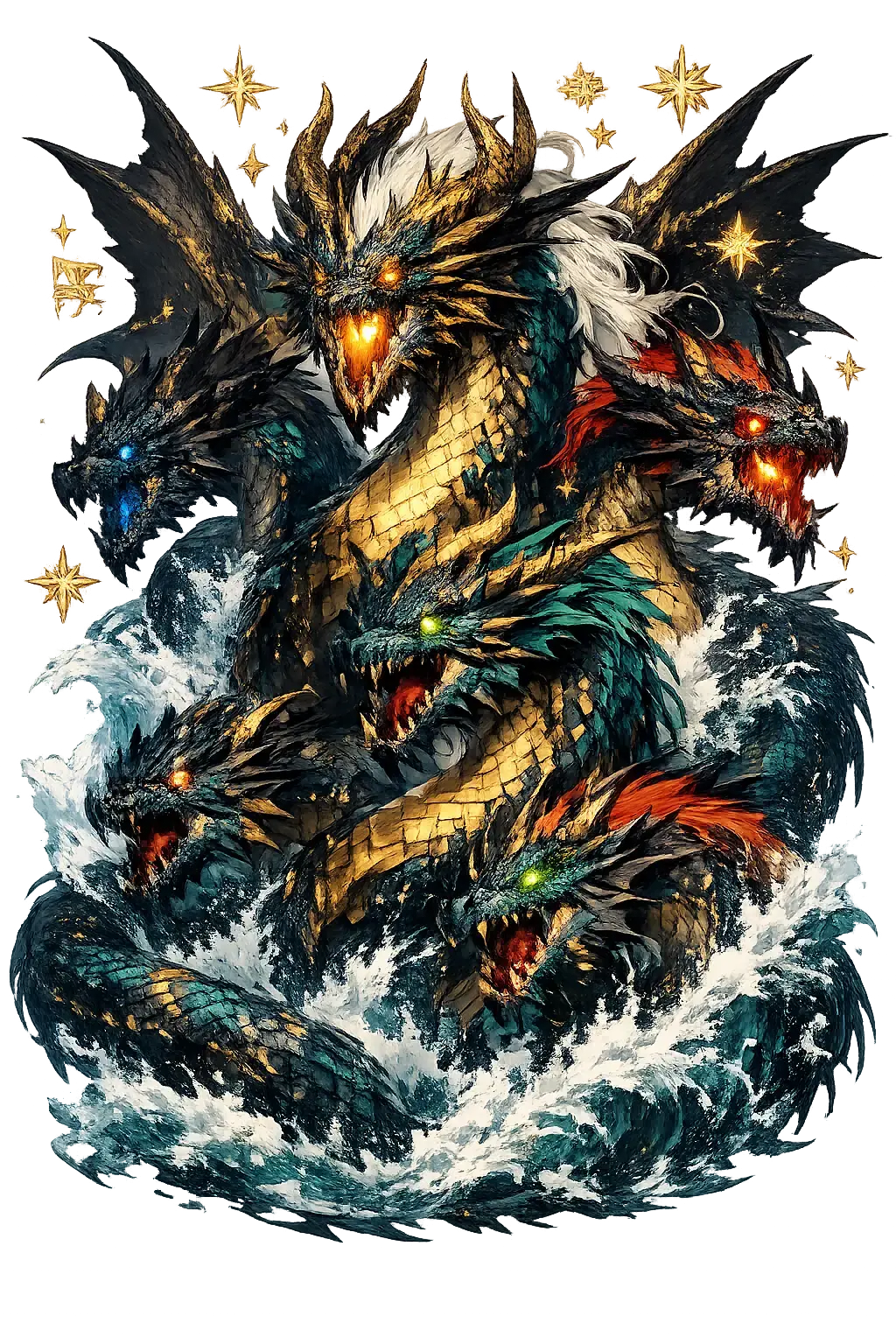
No ancient image of Tiāmat survives, and probably none ever existed: she was the sea, and the sea needs no statue. The visual tradition speaks instead in monsters. Already in the Akkadian period, cylinder seals show a god wielding lightning against a horned, serpentine dragon — the combat of storm and chaos rendered a thousand years before our earliest copy of the Enuma Elish, and plausibly the poem's deep visual ancestry. First-millennium art gave chaos a heraldic body: the mušḫuššu dragon sacred to Marduk coils across the glazed-brick Ishtar Gate at Babylon, now in Berlin, with lions and composite beasts prowling the same walls as the forces the storm-god must master. The scaled, horned, winged body of the goddess herself is a modern reconstruction, projected backward from the poem's dragon-form. What antiquity imaged was the fight, not the mother: chaos as a presence to be confronted, never a portrait to be venerated.

06

Reception & Transformation

The name after its own age — transmission, translation, survival

Afterlives

For two millennia the Enuma Elish lay silenced with the death of cuneiform — the script unread, the name forgotten — until nineteenth-century excavation reopened it. Tablets from Ashurbanipal's library at Nineveh reached the British Museum through Layard's and Rassam's excavations, and in 1872 George Smith electrified the Society of Biblical Archaeology by announcing Babylonian creation and flood tablets older than Genesis; the press sent him back to Nineveh, and his Chaldean Account of Genesis (1876) carried the epic to the public. Successive generations rebuilt the text — fragment joins from Sippar, Babylon and Assur filled the gaps, and modern readers rely on the translations of Speiser, Jacobsen, Dalley and Foster, crowned by W. G. Lambert's critical edition of 2013. Through Berossus, whose third-century BCE Babyloniaca carried a Greek digest of the combat, a shadow of the myth had already reached Hellenistic readers. The poem's true afterlife, though, is the scholarly one: the founding exhibit of Assyriology, whose Genesis parallels have been debated from 1872 to the present — creation by combat proving older than the monotheistic telling that seemed to mirror it.

Identifications Across Traditions

Tiāmat's influence radiates across ancient Near Eastern and later mythologies.

The Unicode form Tiāmat is a reconstruction node: standard Assyriology writes Tiamat or Tiāmat, and the macron makes visible the open question of first-vowel length. In the Hebrew Bible, the primordial tĕhôm ('deep') of Genesis 1:2 likely preserves a memory of Tiāmat, now depersonified into the watery chaos that precedes God's ordering word. Greek sources knew the Babylonian chaos dragon through Berossus; later Jewish and Christian apocalyptic literature reimagined her as Leviathan, Rahab, and the great red dragon of Revelation. In modern fantasy, games, and occult cosmology, Tiamat survives as the five-headed dragon queen and as a symbol of primordial feminine chaos suppressed by patriarchal order.

Modern Legacy

The image of a cosmic sea-monster split to create the world has never lost its power.

It appears in biblical creation hymns that depict God dividing the sea and crushing Leviathan (Psalm 74, Psalm 89, Job 26), in medieval maps that place dragons at the edges of the known world, and in modern geology's recognition that Earth's water and land are products of ancient cataclysms. Tiamat has become an icon of feminist theology and eco-spirituality: the primordial mother whose defeat by a storm-god encodes the violence of order against nature. PuniCodex keeps the macron not as a settled fact but as an invitation: every visitor is welcome into the philological conversation about how this name — and the chaos it names — was pronounced.

07

The Meditation

What Tiāmat means — beyond the dictionary

Tiāmat is the rare monster who is also a mother, and the myth never lets us forget it. Every generation of the gods is born from her mingling with Apsû; the cosmos itself is reassembled from her corpse. To call her 'chaos' and stop there is to read the victor's history: Marduk's triumph is a matricide, and the ordered world rests on the body of the parent who refused, at first, to let her children be killed. The myth asks its Babylonian hearers — and us — what order costs, and whose body pays for it. The restoration Tiāmat, with its visible macron, keeps the question alive at the level of the word itself: even her name, we confess, is a reconstruction; even the mother of everything must be approached through inference, humility and evidence.

08

Frequently Asked Questions

Common questions about Tiāmat, Phonological Reconstruction, Salt Water, Chaos, and Unicode restoration

01How do you pronounce Tiāmat?

In reconstructed pronunciation, Tiāmat is /tiˈaːmat/ — approximately 'tee-AH-maht' — stress the long second syllable and let it open like a calm sea before the final consonants close it.

02What does Tiāmat mean?

Tiāmat means Sea in the mesopotamian tradition.

03What are the symbols of Tiāmat?

Tiāmat is associated with Salt water (The primordial sea and the uncontained chaos that precedes creation), Dragon body (The cosmic form that becomes heaven and earth when split by Marduk), Monster army (The forces of chaos mobilized against the younger gods), The Tablet of Destinies (The tablet of supreme command that Tiāmat fastened on Kingu's breast; Marduk tears it from him and with it legitimates his own kingship — the power of order inherited from chaos).

04Why restore Tiāmat in Unicode?

Plain ASCII tiamat strips the stress, length, and script that make the name specific. Unicode restoration returns the name to its original written dignity.

05What is the most important myth about Tiāmat?

“The Salt-Water Mother” — the Cosmogony story that anchors the mythology of Tiāmat, told in full on the lore page.

09

Scholarly Sources

The philological foundations of this restoration

Every claim on this page is grounded in established scholarship. The orthographic restorations follow disciplinary convention. The etymological chain follows the best available reference works. This is not invention — it is resurrection through scholarship.

◈

Lexicography & Philology

  • Black-Green
◎

Primary Texts

  • Enuma Elish
  • Enuma Elish (tablets I–V)
◉

Archaeology & Art History

  • Material evidence — iconography, inscriptions, and temple archaeology — for Tiāmat and related cults.
✦

Religious Studies

  • CAD (Chicago Assyrian Dictionary), s.v. tiāmtu
  • Dalley, Myths from Mesopotamia
  • Jacobsen, The Treasures of Darkness
  • Foster, Before the Muses
Return

The Surface Awaits

You have traced the name from its earliest attestation to its Unicode restoration. Now return to the myth. The story is where the name lives.

Back to Lore
Tiāmat mascot