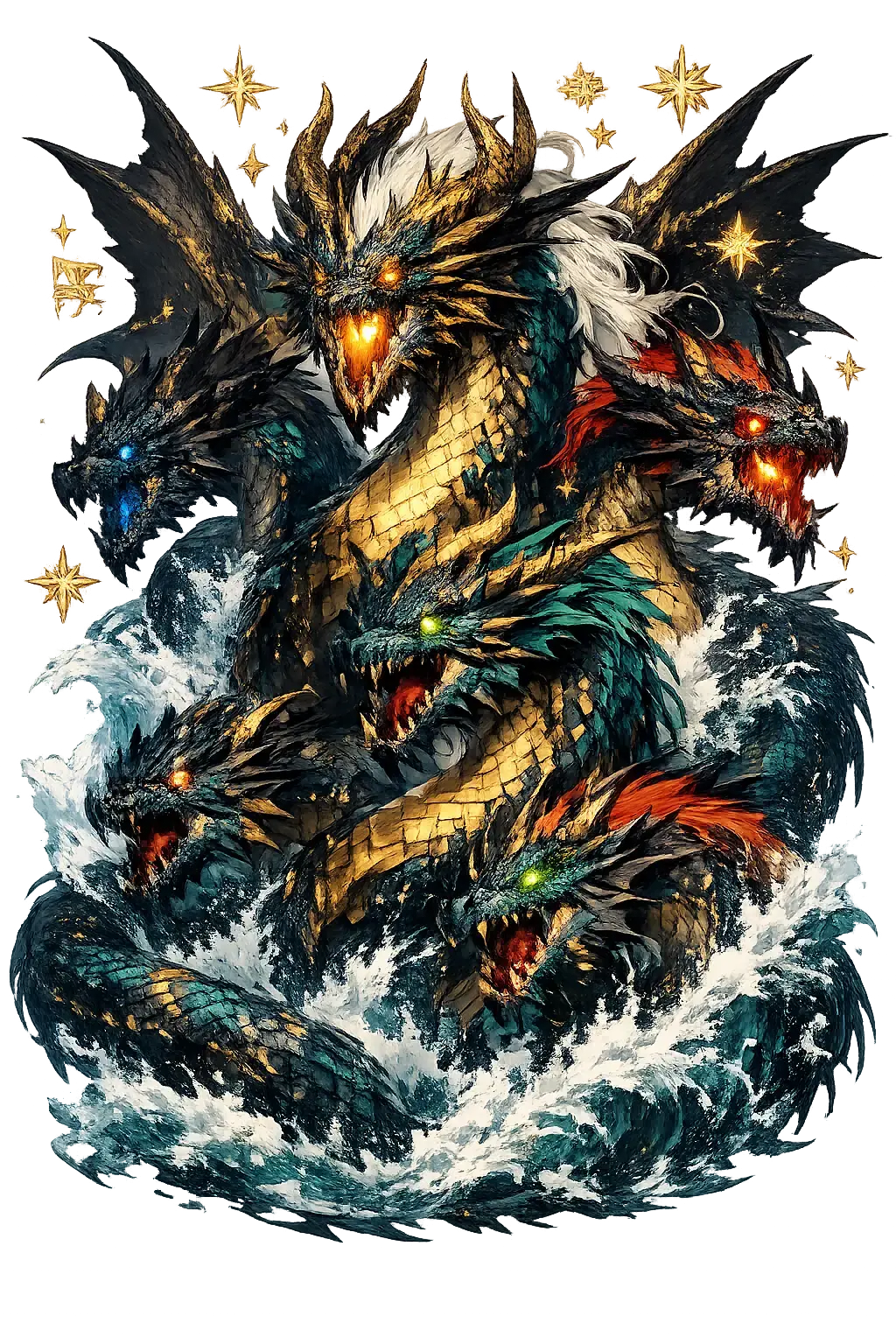
Stories of Tiāmat
Tiāmat is the Babylonian primordial salt sea — the churning watery chaos from whom the gods are born and against whom order must be asserted. In the Enuma Elish she is first the generative mother of the divine generations, then the dragon-mother of monsters, and finally the cosmic body out of which Marduk fashions heaven and earth. She is not merely a sea; she is the possibility of both creation and destruction that precedes form.
Before the gods existed there was no heaven and no earth, only Apsû, the freshwater abyss, and Tiāmat, the salt sea, 'their waters mingled as a single body' (Enuma Elish I.1–20). From their mingling the divine generations rose like silt from a river's meeting: first Lahmu and Lahamu, then Anshar and Kishar, then the sky-god Anu, and finally Ea, the wisest of all. Tiāmat is therefore the primordial matrix — the saline womb in which the cosmos gestates before anything has shape. Where Apsû is stillness, depth and the desire for quiet, Tiāmat is movement, breadth and the uncontained; when the younger gods are born, it is Apsû who wants them silenced and Tiāmat who refuses. The opening tablet means that creation begins as a marriage of waters, and that the mother of the gods is the one parent who did not want them dead.
When the younger gods' noise disturbed Apsû's rest, he resolved to destroy them — and Tiāmat alone said no (Enuma Elish I.44–59). Ea struck first: he cast the slumber-spell on Apsû, slew him, and built his own house upon the corpse of the abyss. But the victory turned the mother. Enraged and grieving, Tiāmat 'screamed aloud, furiously, day and night without ceasing' (II.89), and began the work of vengeance: she bred a monstrous army — serpents with venom for blood, dragons wearing haloes of flame, the bull-man, the scorpion-man, the storm-demons — and over them she set Kingu, her new consort, fastening on his breast the Tablet of Destinies (III.121–128). When the terrified gods could find no champion, Tiāmat had become what she had never been: not the womb of the gods but their executioner. The tablet means that chaos is not wickedness by nature — it is grief organized.
Marduk of Babylon accepted the challenge on one condition: that the assembly grant him supreme kingship, so that his word would bind the gods as Tiāmat's once had (Enuma Elish IV.3–26). Armed with the winds, the hurricane, the whirlwind and the seven winds, he rode out against her; when she opened her mouth to swallow him whole, Marduk loosed the evil wind to hold it open, drove in an arrow that pierced her heart, and 'extinguished her life' (IV.95–104). Then he stood upon the corpse and split it 'like a shellfish into two parts': half he raised up as the sky, half he laid down as the earth. The duel's meaning is doubled and uncomfortable. It is the charter of Babylon's empire — the city-god making cosmos out of chaos — and it is also the matricide at the root of the world: every ordered thing that exists, including the throne of Marduk, stands on the body of the mother.
Tiāmat's body became the inventory of the world. From her eyes Marduk made the sources of the Tigris and Euphrates; from her breasts he raised the mountains, boring springs in them to feed the rivers; from her tail he twisted the Durmāḫ, the 'great bond', to fasten heaven and earth together (V.51–66); her spit he made into the clouds, her foam into the winds and the thunderhead. Then he set the stars, the moon and the calendar in the sky-half, and assigned the gods their stations — the entire civilized cosmos laid out like an estate upon a corpse (Enuma Elish V). The tablet does not celebrate an annihilation; it records an ordering. The chaotic sea is not destroyed but reassembled — every city, mountain and river rests upon the body of the primordial salt-water mother. The myth means that chaos was not the enemy of creation but its material, and the world has never stopped being her body.
Salt Water · Chaos Dragon · Cosmic Matrix
The name is written 𒀭𒋾𒀀𒈲𒌈. Standard Assyriology transliterates it as Tiamat or Tiāmat, from Akkadian tiāmtu, 'sea'. But the length of the first vowel — the very mark that turns Tiamat into Tiāmat — remains a reconstruction, not a sign-given fact. It is here, in the space between the cuneiform sign and the spoken sound, that this temple operates. This node of PuniCodex is dedicated to the phonological reconstruction and didactic grammar of the ancient Near East. We mark vowel length not because it is certain, but because it is discussable. The macron is a question mark made visible.
Tiāmat is nevertheless the salt-water chaos mother of Babylonian cosmogony — the primordial sea whose mingling with Apsû's fresh abyss produces the gods, and whose defeated body becomes the sky and earth. She is the contradiction at the heart of creation: the mother who must be overcome for the world to exist.
The primordial tiāmtu, the cosmic salt water that surrounds and underlies the ordered world.
She breeds dragons, serpents, and scorpion-men to avenge Apsû and challenge the younger gods.
Marduk divides her corpse to form heaven, earth, rivers, and mountains.
She embodies the formless deep that must be shaped — never simply evil, but the raw material of cosmos.
From the original script to the living URL
𒀭𒋾𒊩𒆳
The name in its original Mesopotamian form. Tiāmat (𒀭𒋾𒊩𒆳) is attested in the source tradition — “Sea”. Its macron-length vowels carry the full phonetic and orthographic weight of the source tradition.
tiamat
Reduced to plain tiamat, the name loses everything that made it specific: macron-length vowels. What remains is an ASCII string that machines can parse but that no longer speaks with its original voice.
Tiāmat
The Unicode restoration recovers what ASCII flattened. Tiāmat restores macron-length vowels, returning the name to its original written dignity. The domain encodes to Punycode, but the browser displays the truth.
Tiāmat.com → xn--timat-gwa.com
The non-ASCII characters in Tiāmat are encoded while the ASCII remains visible. To the DNS, it is Punycode. To humanity, it is Tiāmat.
Owned, ideal, and ASCII forms of Tiāmat
Tiāmat
Restores 𒀭𒋾𒊩𒆳. The live temple domain — tiāmat.com.
tiamat
Flattens 𒀭𒋾𒊩𒆳. The plain ASCII fallback — what DNS and legacy systems see.
How Tiāmat was spoken
How Tiāmat travels from ancient script to the modern URL
Akkadian tiāmtu “sea, ocean"; Tiāmat personifies the primordial salt-water abyss and is the antagonist of Marduk in the Enūma Eliš.
Salt Water, Chaos
The Unicode restoration Tiāmat preserves vowel length; the cuneiform form is not registrable in .com.
The lore you have read is the living myth. Extended Lore opens the scholarly vault beneath it: the cult and its material remains, a history of the image, the name after antiquity, a meditation on what the name still means, and the full scholarly apparatus — etymology, orthography, sources.
Enter Extended Lore