
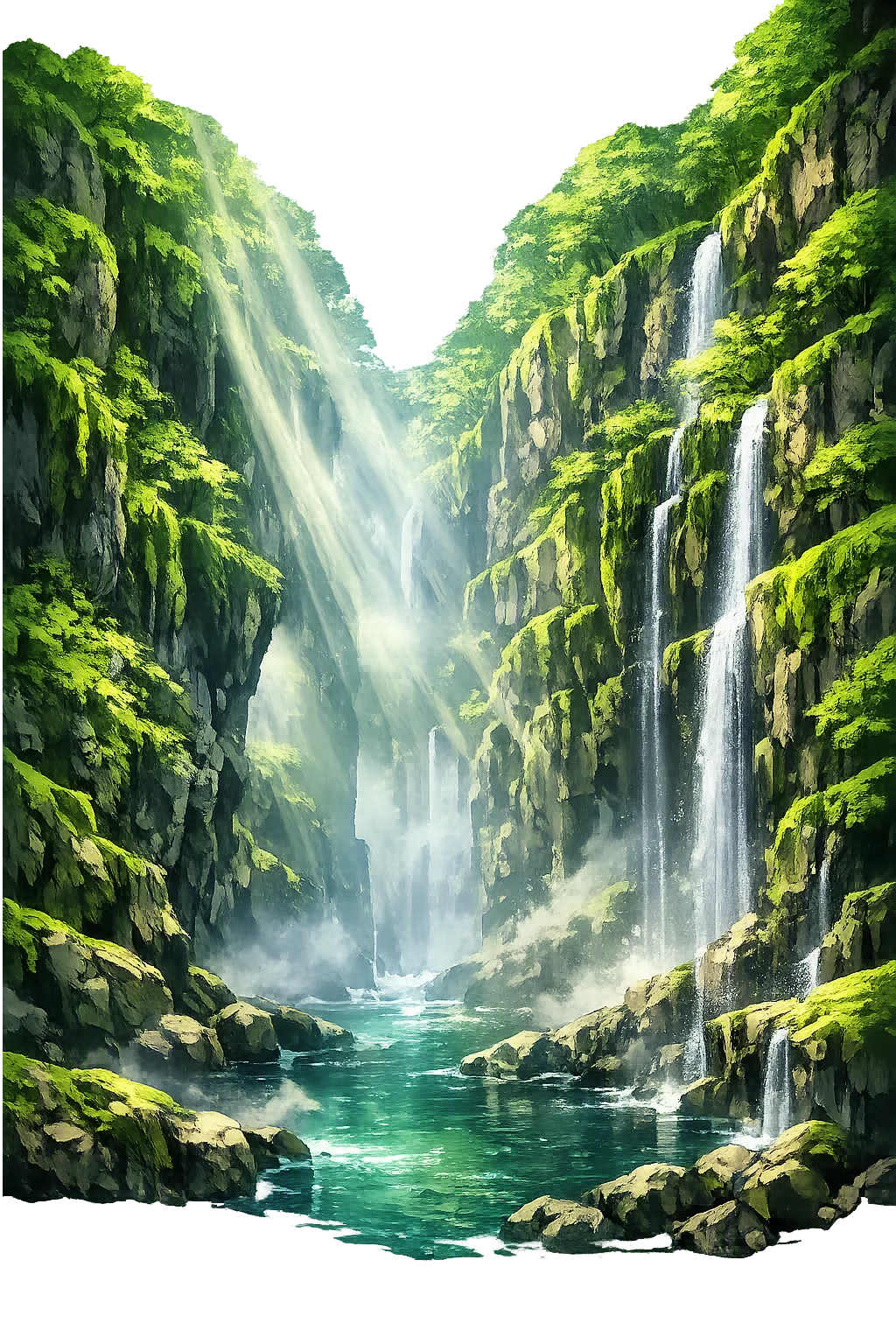
Takachiho: the stories first, then the spelling
You cannot weigh an accent without knowing what it carries. Here is what Takachiho has been carrying.
The Stories That Carry the Name
The Descent at the Peak of Takachiho. The Kojiki and Nihon Shoki agree on the itinerary: when Amaterasu resolved that her grandson Ninigi should rule the visible world, she sent him down from the Plain of High Heaven at the head of a divine escort, bearing the mirror, sword, and curved jewel that became the Three Sacred Regalia. Both texts name the landing place Takachiho no mine — the peak of Takachiho — in the land of Himuka, present-day Miyazaki Prefecture (Kojiki; Nihon Shoki, Age of the Gods). Ninigi wed the blossom-princess Konohanasakuya-hime, and from the line of their son Hoori came the first emperor, Jimmu.
The Cave of Heaven. The classical texts do not say where the Rock Cave of Heaven stood. The Kojiki tells how Amaterasu, frightened by her brother Susanoo's rampage, sealed herself inside Ama-no-Iwato and plunged the world into darkness, until the goddess Uzume's bawdy dance on an overturned tub drew the gods' laughter and lured the sun back out (Kojiki, Age of the Gods). Local tradition in Takachiho locates the cave on the Iwato River gorge, where Ama-no-Iwato Shrine keeps the memory — the sacred rope, the crowing rooster, the mirror hung on the sakaki tree.
The Dance That Reenacts the Dawn. Each year from mid-November to mid-February, the villages around Takachiho perform the yokagura — the night kagura — a cycle of some thirty-three episodes danced from dusk until dawn to make the fields fertile and the year safe. The climactic piece is always the cave: Uzume's dance, the gods' laughter, the sun's return, reenacted with masks and drums by the villages' own performers. The tradition was designated an Important Intangible Folk-Cultural Property of Japan in 1978, and the Takachiho Kagura has become one of the country's most watched winter rituals, with performances staged nightly for visitors at Takachiho Shrine.
And Here Is What the Spelling Preserves
Against those stories, the attestation: 高千穂, as Kojiki, trans. Donald L. Philippi (Princeton University Press, 1968) — the descent of Ninigi and the Rock Cave of Heaven. and Nihon Shoki, trans. W. G. Aston (1896) — the descent at Takachiho no mine in Himuka. record. The name means "High thousand ears".
At a Glance
- Restored name: Takachiho
- ASCII form: takachiho
- Meaning: "High thousand ears"
- Domain of influence: Sacred Gorge, Descent of Gods
- Pantheon: Japanese
- Classification: Tier 2
- Original script: 高千穂
- Series: The Restoration Files, No. 474 of 548
The Name Travels
Takachiho is a palimpsest of Japanese religious history. The descent myth is imperial and Shinto in its present form, yet the mountain district long lay within the world of Shugendō ascetics, who trained among its peaks and gorges; the cave shrine and the kagura coexist with Buddhist-founded institutions in the town.
The Address It Earned
The temple of Takachiho stands at /takachiho/ — lore, scholars, patterns — because a name carrying this much story deserves more than a parking page. Tier-2 here means one preserved truth — not less important, just singular. The temple shows it and names it.
The Sources Are Open
The myths above are retold from the temple's record; the primary voices are in the Sacred Texts: Kojiki and Nihon Shoki. Nothing in this file outranks them.
The File Continues
Read the founding dispatch for the name's full story, the Resonance File for the archetype at work — or the whole archive in one sitting.
Continue the series — previous file: Tajikarao (read it here) · next file: Taliesin (read it here).
The Restoration Files are written from the same canonical record as the temples themselves: the lexicon, the lore catalog, the pattern atlas, and the cited scholarly sources. If a file ever disagrees with its temple, the temple is right — tell us, and the file will be corrected.