PuniCodex

Extended Lore

Takachiho — The Deeper Record

Etymology · Orthography · Cult · Iconography · Reception · Sources

ASCII-equivalent form Takachiho
Takachiho — Sacred Gorge, Descent of Gods
01

At a Glance

Takachiho — every fact links to its home

PantheonJapanese
DomainSacred Gorge, Descent of Gods
Original Script高千穂 →
Primary Sources4 cited →
02

Etymology & Word Family

From original script to canonical restoration — the full etymology page →

Original Script 高千穂 Takachiho — "High thousand ears"
Canonical Restoration Takachiho Canonical scholarly spelling — ASCII-identical
Modern ASCII takachiho Plain-ASCII fallback

The name Takachiho reaches the modern world through scholarly transliteration of the japanese tradition. Because the conventional spelling uses only Latin letters, its canonical and ASCII forms coincide — the tradition it carries is in the name itself, not in diacritics.

03

Character breakdown

Character-by-character philological analysis

CharacterUnicodeNameBlockPhonetic Role
TU+0054Latin Capital Letter TBasic LatinSame, capitalized
aU+0061Latin Small Letter ABasic LatinSame
kU+006BLatin Small Letter KBasic LatinSame
aU+0061Latin Small Letter ABasic LatinSame
cU+0063Latin Small Letter CBasic LatinSame
hU+0068Latin Small Letter HBasic LatinSame
iU+0069Latin Small Letter IBasic LatinSame
hU+0068Latin Small Letter HBasic LatinSame
oU+006FLatin Small Letter OBasic LatinSame

This restoration reflects fidelity to the attested tradition, not recovered diacritics: every character of Takachiho already survives in ASCII. What the restoration preserves is the canonical spelling itself — the form scholarship standardised.

04

Cult & Worship

How the sacred was kept — rites, sanctuaries, remains

The Cult

Takachiho has been a working cult landscape for well over a millennium. Two sanctuaries anchor the town: Takachiho Jinja, standing among venerable cryptomeria at its heart, serves the local community year-round, while Amano-Iwato Jinja guards the cave gorge upriver, where the Rock Cave of Heaven is said to have opened. The cult's great engine is kagura. From November to February the villages of the district stage yokagura — all-night masked dance-dramas replaying the cave myth and the descent of Ninigi — a cycle designated an Important Intangible Folk-Cultural Property in 1978. The ritual year turns at the shrine festivals, and in the quiet devotion of visitors who stack small stone cairns in the riverbed at Amano Yasugawara, one stone for each petition.

In the Earth

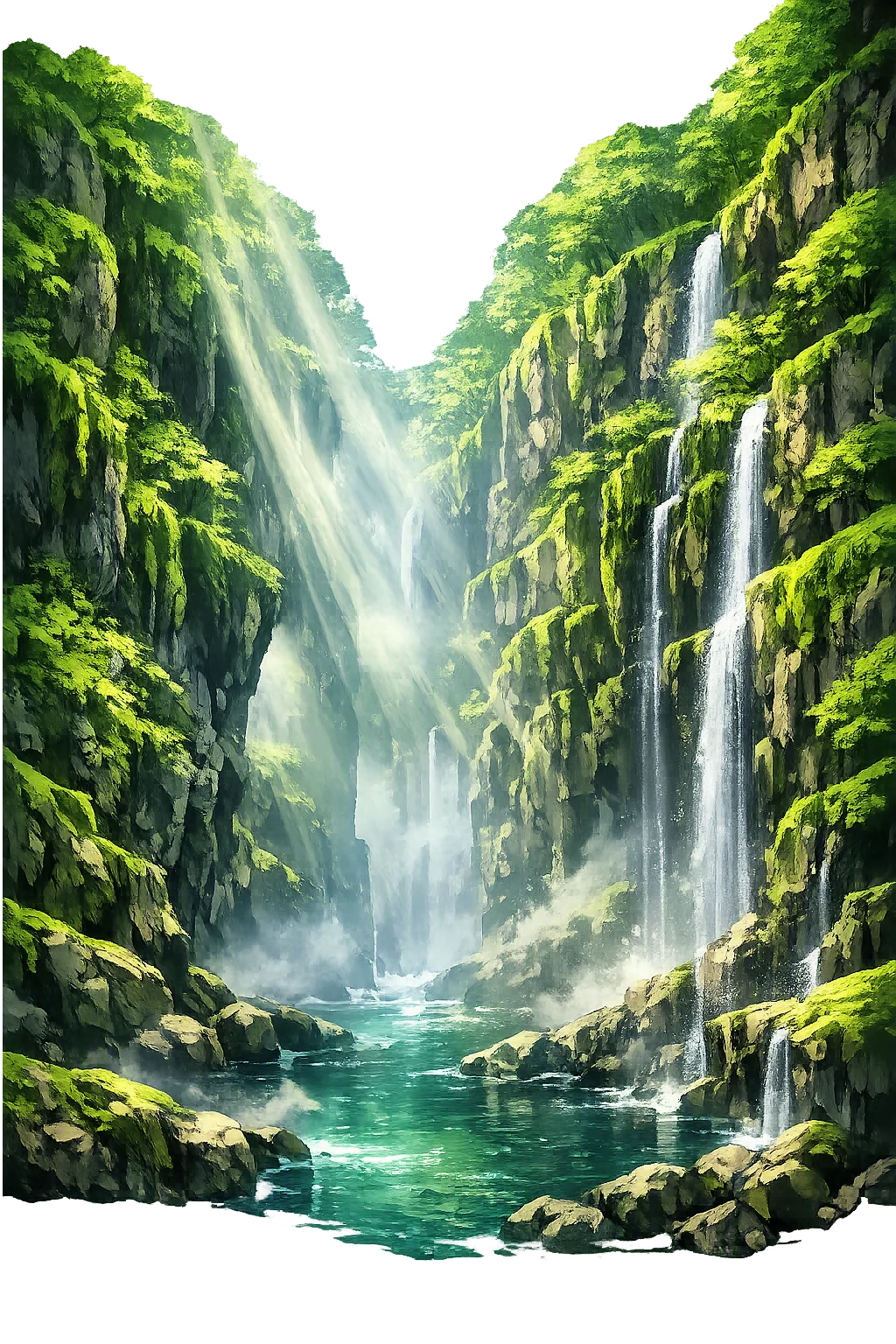
Takachiho Gorge is a volcanic landscape formed by the eruptions of Mount Aso, which filled the old river valley with basalt; the Gokase River cut back down through it, leaving the columned walls and the seventeen-metre Manai Falls. The town's ritual architecture records the myth it performs: Ama-no-Iwato Shrine, at the head of the Iwato River gorge, keeps the cave precinct with its sacred rope and sakaki; Takachiho Shrine anchors the town's central cult; and each village preserves a kagura-den (kagura hall) or designated performance ground where the night dances are staged from November to February. The shrine buildings are Edo-period and later reconstructions in the standard style, but the performance spaces, the gorge paths, and the falls themselves are the primary 'site' — a landscape whose geology and whose mythology tell the same story of something vast coming down.

05

Iconography

How Takachiho was imaged across the ages

The Image

Takachiho is imaged less by statues than by a landscape and a cast of masks. The gorge's columnar basalt and the Manai Falls serve as natural icons — a wall of heaven, a rope of falling light — while the cave shrine hides its sanctum behind fence and sacred rope, so that the deity's house is precisely what cannot be seen. The human face of the myth lives in the carved wooden kagura masks of Susanoo, Amaterasu, and Uzume, donned in the night dances; the Amaterasu mask is honoured as the goddess's temporary body. No ancient figural image of the place survives. From Meiji times onward, photography and print fixed the gorge-and-waterfall view as the town's portrait, and so it remains: a town whose icon is a photograph of itself.

06

Reception & Transformation

The name after its own age — transmission, translation, survival

Afterlives

The name enters writing at the head of Japan's history: the Kojiki (712) and Nihon Shoki (720) set the descent of Ninigi at the peak of Takachiho in the land of Himuka, and every age since has re-read that sentence. Medieval readers folded the sacred mountain into itineraries of practice, and the valley's mountain ascetics made its heights a training ground. Edo-period antiquarians listed the town among Japan's sacred geography; in the Meiji decades the descent narrative pulled Takachiho into the orbit of emperor-centred nationalism, and the state enrolled its shrines in the modern ranked cult system. The twentieth century re-read the valley as folklore: ethnographers documented the yokagura village by village, and the 1978 designation fixed the dances as national heritage. Through Aston's and Philippi's translations the toponym entered Western scholarship, where it now serves as the type-case of a myth that named its own mountain — and of a town that has spent thirteen centuries living inside a sentence of its national scripture.

Identifications Across Traditions

Takachiho is a palimpsest of Japanese religious history. The descent myth is imperial and Shinto in its present form, yet the mountain district long lay within the world of Shugendō ascetics, who trained among its peaks and gorges; the cave shrine and the kagura coexist with Buddhist-founded institutions in the town. In the Meiji period the narrative was pressed into service of emperor-centred nationalism, and the 'descent of the grandson' became a station in the state's cult calendar. After 1945 the town quietly re-centred itself on local folklore: the gorge, the shrine, and the dances became heritage rather than ideology. The result is a characteristically Japanese syncretism in which imperial scripture, mountain asceticism, agricultural ritual, and modern tourism occupy the same valley without apparent strain.

Modern Legacy

Takachiho is one of Kyūshū's signature destinations — the gorge with its rental rowboats beneath the basalt columns, the Manai Falls, and the nightly kagura at the shrine. The town's name has become shorthand in Japan for the moment when myth touches ground: school textbooks repeat the descent, and the phrase 'Takachiho of heaven' echoes through tourism copy and local pride. The winter yokagura, designated an Important Intangible Folk-Cultural Property in 1978, keeps thirty-three villages dancing through the coldest months, and the rice of the district still trades on the 'thousand ears' in the name. For many Japanese visitors, Takachiho is the closest thing to a pilgrimage they will make: a place where the national story can be entered by boat, on foot, and by lamplight.

08

The Original Script Note

What the written record preserves — and what it does not

Original Script

高千穂 — 高 'high' + 千 'thousand' + 穂 'ear of grain' — 'the high place of a thousand rice-ears', an auspicious semantic spelling of the kind place names favor. The Kojiki and Nihon Shoki set Ninigi's descent at the peak of Takachiho in the land of Himuka (Hyūga), and the gorge, shrine, and town of Miyazaki Prefecture still carry the name. The characters preserve a geography that the chronicles deliberately loaded with meaning: here, they say, the grandson of the sun first set foot on earth.

09

The Meditation

What Takachiho means — beyond the dictionary

Takachiho asks what a sacred place actually is. The scriptures mention a peak; the town claims a gorge; the tradition locates a cave nobody can prove was ever the cave. None of this diminishes the place — it is the mechanism by which sacred places always come into being. Myth falls on landscape like seed, and where it takes root the land becomes legible: every cliff is a wall of heaven, every waterfall a rope of light, every winter dance a reenactment of the first dawn. The citation form of the name does the same work at a smaller scale. Takachiho is not an exotic label on a map; it is the exact syllables in which a community has agreed, for over a millennium, to remember that heaven once came this low. To pronounce it correctly is to join the performance.

10

Frequently Asked Questions

Deep-dives into the cult, attestation, reception, and sources of Takachiho

01How do we know how Takachiho was worshipped?

Takachiho Gorge is a volcanic landscape formed by the eruptions of Mount Aso, which filled the old river valley with basalt; the Gokase River cut back down through it, leaving the columned walls and the seventeen-metre Manai Falls. The full cult record →

02Where do the earliest attestations of Takachiho come from?

The record rests on Kojiki, trans. Donald L. Philippi (Princeton University Press, 1968) — the descent of Ninigi and the Rock Cave of Heaven., Nihon Shoki, trans. W. G. Aston (1896) — the descent at Takachiho no mine in Himuka., Bock, Felicia G., Classical Learning and Taoist Practices in Early Japan, with a Translation of Books XVI–XX of the Engi-shiki (University of Arizona Press, 1985) — the ritual frame of kagura performance., among 4 cited works. The full source apparatus →

03How did later traditions reinterpret Takachiho?

The name enters writing at the head of Japan's history: the Kojiki (712) and Nihon Shoki (720) set the descent of Ninigi at the peak of Takachiho in the land of Himuka, and every age since has re-read that sentence. Reception & transformation →

04What do the surviving images of Takachiho actually show?

Takachiho is imaged less by statues than by a landscape and a cast of masks. The iconography →

05What does the written record of Takachiho actually preserve?

高千穂 — 高 'high' + 千 'thousand' + 穂 'ear of grain' — 'the high place of a thousand rice-ears', an auspicious semantic spelling of the kind place names favor. The Original Script note →

11

Scholarly Sources

The philological foundations of the record

Every claim on this page is grounded in established scholarship. The orthographic restorations follow disciplinary convention. The etymological chain follows the best available reference works. This is not invention — it is resurrection through scholarship.

◎

Primary Texts

  • Kojiki
  • Nihon Shoki
  • Kojiki, trans. Donald L. Philippi (Princeton University Press, 1968) — the descent of Ninigi and the Rock Cave of Heaven.
  • Nihon Shoki, trans. W. G. Aston (1896) — the descent at Takachiho no mine in Himuka.
◉

Archaeology & Art History

  • Guth, C. Art of Edo Japan; Kidder, J. E. Early Japanese Art.
✦

Religious Studies

  • Bock, Felicia G., Classical Learning and Taoist Practices in Early Japan, with a Translation of Books XVI–XX of the Engi-shiki (University of Arizona Press, 1985) — the ritual frame of kagura performance.
  • Agency for Cultural Affairs (Japan), designation records for Takachiho no Yokagura (Important Intangible Folk-Cultural Property, 1978).
Return

The Surface Awaits

You have traced the name from its earliest attestation to its canonical restoration. Now return to the myth. The story is where the name lives.

Back to Lore
Takachiho mascot