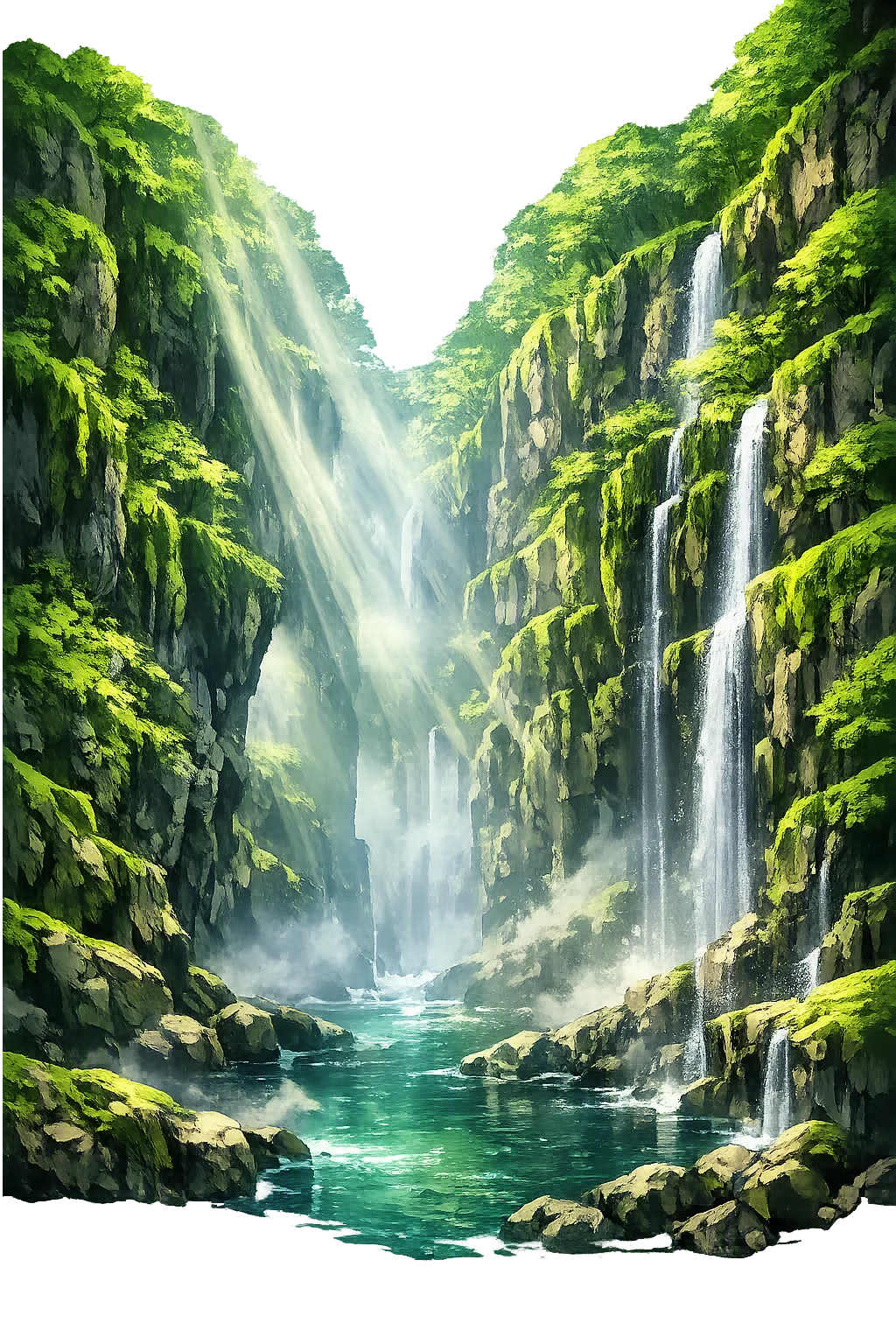
Stories of Takachiho
Takachiho's 'mythology' is a convergence of scripture, landscape, and performance. The Kojiki and Nihon Shoki agree that Ninigi, grandson of Amaterasu, descended at the peak of Takachiho in the land of Hyūga; the town that bears the name claims the story as its own and keeps it alive each winter in the all-night kagura dances that reenact the cave of heaven.
The Kojiki and Nihon Shoki agree on the itinerary: when Amaterasu resolved that her grandson Ninigi should rule the visible world, she sent him down from the Plain of High Heaven at the head of a divine escort, bearing the mirror, sword, and curved jewel that became the Three Sacred Regalia. Both texts name the landing place Takachiho no mine — the peak of Takachiho — in the land of Himuka, present-day Miyazaki Prefecture (Kojiki; Nihon Shoki, Age of the Gods). Ninigi wed the blossom-princess Konohanasakuya-hime, and from the line of their son Hoori came the first emperor, Jimmu. The tradition is the charter of Japanese kingship, and it plants that charter on a real mountain in Kyūshū. What Takachiho means is therefore not merely 'where the gods came down' but where heaven first accepted a Japanese address — the point where the divine genealogy touches soil that can still be walked.
The classical texts do not say where the Rock Cave of Heaven stood. The Kojiki tells how Amaterasu, frightened by her brother Susanoo's rampage, sealed herself inside Ama-no-Iwato and plunged the world into darkness, until the goddess Uzume's bawdy dance on an overturned tub drew the gods' laughter and lured the sun back out (Kojiki, Age of the Gods). Local tradition in Takachiho locates the cave on the Iwato River gorge, where Ama-no-Iwato Shrine keeps the memory — the sacred rope, the crowing rooster, the mirror hung on the sakaki tree. Scholars note that the identification is devotional rather than textual: many places in Japan claim the cave, and the sources are silent. But the gorge gives the story a theatrical setting, a narrow chasm where sunlight and shadow trade places across the water. The myth's engine is social: order is restored not by force but by laughter, performance, and a community coaxing its sun back into view.
Each year from mid-November to mid-February, the villages around Takachiho perform the yokagura — the night kagura — a cycle of some thirty-three episodes danced from dusk until dawn to make the fields fertile and the year safe. The climactic piece is always the cave: Uzume's dance, the gods' laughter, the sun's return, reenacted with masks and drums by the villages' own performers. The tradition was designated an Important Intangible Folk-Cultural Property of Japan in 1978, and the Takachiho Kagura has become one of the country's most watched winter rituals, with performances staged nightly for visitors at Takachiho Shrine. The myth survives here the way medieval mystery plays carried scripture: not as text recited but as action repeated, so that every winter the community itself plays the part of the gods who once, in its own gorge, brought the sun back out of the rock.
For most of its history Takachiho was a remote mountain district whose chief asset was the descent narrative itself. Pilgrims came despite the distance, and the Meiji state's promotion of the imperial cult gave the town's shrines new standing as way-stations of the emperor's divine ancestry. The railway from Nobeoka reached the town only in 1972 — the same mountain line that closed in 2008 after typhoon damage — and motor tourism turned the gorge, the shrine, and the night kagura into the town's living. The gorge, geologically, is young: the Gokase River cut its columned walls down through the basalt laid down by Mount Aso's eruptions, and the Manai Falls drop seventeen metres at the chasm's head. Takachiho's mythology thus layers like its rocks: an imperial charter, a cave of the sun, a dancer's dance, and a modern community that keeps all three reenacted.
Myth, Gorge, and Sacred Rice
Takachiho is a town and gorge in the mountains of Kyūshū, famous as the place where Ninigi descended from heaven to begin the rule of the terrestrial world. Its name, 'High Thousand Ears of Grain,' evokes a landscape of tall rice and misty peaks where the divine once touched the earth.
Ninigi landed here with the Three Sacred Regalia.
A dramatic volcanic gorge and waterfall, central to local myth.
The town preserves performances of the Ama-no-Iwato dance.
The 'thousand ears' of the name refer to abundant rice.
From the original script to the living URL
高千穂
The name in its original Japanese form. Takachiho (高千穂) is attested in the source tradition — “High thousand ears”. Its original diacritics and script distinctions carry the full phonetic and orthographic weight of the source tradition.
takachiho
The plain takachiho form is identical to the Unicode restoration. Because this name is already written in Latin letters, no diacritics, stress, or script information were lost — only capitalization differs.
Takachiho
The Unicode restoration does not need to recover lost marks for Takachiho. Its value is canonical spelling and consistent cataloguing, not the reconstruction of erased orthography. The domain is readable as-is to both DNS and humanity.
Takachiho.com
This restoration is written entirely in ASCII letters — no Punycode encoding stands between Takachiho and the DNS. The domain reads identically to machines and to human eyes.
Owned, ideal, and ASCII forms of Takachiho
Takachiho
Restores 高千穂. The full Unicode restoration. takachiho.com is not in the PuniCodex collection — it is watched for release; if it drops, this temple upgrades to an owned flagship.
How Takachiho was spoken
How Takachiho is preserved in writing
A bespoke provenance study for Takachiho is being prepared by the PUNICODEX scholarly team.
Contribute scholarly provenance →The lore you have read is the living myth. Extended Lore opens the scholarly vault beneath it: the cult and its material remains, a history of the image, the name after antiquity, a meditation on what the name still means, and the full scholarly apparatus — etymology, orthography, sources.
Enter Extended Lore