
Takachiho: canonical, contested, and the false forms on record
Evidence dossier 474 — Takachiho. Every exhibit catalogued, every ruling stated with its grounds.
At a Glance
- Canonical form: Takachiho
- Original script: 高千穂
- Pantheon: Japanese
- Convention: Hepburn with macrons — ō and ū marked, never collapsed to o/u or rewritten ou
- False forms on record: 0
- Contested forms: none attested
- Series: The Canonical Register, No. 474 of 548
The Evidence
Exhibit 1 — the attestation. The name is attested as 高千穂, as Kojiki, trans. Donald L. Philippi (Princeton University Press, 1968) — the descent of Ninigi and the Rock Cave of Heaven. and Nihon Shoki, trans. W. G. Aston (1896) — the descent at Takachiho no mine in Himuka. record. On the evidence, it means "High thousand ears". The canonical transliteration is Takachiho.
Exhibit 2 — the flattened form. The plain form takachiho differs from the canonical Takachiho only by convention of display — case, not content. It is acceptable everywhere: in legacy systems, in plain-text citation, in the DNS itself. What is not acceptable is what follows in the register: respellings that change the letters, not just their case.
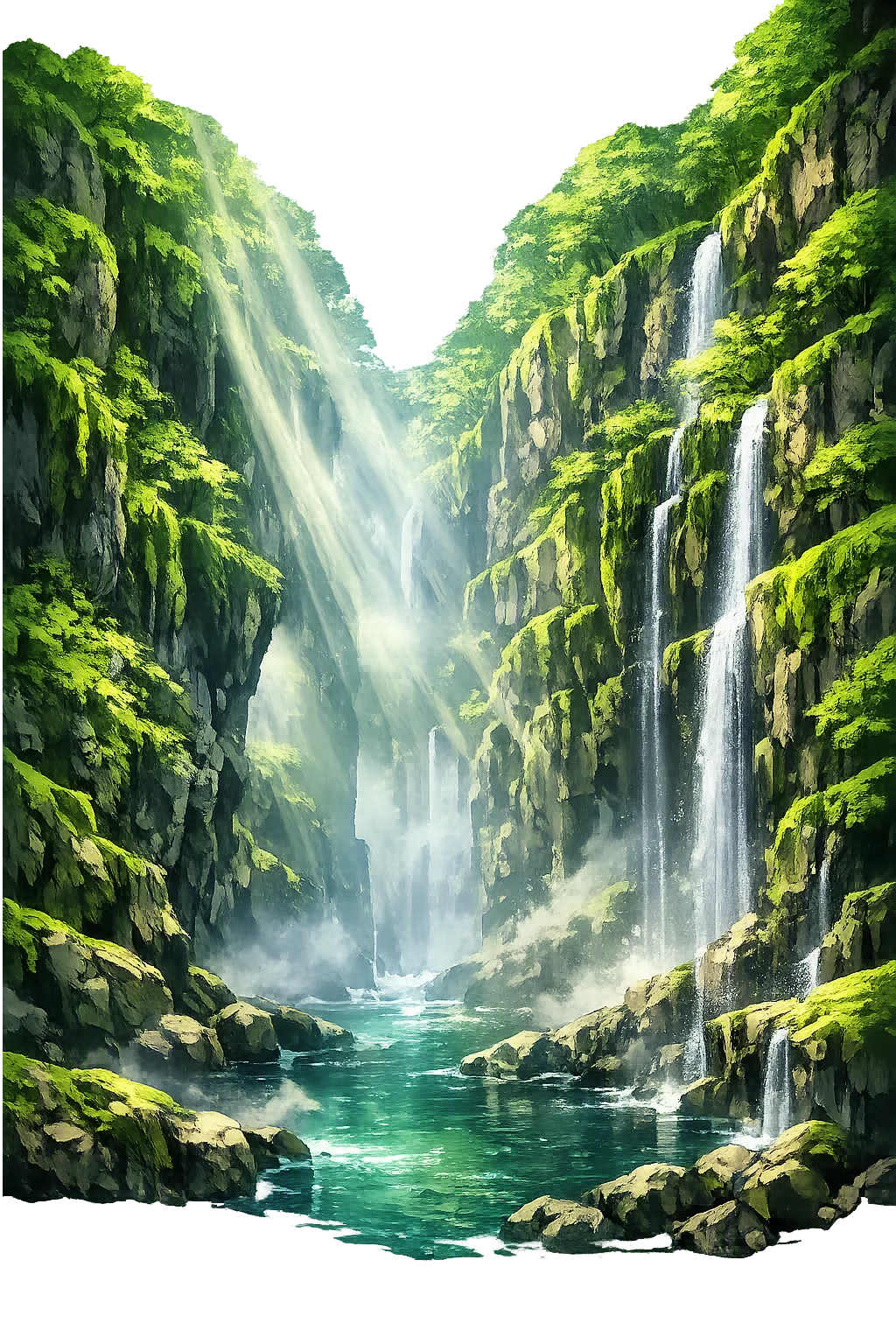
Exhibit 3 — the physical record. Takachiho Gorge is a volcanic landscape formed by the eruptions of Mount Aso, which filled the old river valley with basalt; the Gokase River cut back down through it, leaving the columned walls and the seventeen-metre Manai Falls. The town's ritual architecture records the myth it performs: Ama-no-Iwato Shrine, at the head of the Iwato River gorge, keeps the cave precinct with its sacred rope and sakaki; Takachiho Shrine anchors the town's central cult; and each village preserves a kagura-den (kagura hall) or designated performance ground where the night dances are staged from November to February. The shrine buildings are Edo-period and later reconstructions in the standard style, but the performance spaces, the gorge paths, and the falls themselves are the primary 'site' — a landscape whose geology and whose mythology tell the same story of something vast coming down.
Exhibit 4 — the continuing record. Takachiho is one of Kyūshū's signature destinations — the gorge with its rental rowboats beneath the basalt columns, the Manai Falls, and the nightly kagura at the shrine. The town's name has become shorthand in Japan for the moment when myth touches ground: school textbooks repeat the descent, and the phrase 'Takachiho of heaven' echoes through tourism copy and local pride.
The Convention's Own History
Every tradition in this register has its own scholarly transliteration standard, built by its own specialists over decades or centuries, and the register follows each on its own terms: Hepburn with macrons — ō and ū marked, never collapsed to o/u or rewritten ou. The principle that unifies them is the one the whole project stands on: a name is evidence, and evidence is not negotiable — not for keyboards, not for convenience, not for anyone.
The Protocol's Position
Can the canonical form live in the address bar? Almost always, yes. IDNA 2008 admits every mark this register defends — the DNS stores them as `xn--` punycode and modern browsers render them natively. The real frictions are practical, not legal: some registrars stock only part of the IDN space, so a theoretically valid name can be temporarily unbuyable; and stacked combinations (an acute riding a macron) remain awkward to type on mobile keyboards even where the protocol accepts them.
The project's answer is a ranked ladder, not a compromise: the full restoration first, then attested fallbacks in descending order of completeness. The ladder's lowest rung, plain ASCII, is a vehicle for legacy systems — sanctioned, but never presented as the scholarly form.
The Verdict
Case closed on Takachiho: canonical, cited, and defended. The keyboard form takachiho is the same name in another register of display — always acceptable. The register's files remain open: if a source surfaces that changes any line of this entry, the entry changes. Until then, the temple at /takachiho/ holds the canonical form.
The docket for this ruling: no false forms on the docket; no contested forms attested; the attestation rests on 4 cited sources — Kojiki, trans. Donald L. Philippi (Princeton University Press, 1968) — the descent of Ninigi and the Rock Cave of Heaven., Nihon Shoki, trans. W. G. Aston (1896) — the descent at Takachiho no mine in Himuka., Bock, Felicia G., Classical Learning and Taoist Practices in Early Japan, with a Translation of Books XVI–XX of the Engi-shiki (University of Arizona Press, 1985) — the ritual frame of kagura performance..
The Register Continues
The register holds 548 entries like this one — each temple with its own ruling. Read the temple's founding dispatch for the story, its Restoration File for the philology, its Resonance File for the industries, or the whole archive end to end.
Continue the register — previous entry: Tajikarao (read it) · next entry: Taliesin (read it).
The Canonical Register is written from the same canonical record as the lexicon itself. If a false form is missing from this page, it is because the evidence does not support calling it false — or because we have not seen it yet. Show us, with a citation, and the register will answer.