
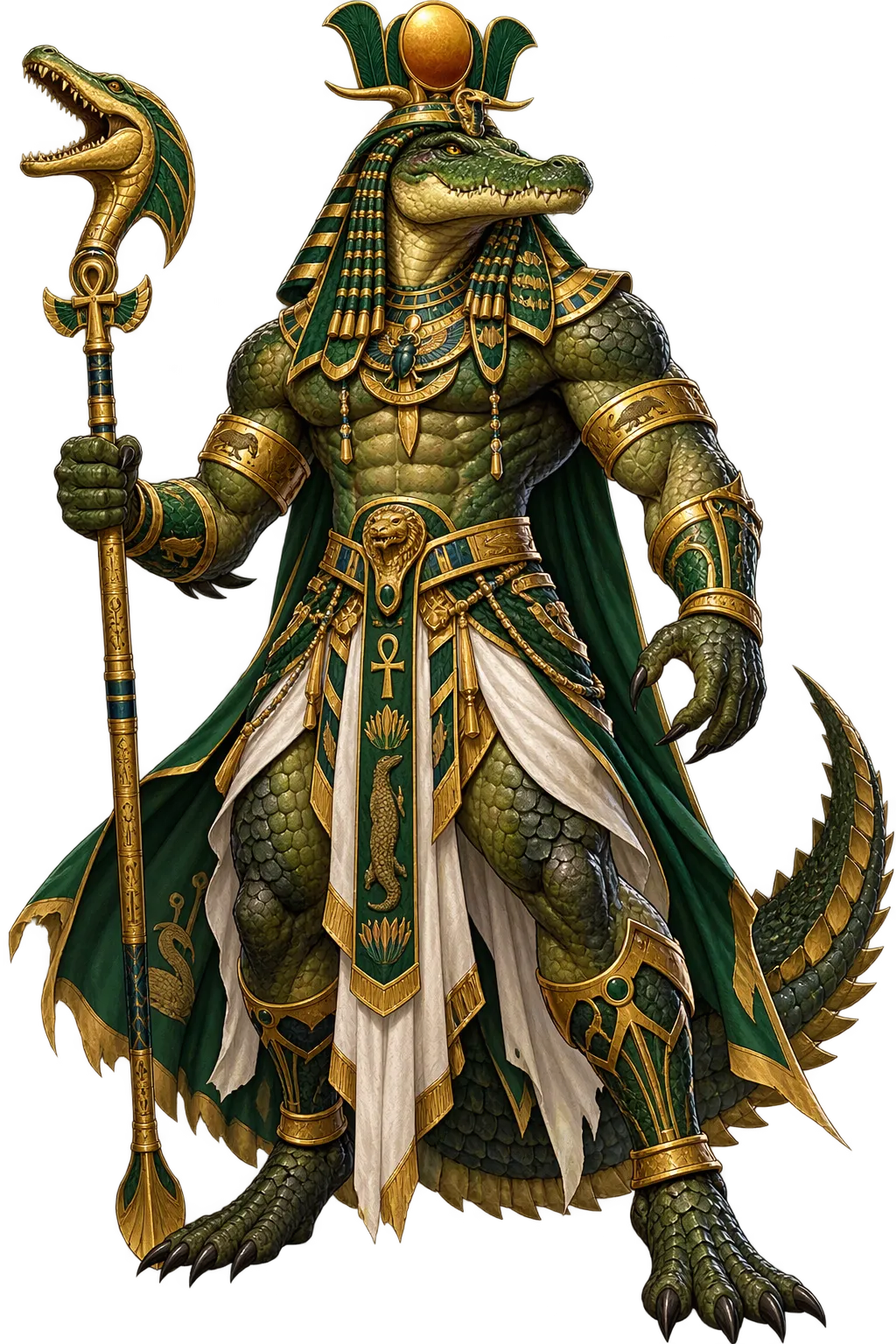
Stress-testing Sbk: do the industry seats hold?
Audit notes, Sbk: we took every seat the atlas claims for this temple and tried to break it against the myths. What survived is below.
At a Glance
- Temple: Sbk
- Pantheon: Egyptian
- Domain of influence: Nile, Fertility, Crocodiles
- Pattern seats: 3
- Sectors touched: Energy & Natural World · Home & Lifestyle
- Strongest seat: Agriculture, Food & Harvest
- Series: The Resonance Files, No. 493 of 597
The Test
Seat 1: Agriculture, Food & Harvest
Claim: The inundation itself was called "the arrival of Sobek" — the crocodile god is the flood that feeds the harvest. Exhibit: The Crocodile Who Emerges from Nun — The Sobek theology of the Fayum — best preserved in the hymn cycles of the crocodile temples — casts him as the one who first climbed from the primeval waters, creator of the world’s order and of the Nile itself.
Verdict: holds under load. The correspondence is functional, not decorative.
Seat 2: Maritime, Shipping & Ocean Industries
Claim: Master of the Nile and its crocodiles — the river's most dangerous passenger, propitiated by every who worked its waters. Exhibit: The Double Temple — At Kom Ombo south of Luxor, Sobek shares a perfectly symmetrical double temple with Horus the Elder: one half for the falcon of the sky, one for the crocodile of the river.
Verdict: stands. Strip both to their function and the functions match.
Seat 3: Pet Care & Animal Industries
Claim: His sacred crocodiles were kept, fed, adorned, and buried with honours — animal-keeping as cult. Exhibit: Sobek and the Wonders at Court — In the Westcar Papyrus’ cycle of Khufu-era wonders, the crocodile motif appears in the tale of the adulterer punished by a wax crocodile that comes alive at a word — a demonstration that the river-god’s animal is an instrument of moral order, released and recalled by priestly power.
Verdict: stands. Strip both to their function and the functions match.
The Control Group
Against the seats that survived, one control: the temple's own summary of its figure — Sobek has no single continuous myth-cycle; his theology was assembled from the river itself — the annual flood that could drown or feed — and from the pharaonic appetite for a god who united raw natural violence with legitimate kingship. The seats do not drift far from it. That is the audit's cleanest result.
The Method, Stated Plainly
None of this is numerology. A seat exists only where the match can be argued from the deity’s documented domains and deeds — weighted, published, and falsifiable. The derivation, the weights, and the challenge process are public on the methodology page. If a seat in this file reads wrong, the atlas itself tells you how to prove it — and the correction becomes part of the record.
For the Ones Who Work There
For a sponsor in agriculture, food & harvest, the fit here is not adjacency — it is inheritance. Your trade already tells this story every working day; the temple simply holds the original. The patron tier and the advertising terms carry the mechanics; the myths above carry the reason.
The File Continues
This is one of 597 Resonance Files — the third dispatch from every flagship temple, where the myths meet the markets. The temple's founding dispatch tells the name's story; its Restoration File tells the spelling's; the blog index holds the whole archive.
Continue the series — previous: Sleipnir (read it) · next: Skr (read it).
The Resonance Files are argued from the same canonical record as the pattern atlas itself: the lexicon, the lore catalog, and the cited sources. Every seat can be challenged at the methodology page — and the challenge is the point.