The Living Myth
Nile, Fertility, Crocodiles · The Nile, Fertility, Military Power · He who causes to be fertile
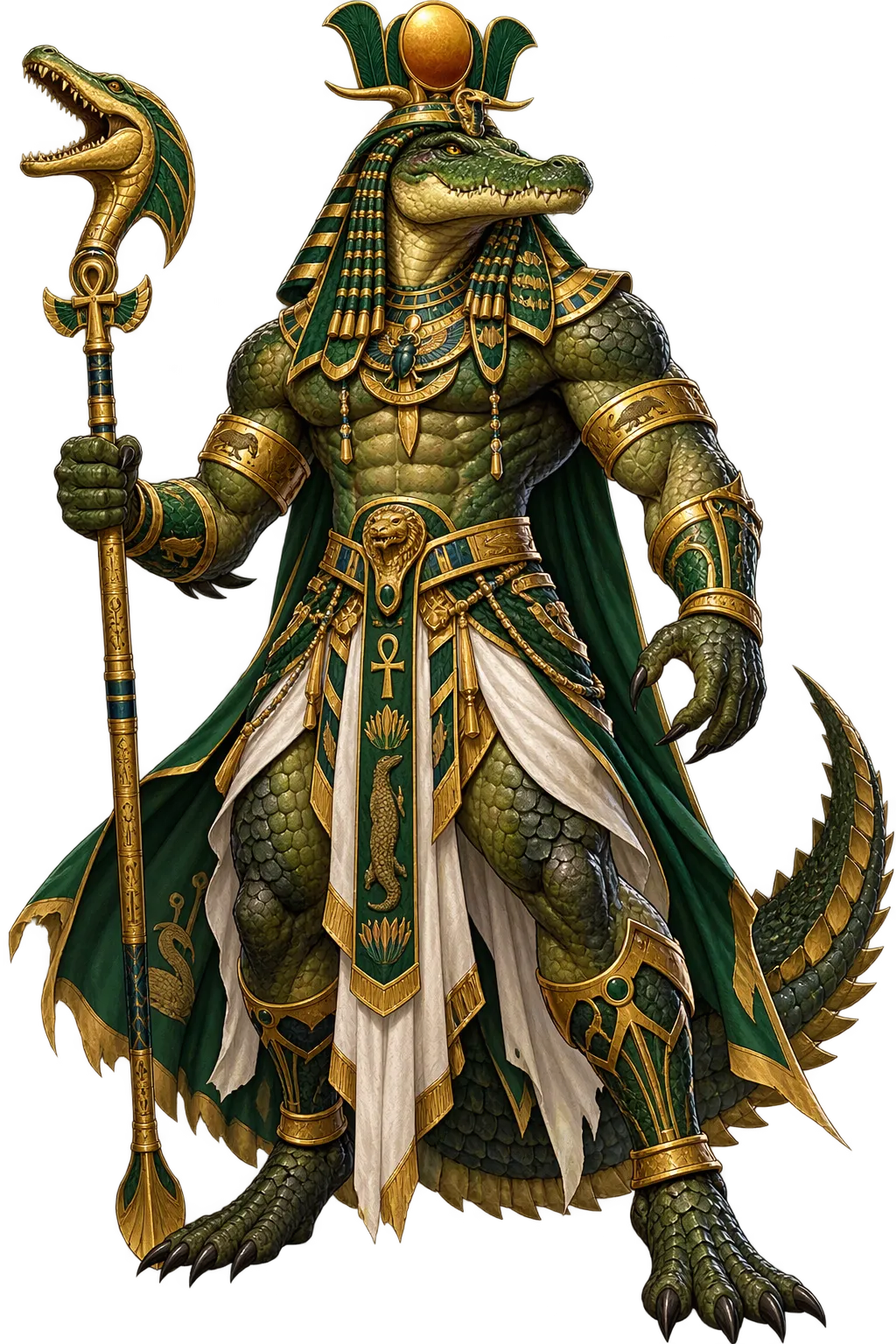
Stories of Sbk
Sobek has no single continuous myth-cycle; his theology was assembled from the river itself — the annual flood that could drown or feed — and from the pharaonic appetite for a god who united raw natural violence with legitimate kingship. The Middle Kingdom elevated him to cosmic rank: a creator who rises from the Nun, the primordial water.
The Sobek theology of the Fayum — best preserved in the hymn cycles of the crocodile temples — casts him as the one who first climbed from the primeval waters, creator of the world’s order and of the Nile itself. Later tradition even made him a form of the sun god’s power, the fierce Eye of Ra returned from the Nubian desert.
At Kom Ombo south of Luxor, Sobek shares a perfectly symmetrical double temple with Horus the Elder: one half for the falcon of the sky, one for the crocodile of the river. The division stages the Egyptian ideal of the Two Lands’ balance — sky and water, kingship and fertility — under one roof.
In the Westcar Papyrus’ cycle of Khufu-era wonders, the crocodile motif appears in the tale of the adulterer punished by a wax crocodile that comes alive at a word — a demonstration that the river-god’s animal is an instrument of moral order, released and recalled by priestly power.
Strabo and Herodotus describe the living god of Crocodilopolis: a great crocodile called Petsuchos, kept in a pool, fed by priests, adorned with gold and crystal rings. When it died the city mourned; a new Petsuchos was sought among the river animals by oracular selection — the god re-incarnating indefinitely.
The Crocodile Who Rises from the River
Sbk — Sobek — is the crocodile god of the Nile’s dangerous fertility: the animal that kills at the water’s edge and the power that makes the flood bring life. In the Middle Kingdom he rose from local river god to a creator deity in his own right, and his cult centres — Crocodilopolis and Kom Ombo — kept living sacred crocodiles as his incarnations.
Master of the Nile and its inundation; the flood itself was called “the arrival of Sobek”.
Incarnate in Crocodylus niloticus; temple pools held living sacred crocodiles adorned with jewellery.
In Middle Kingdom theology he emerges from the primordial waters; at Kom Ombo he shares a temple with Horus.
Soldiers and the Pharaoh’s power; his epithets link him to strength and military might.
From the original script to the living URL
𓃣
The name in its original Egyptian form. Sbk (𓃣) is attested in the source tradition — “He who causes to be fertile (Egyptian sbk)”. Its original diacritics and script distinctions carry the full phonetic and orthographic weight of the source tradition.
sobek
The plain sobek form is identical to the Unicode restoration. Because this name is already written in Latin letters, no diacritics, stress, or script information were lost — only capitalization differs.
Sbk
The Unicode restoration does not need to recover lost marks for Sbk. Its value is canonical spelling and consistent cataloguing, not the reconstruction of erased orthography. The domain is readable as-is to both DNS and humanity.
Sbk.com
This restoration is written entirely in ASCII letters — no Punycode encoding stands between Sbk and the DNS. The domain reads identically to machines and to human eyes.
The attested spelling family of Sbk
Sbk
Restores 𓃣. The full Unicode restoration. sbk.com is not in the PuniCodex collection — it is watched for release; if it drops, this temple upgrades to an owned flagship. Attested by Faulkner, Wb.
How Sbk was spoken
How Sbk travels from ancient script to the modern URL
Egyptian sbk; the original vocalisation is unknown. The name is connected with the crocodile and means “he who causes to be fertile".
The lore you have read is the living myth. Extended Lore opens the scholarly vault beneath it: the cult and its material remains, a history of the image, the name after antiquity, a meditation on what the name still means, and the full scholarly apparatus — etymology, orthography, sources.
Enter Extended Lore