PuniCodex

Extended Lore

𓃣 Sbk

Etymology · Orthography · Cult · Iconography · Reception · Sources

ASCII-equivalent form Sbk
Sbk — Nile, Fertility, Crocodiles
01

Quick Facts

Essential information about Sbk, Nile, Fertility, Crocodiles

Original Script𓃣
Unicode RestorationSbk
Reconstructed Pronunciation/ˈsoʊbɛk/ (conventional)
PantheonEgyptian
DomainNile, Fertility, Crocodiles
MeaningHe who causes to be fertile (Egyptian sbk)
ClassificationASCII-equivalent form
Primary DomainSbk
Sacred SymbolsLord of the Waters, The Crocodile God, Creator and Solar Eye, Patron of the Army
02

Etymology & Word Family

From original script to Unicode restoration

Original Script 𓃣 Sbk — "He who causes to be fertile (Egyptian sbk)"
Unicode Restoration Sbk Canonical scholarly spelling — ASCII-identical
Modern ASCII sobek Plain-ASCII fallback

The name Sbk reaches the modern world through scholarly transliteration of the egyptian tradition. Because the conventional spelling uses only Latin letters, its Unicode and ASCII forms coincide — the tradition it carries is in the name itself, not in diacritics.

03

Unicode Character Breakdown

Character-by-character philological analysis

CharacterUnicodeNameBlockPhonetic Role
SU+0053Latin Capital Letter SBasic LatinSame
—N/ADropped characterEgyptian orthographyDropped: vowel not written
bU+0062Latin Small Letter BBasic LatinSame
—N/ADropped characterEgyptian orthographyDropped: vowel not written
kU+006BLatin Small Letter KBasic LatinSame

This restoration reflects fidelity to the attested tradition, not recovered diacritics: every character of Sbk already survives in ASCII. What the restoration preserves is the canonical spelling itself — the form scholarship standardised.

04

Cult & Worship

How the sacred was kept — rites, sanctuaries, remains

The Cult

His priests kept living crocodiles as cult statues made flesh; the animals were fed, adorned, and oracularly consulted, and at death mummified and buried in necropolises of their own. The Fayum’s Krokodilophoria festival carried the god’s image on procession; the flood season itself was his epiphany.

In the Earth

Crocodilopolis (Shedet, modern Medinet el-Fayum) held the main temple; Kom Ombo’s double temple survives in superb relief, its columns carrying intact crocodile capitals. Crocodile cemeteries at Tebtunis and el-Shams el-Qawassim held mummified sacred crocodiles by the hundreds, each an embodied Sobek buried with honours.

05

Iconography

How Sbk was imaged across the ages

The Image

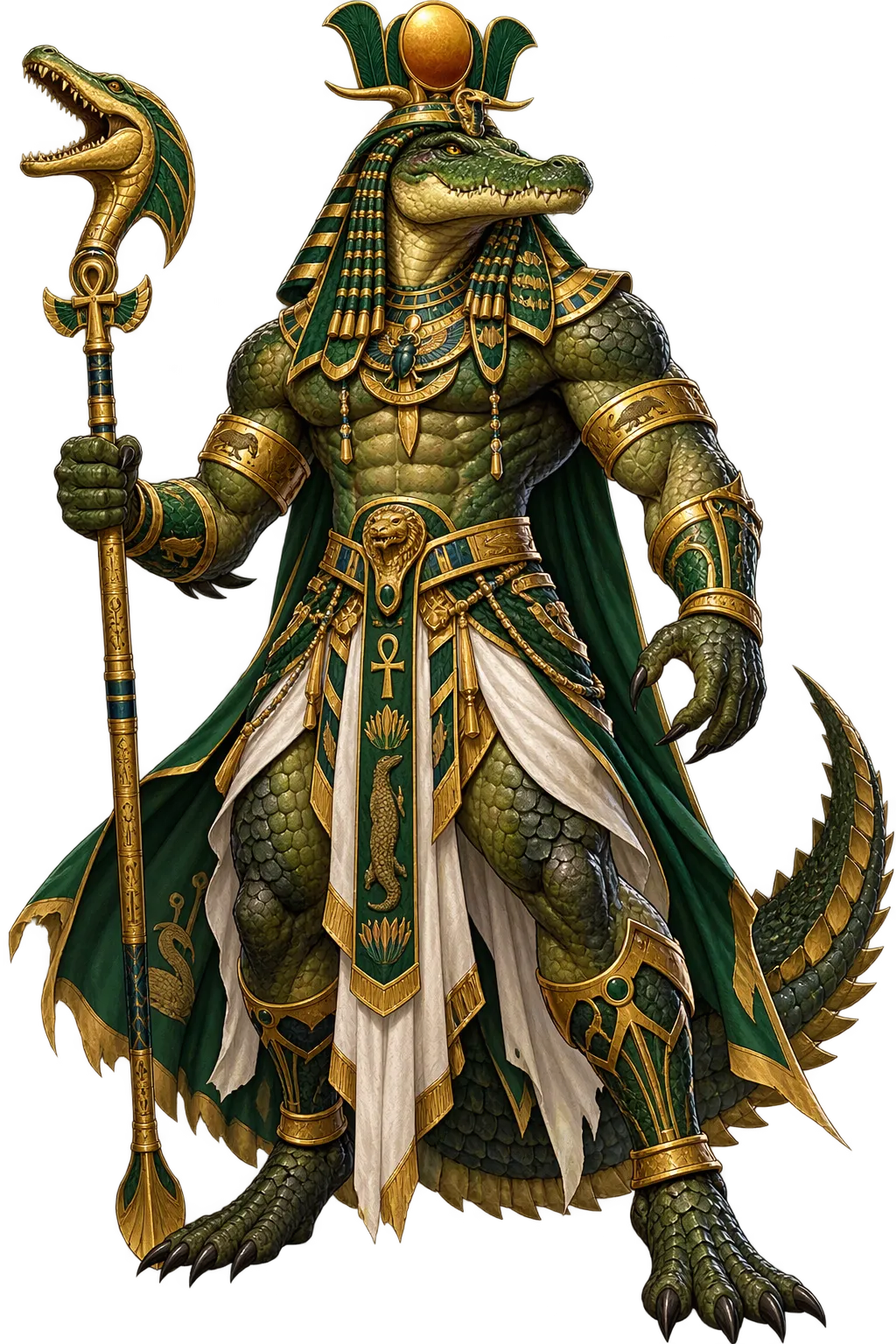
Human-bodied with the head of a Crocodylus niloticus, crowned with ram’s horns, sun disc and uraeus when solar, or with the plumes and horns of Amun when fused as Sobek-Amun. His sacred colour is the green-blue of the inundation; the was-sceptre of power is his frequent attribute.

06

Reception & Transformation

The name after its own age — transmission, translation, survival

Afterlives

Greek and Roman travellers were fascinated and repelled in equal measure — Herodotus’ crocodile chapter opens with the tame-temple beast and closes with the mummification of the species. Sobek remains the standard example in comparative religion of the worship of dangerous fauna as a strategy of propitiation.

Identifications Across Traditions

Sobek absorbed and was absorbed: as Sobek-Ra he took solar status, while earlier he had fused with Horus as Sobek-Horus, lord of the Fayunite unity of king and river. The Greeks called his city Crocodilopolis and identified him with their own river-figures rather than a single Olympian; Roman-period Fayum mummy portraits from his cities remain among Egyptology’s most familiar images.

Modern Legacy

The name Sobek survives in the modern scholarly vocabulary of the Nile and appears throughout Egyptological literature as the archetype of Egyptian theriolatry — the worship of a dangerous animal not despite but because of its power. The Fayum’s temple of Medinet Madi preserves the longest surviving sacred hymn cycles addressed to a crocodile.

07

The Meditation

What Sbk means — beyond the dictionary

To restore Sbk is to keep the consonants the Egyptians trusted to carry a name across millennia of silence. The crocodile god needs no decoration: the word itself snaps shut like the animal — four letters, one vowel of uncertainty, the whole Nile behind it.

08

Frequently Asked Questions

Common questions about Sbk, Nile, Fertility, Crocodiles, and Unicode restoration

01How do you pronounce Sbk?

In reconstructed pronunciation, Sbk is /ˈsoʊbɛk/ (conventional) — approximately “SOH-bek” — already essentially the form used today.

02What does Sbk mean?

Sbk means He who causes to be fertile (Egyptian sbk) in the egyptian tradition.

03What are the symbols of Sbk?

Sbk is associated with Lord of the Waters (Master of the Nile and its inundation; the flood itself was called “the arrival of Sobek”.), The Crocodile God (Incarnate in Crocodylus niloticus; temple pools held living sacred crocodiles adorned with jewellery.), Creator and Solar Eye (In Middle Kingdom theology he emerges from the primordial waters; at Kom Ombo he shares a temple with Horus.), Patron of the Army (Soldiers and the Pharaoh’s power; his epithets link him to strength and military might.).

04Why restore Sbk in Unicode?

Sbk is written entirely in ASCII letters, so its restoration is about canonical fidelity rather than recovered diacritics: the temple fixes the name in its scholarly standard spelling, attested in the source tradition, instead of leaving it to drift.

05What is the most important myth about Sbk?

“The Crocodile Who Emerges from Nun” — the Fayum Theology story that anchors the mythology of Sbk, told in full on the lore page.

09

Scholarly Sources

The philological foundations of this restoration

Every claim on this page is grounded in established scholarship. The orthographic restorations follow disciplinary convention. The etymological chain follows the best available reference works. This is not invention — it is resurrection through scholarship.

◈

Lexicography & Philology

  • Faulkner, R. O. A Concise Dictionary of Middle Egyptian. Oxford: Griffith Institute, 1962.
  • Wb
◎

Primary Texts

  • Strabo, Geography 17.1.38 (Petsuchos)
◉

Archaeology & Art History

  • Material evidence — iconography, inscriptions, and temple archaeology — for Sbk and related cults.
✦

Religious Studies

  • Papyrus Westcar (the wax crocodile episode)
  • Herodotus, Histories 2.68–69 (the crocodile and Crocodilopolis)
  • Sobek hymns of Medinet Madi (Fayum temple liturgy)
  • Bresciani, ‘Sobek’ in Lexikon der Ägyptologie
Return

The Surface Awaits

You have traced the name from its earliest attestation to its Unicode restoration. Now return to the myth. The story is where the name lives.

Back to Lore
Sbk mascot