
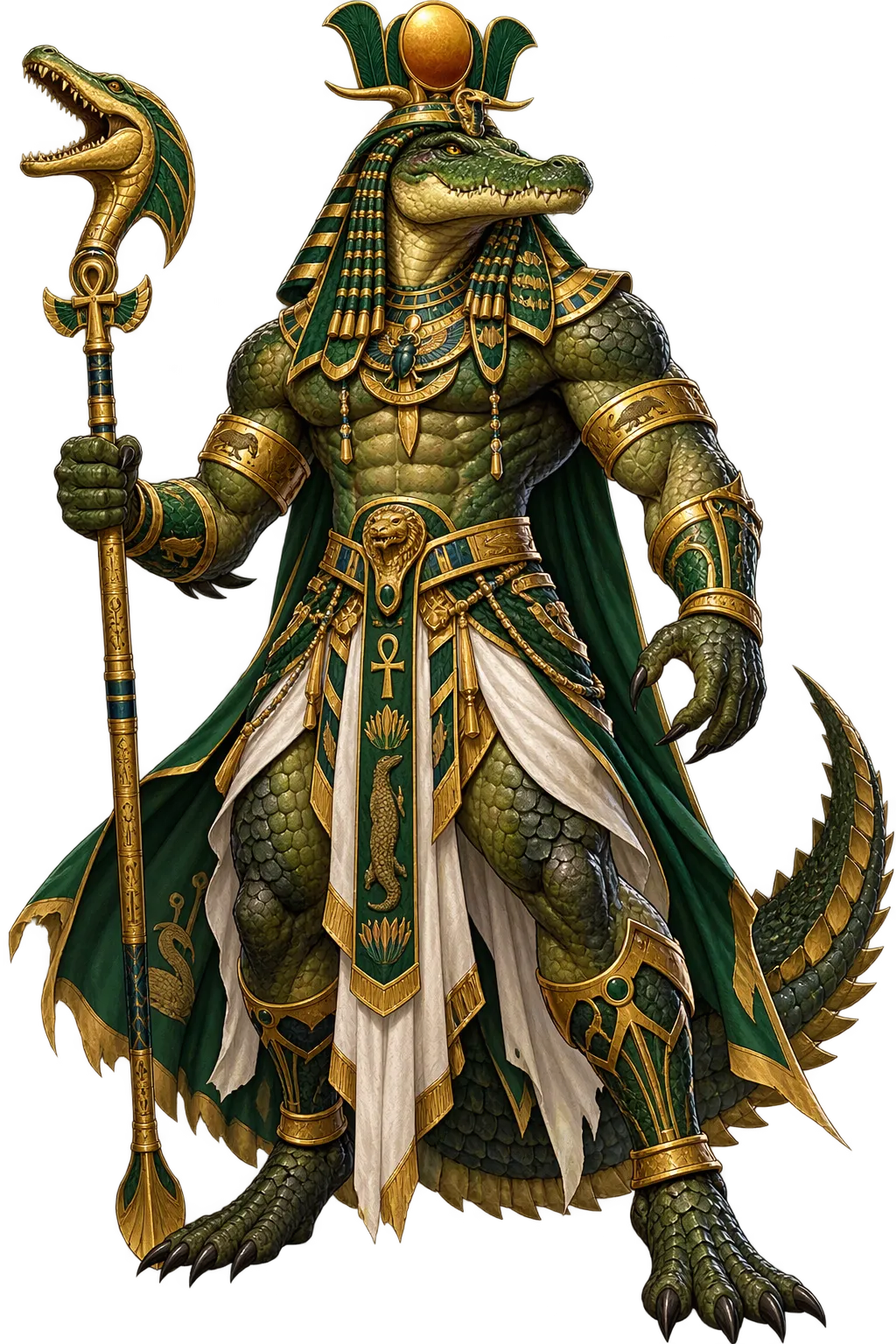
The provenance file on Sbk
Provenance record 493 · Sbk · one temple, fully accounted for.
Provenance
1. The attestation. 𓃣, from the tradition's own record. On record: Papyrus Westcar (the wax crocodile episode), Herodotus, Histories 2.68–69 (the crocodile and Crocodilopolis), Strabo, Geography 17.1.38 (Petsuchos), Sobek hymns of Medinet Madi (Fayum temple liturgy).
2. The narrative record. The Crocodile Who Emerges from Nun — The Sobek theology of the Fayum — best preserved in the hymn cycles of the crocodile temples — casts him as the one who first climbed from the primeval waters, creator of the world’s order and of the Nile itself. Later tradition even made him a form of the sun god’s power, the fierce Eye of Ra returned from the Nubian desert. The Double Temple — At Kom Ombo south of Luxor, Sobek shares a perfectly symmetrical double temple with Horus the Elder: one half for the falcon of the sky, one for the crocodile of the river. The division stages the Egyptian ideal of the Two Lands’ balance — sky and water, kingship and fertility — under one roof.
3. The physical record. Crocodilopolis (Shedet, modern Medinet el-Fayum) held the main temple; Kom Ombo’s double temple survives in superb relief, its columns carrying intact crocodile capitals. Crocodile cemeteries at Tebtunis and el-Shams el-Qawassim held mummified sacred crocodiles by the hundreds, each an embodied Sobek buried with honours.
4. The current holding. The temple at /sobek/, a temple of the restored name. aSCII-equivalent form
5. The documented resonances. Agriculture, Food & Harvest, Maritime, Shipping & Ocean Industries, Pet Care & Animal Industries — seats argued and weighted in the pattern atlas, read through the myths in this temple's Resonance File.
6. The primary sources. The Book of the Dead — the library this file answers to, open at the Sacred Texts collection.
7. The continuing record. The name Sobek survives in the modern scholarly vocabulary of the Nile and appears throughout Egyptological literature as the archetype of Egyptian theriolatry — the worship of a dangerous animal not despite but because of its power. The Fayum’s temple of Medinet Madi preserves the longest surviving sacred hymn cycles addressed to a crocodile.
At a Glance
- Restored name: Sbk
- ASCII form: sobek
- Meaning: "He who causes to be fertile (Egyptian sbk)"
- Domain of influence: Nile, Fertility, Crocodiles
- Pantheon: Egyptian
- Restoration: ASCII-equivalent form
- Original script: 𓃣
- Series: The Restoration Files, No. 493 of 597
The File Continues
Read the founding dispatch for the name's full story, the Resonance File for the archetype at work — or the whole archive in one sitting.
Continue the series — previous file: Sleipnir (read it here) · next file: Skr (read it here).
The Restoration Files are written from the same canonical record as the temples themselves: the lexicon, the lore catalog, the pattern atlas, and the cited scholarly sources. If a file ever disagrees with its temple, the temple is right — tell us, and the file will be corrected.