
The many faces of Skanda
No important name has only one face. Skanda appears as a figure of myth, a scholarly reconstruction, a piece of material culture, a memory carried across languages, and — most recently — a Unicode domain. This post looks at each face in turn: the name and its roots, the Devanagari original, the reconstructed pronunciation, the mythological record, the symbols and sanctuaries, the cross-cultural afterlife, and the engineering that lets the restored spelling resolve in a browser. Taken together, those faces explain why skanda was never going to be enough — and why the restored form is worth a domain of its own.
At a Glance
- Restored name: Skanda
- ASCII form: skanda
- Meaning: "‘The Attacker’ — a name of Kārttikeya, son of Śiva (or of Agni), the god of war who leads the divine hosts against the enemies of the gods."
- Domain of influence: War, Commander
- Pantheon: Sanskrit
- Restoration: ASCII-equivalent form
- Original script: स्कन्द (Devanagari)
Overview
Skanda (skanda) — War, the Divine Hosts · ‘The Attacker’ — a name of Kārttikeya, son of Śiva — belongs to the Sanskrit tradition, where it is catalogued under the domain "War, Commander". The name means "‘The Attacker’ — a name of Kārttikeya, son of Śiva (or of Agni), the god of war who leads the divine hosts against the enemies of the gods.".
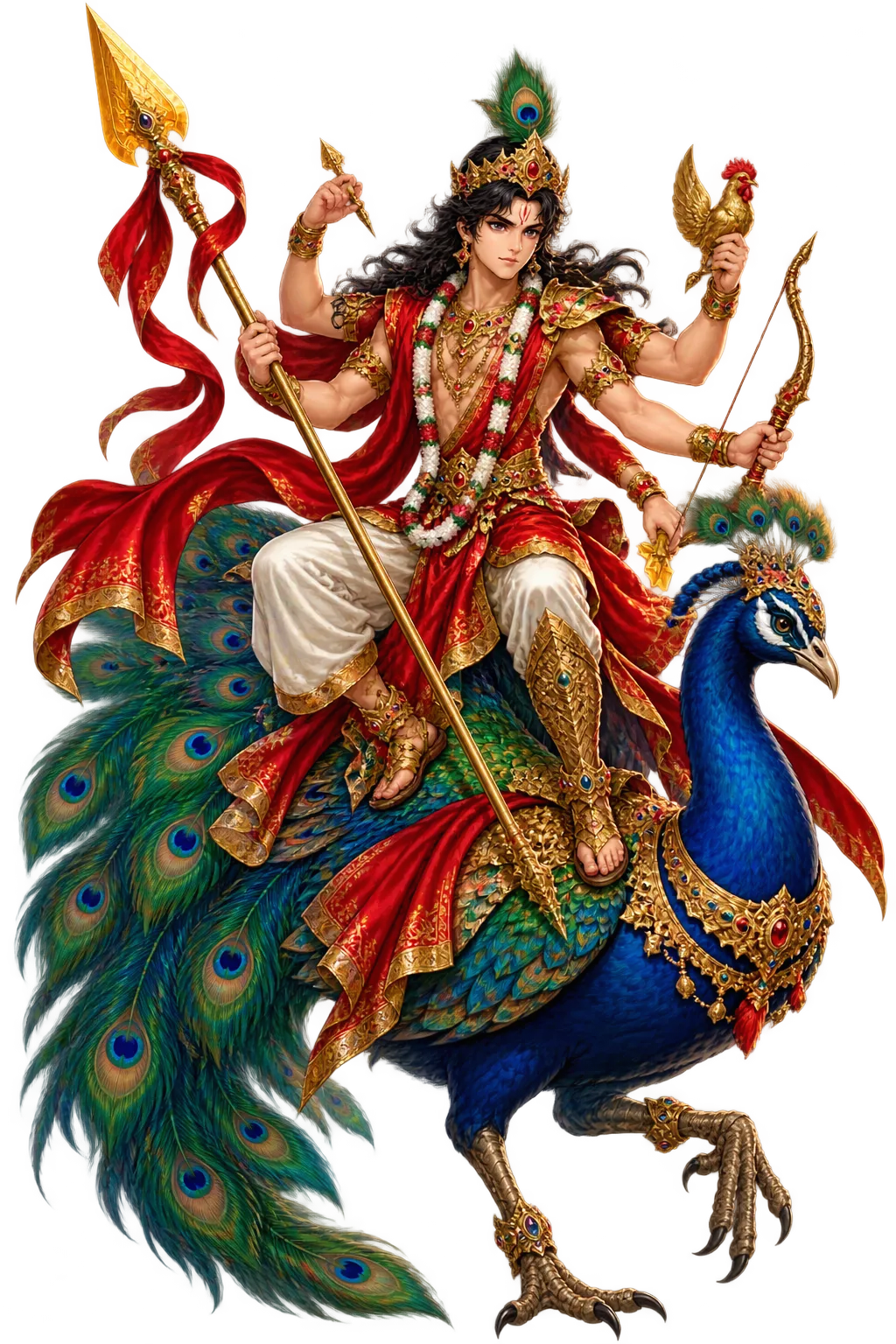
Skanda is the Hindu war-god: the ever-youthful general of the devas’ hosts, born from the combined fire of Śiva’s third eye to destroy the demon Tāraka. Tamil India knows him as Murugan, the eternally beautiful mountain lord of the six abodes; the Sanskrit world as Kārttikeya, son of the Pleiades’ fosterage.
PuniCodex restores the name as Skanda and serves its temple at its temple. The restoration aSCII-equivalent form — a description computed from the displayed form itself. The plain ASCII form skanda survives as a modern convenience imposed by the early domain-name system; the restoration, not the fallback, is the form the project defends as philologically complete.
The Name
The name is attested in Devanagari as स्कन्द. Etymologically it means "‘The Attacker’ — a name of Kārttikeya, son of Śiva (or of Agni), the god of war who leads the divine hosts against the enemies of the gods.".
The ASCII form skanda survives only because the early domain-name system could not carry diacritics; it is a technological compromise, not an ancient spelling. The Unicode restoration Skanda recovers the full diacritic detail of the scholarly transliteration directly in the address bar. The restoration aSCII-equivalent form — a description computed from the displayed form itself.
The letter-by-letter transformation runs:
- s → S — Same, capitalized
- k → k — Same
- a → a — Same
- n → n — Same
- d → d — Same
- a → a — Same
The Original Script
The name is preserved in Devanagari as स्कन्द.
The scholarly transliteration is Skanda.
The rendering proceeds step by step:
- Sanskrit Skanda is written in Devanagari as स्कन्द
- IAST transliteration maps each Devanagari vowel and consonant to a Latin equivalent
- Macrons mark long vowels (ā, ī, ū); dots beneath consonants mark retroflex articulation (ṭ, ḍ, ṇ, ṣ)
Pronunciation
The reconstructed pronunciation of the name is /ˈskʌndə/ — Sanskrit (IAST: Skanda).
Phoneme by phoneme:
- Skan- — The cluster sk is preserved; short a as in “cup”.
- -da — The name means “the Attacker”, “the Leaper” — a war-name, not a birth-name.
- -n- — The cluster sk is preserved in every period of the language; no sound is lost between the s and the k.
For the modern speaker, the closest approximation is: “SKUN-duh”
Kindred and historical forms of the name:
- Form — Kārttikeya
- Form — Murugan
- Form — Subrahmaṇya
- Kumāra — (all the same god)
- Tamil — Murukan
One god, six names per tradition — born of six sparks from the gods’ outraged eyes.
Mythology
The Skanda myth is the war-god’s birth-saga: the gods, unable to defeat Tāraka, whose boon made him unkillable except by a son of Śiva, contrived the god’s marriage to Pārvatī; the child was born as fire from the third eye, fostered by the Pleiades, and general of heaven before he was a week old. The Tamil Murugan traditions add the wooing of Vaḷḷi, the huntress, and the gnostic doctrine of the Arupadaiveedu, the six stations of grace.
The Birth of Fire (Kumāra Cycle)
When Agni and the river Ganges could not carry the god’s seed, they left it in the reeds of the Gangā’s bank; six infants were found there by the six Kṛttikā nymphs, each nursing one — until Pārvatī gathered them into a single six-headed child. His first week closed with the death of Tāraka, slain by the spear his mother gave him.
The Deva-Senāpati (Skanda Purāṇa)
The great Purāṇa bearing his name makes him general of the gods’ hosts and husband of Devasenā — ‘the army of the gods’ — a marriage arranged before his birth. His camp is on the world’s margin; his peacock mount, the demon Siṃhakeśin subdued, struts beneath his banner.
Vaḷḷi and Teyvāyāṉai (Murugan Cycle)
The Tamil epics tell how Murugan wooed the huntress Vaḷḷi in the guise of a tree-shade, and wed both her and Teyvāyāṉai, Indra’s daughter, in the great marriage at Tiruchendur. The legend’s two wives read theologically: divine grace (Teyvāyāṉai) and the soul’s own effort (Vaḷḷi) are both needed for union with the lord.
The Sage-Child (Subrahmaṇya Cycle)
As Subrahmaṇya — ‘the dear one to the Brahmins’ — he is the teacher-god, expounding the Vedas to his own father Śiva in the role of guru. The image flips the war-god into wisdom’s child, and fixes his southern temples as places of learning as much as of arms.
Symbols & Iconography
The iconography associated with Skanda concentrates in a small set of recurring attributes, each a compressed statement about the name:
- The Divine General — Commander of the gods’ armies — the deva-senāpati — before whom no asura line holds.
- Born of the Third Eye — Six sparks from the gods’ wrath-eyes, fostered by the Kṛttikā — the Pleiades — as six infants, fused into one.
- The Spear — Śakti, the lance his mother Umā gave him — one throw ended Tāraka, the boon-armed demon.
- Lord of the Six Abodes — Murugan’s six mountain shrines from Tirupparankunram to Palani mark his Tamil country.
Archaeology & Evidence
The material record for Skanda survives in a small number of securely identified remains, catalogued below; the corpus is thin but unambiguous, and each site is tied to the name by ancient testimony.
The six abodes (Ārupadaiveṭṭu) of Tamil Nadu are his living monuments; Gupta and Kushan sculpture give him his classical six-headed infant form. The Batu Caves of Malaysia, a modern Murugan shrine of cathedral scale, extend his geography into the diaspora.
Realm & Domain
Skanda is the Hindu war-god: the ever-youthful general of the devas’ hosts, born from the combined fire of Śiva’s third eye to destroy the demon Tāraka. Tamil India knows him as Murugan, the eternally beautiful mountain lord of the six abodes; the Sanskrit world as Kārttikeya, son of the Pleiades’ fosterage.
The Divine General
Commander of the gods’ armies — the deva-senāpati — before whom no asura line holds.
Born of the Third Eye
Six sparks from the gods’ wrath-eyes, fostered by the Kṛttikā — the Pleiades — as six infants, fused into one.
The Spear
Śakti, the lance his mother Umā gave him — one throw ended Tāraka, the boon-armed demon.
Lord of the Six Abodes
Murugan’s six mountain shrines from Tirupparankunram to Palani mark his Tamil country.
Across Cultures
Skanda is the great pan-Indian convergence: Vedic Rudra’s son, Tamil Murugan, Buddhist Kārttikeya of the north, and the Graha of the week’s Tuesday. The Greeks of the Northwest compared him to Ares and Mars; the Kushan coins show him as Skanda-Kumāra beside the Buddha. His peacock entered Christian art’s immortality symbolism by the strangest of roads.
Within the Sanskrit tradition, closely related names in the corpus include Aditi, Agni, Ambikā, Aṃśa, Arjuna, and Bhakti.
Cultural Legacy
Murugan is Tamil country’s beloved god — the Kanda Ṣaṣṭhī festival at Tiruchendur draws millions, and the god’s hill-shrines anchor Tamil sacred geography. His six-headed infant image, the Kārttikeya of Gupta art, defined the war-god’s iconography for Asia; and the Ṣaṣṭhī vow is observed across the subcontinent by parents of sons.
The Scholarly Record
The account of Skanda given in this edition rests on the witnesses and reference works listed below. Lexica and etymological dictionaries secure the form and meaning of the name; the literary and religious texts supply the narrative evidence.
- Kumārasaṃbhava of Kālidāsa (the birth of the war-god).
- Skanda Purāṇa (the senāpati theology).
- Cilappatikāram & Tamil Murugan epics (Vaḷḷi cycle).
- Kushan-period Skanda-Kumāra coinage.
A Meditation
Skanda: the war-name that means ‘the one who attacks’. In plain letters it reads like what it is — a battle-cry reduced to a name. The Tamil country still shouts it in festival; the lexicon keeps it here, at rest, its spear laid across the threshold of the temple.
The Unicode Restoration
Skanda aSCII-equivalent form. The ASCII fallback skanda still resolves everywhere, but it is the restored form that carries the name's full information. That is the whole thesis of this temple: the marks are the message.
Character by Character
The journey from skanda to Skanda, one character at a time:
- s → S — Same, capitalized
- k → k — Same
- a → a — Same
- n → n — Same
- d → d — Same
- a → a — Same
The Sanskrit Pantheon
Skanda is one of 102 entries the PuniCodex lexicon catalogues under the Sanskrit pantheon. The Pantheon page gathers the tradition's major figures in one place, and the Lexicon lets you filter all 983 restorations by tradition or script — the fastest way to see where this name sits among its kin.
Frequently Asked Questions
What does Skanda mean? The traditional gloss is "‘The Attacker’ — a name of Kārttikeya, son of Śiva (or of Agni), the god of war who leads the divine hosts against the enemies of the gods.."
Which tradition does Skanda belong to? Skanda is catalogued in the Sanskrit pantheon of the PuniCodex lexicon.
What does Skanda preserve that ASCII cannot show? The form itself answers: Skanda aSCII-equivalent form — and the marks in the restored spelling are exactly that evidence.
Can I use Skanda in a normal browser? Yes. The DNS resolves the punycode form automatically, and the type tool on this site converts skanda to Skanda for copying and pasting.
Where does the scholarly information come from? The entry is built from lexica, inscriptional evidence, and reviewed scholarly sources listed in the Scholarly Edition. Every claim is traceable to a canonical source.
Typing Skanda
You do not need a special keyboard to use this restoration. The PuniCodex Type Tool converts the ASCII form skanda into Skanda as you type, and the browser extension offers the same conversion inside any text field. Copy the restored form, paste it into the address bar, and the DNS does the rest.
Sister Temples
Other temples in the Sanskrit pantheon include Karṇa, Kṛṣṇa, and Língam — each with its own restoration story, its own scholarly record, and its own place in the lexicon.
Why This Restoration Matters
Myth, script, sound, cult, legacy, domain: the faces of Skanda add up to a single argument — that a name is a record, and records deserve fidelity. The PuniCodex restoration keeps that record in working order: the temple presents it, the Scholarly Edition footnotes it, the lexicon catalogs it, and the domain makes it addressable. skanda will always exist as a fallback. But fallback is not identity. Skanda is the name; everything else is a convenience.
Explore Further
This post is one doorway into the temple. The home page carries the full character breakdown and the ambient canvas; the lore page tells the myths in long form; the Scholarly Edition preserves the sources, pronunciation data, and revision history; and the patron wall supports the restoration directly. For the wider map, browse the Lexicon, explore the Pantheon, or return to the PuniCodex blog.
A Closer Look at the Marks
A restored name is a small map. In the case of Skanda, the map does not lead through diacritics or special letters, because the source tradition wrote the name in Devanagari rather than in the Latin alphabet. The ASCII form skanda and the restored form share the same letters; the restoration is a decision about which conventional spelling should serve as the public reference.
That decision is not cosmetic. The original script attestation carries semantic and phonetic information that no romanization can fully reproduce. By fixing one conventional spelling as the canonical domain form, the project prevents the drift that happens when a name is romanized differently in every article, map, and database. The breakdown still lists each character — s, k, a, n, d, a — so visitors can see exactly what is being carried forward and what is not. What looks like "no change" is, in fact, a deliberate choice to keep the name stable, searchable, and addressable.
Skanda in Its Tradition
Skanda does not stand alone. It belongs to the Sanskrit tradition, where it is counted among 102 names in the PuniCodex lexicon. Its sphere — War, Commander — places it beside other figures who govern similar aspects of experience. The restored spelling is therefore not only a philological decision; it is a way of keeping the name in the company of its kin. When the address bar shows Skanda, it marks the boundary between a generic search term and a named entry in a living catalog of myth. That catalog is the point of the project. Every restored name is a vote for specificity: the web should know the difference between a figure and a keyword, between a tradition and a trend. Skanda is one such vote.
What You Will Find in the Temple
The temple page for Skanda is more than a landing page. The home tab presents the character breakdown, the pronunciation guide, and the live domain status in a single view. The lore tab gathers the myths and narratives that give the name its depth. The Scholarly Edition tab publishes the sources, variant forms, and review history that justify the restoration. Industry patterns show where the name appears in modern commerce and culture, while the gallery and creatives tabs collect visual and sponsor material. The patron wall lets visitors support the restoration directly. Each tab is generated from the same canonical sources, so the domain, the blog, the scholars page, and the search index all agree. The result is a single source of truth about a name, delivered through several doors.
The Restoration on the Live Web
A domain name is a kind of publication. When Skanda resolves, it proves that the restored spelling is not a theoretical exercise; it is a working address on the public internet. Search engines can index it, language models can encounter it, and anyone who copies it from a manuscript can paste it into a browser. That practical reality changes the status of the restoration. Before Unicode domains, a scholar could write the name correctly in an article while the public web flattened it to skanda. Now the public web can carry the correct form end to end. The punycode translation happens silently, so the infrastructure remains compatible while the visible name keeps its marks. That compromise — human-readable restoration, machine-readable encoding — is the foundation of every PuniCodex temple.
Restoration Notes
Restoring a name is not a single decision; it is a sequence of smaller decisions, each backed by a different kind of evidence. For Skanda, the chain begins with the attested form in Devanagari, continues through the standard scholarly romanizations, and ends with the DNS-compatible Unicode spelling used by this temple. The meaning "‘The Attacker’ — a name of Kārttikeya, son of Śiva (or of Agni), the god of war who leads the divine hosts against the enemies of the gods." anchors the name in its semantic field; without that anchor, the marks would float free of the figure they name. The restored form Skanda and the ASCII form skanda share the same Latin letters; the restoration here is a conventional capitalization rather than a recovery of lost diacritics or special characters. Those adjustments are not arbitrary styling. They follow the restoration logic the displayed form wears openly: Skanda aSCII-equivalent form. The rule is mechanical, not editorial, which means the same standard applies to every entry in the lexicon. A visitor who disagrees with the classification can at least see exactly which evidence produced it, because every step is recorded in the Scholarly Edition. That transparency is the difference between a restoration project and a branding exercise. The name is being put back, not invented.
Related Names
Sources
The full scholarly apparatus — every citation, revision, and review — lives in the Scholarly Edition. Key references for this post:
- Kumārasaṃbhava of Kālidāsa (the birth of the war-god).
- Skanda Purāṇa (the senāpati theology).
- Cilappatikāram & Tamil Murugan epics (Vaḷḷi cycle).
- Monier-Williams Sanskrit-English Dictionary.
- Lexicon authorities for this entry: MW, Puranas.