
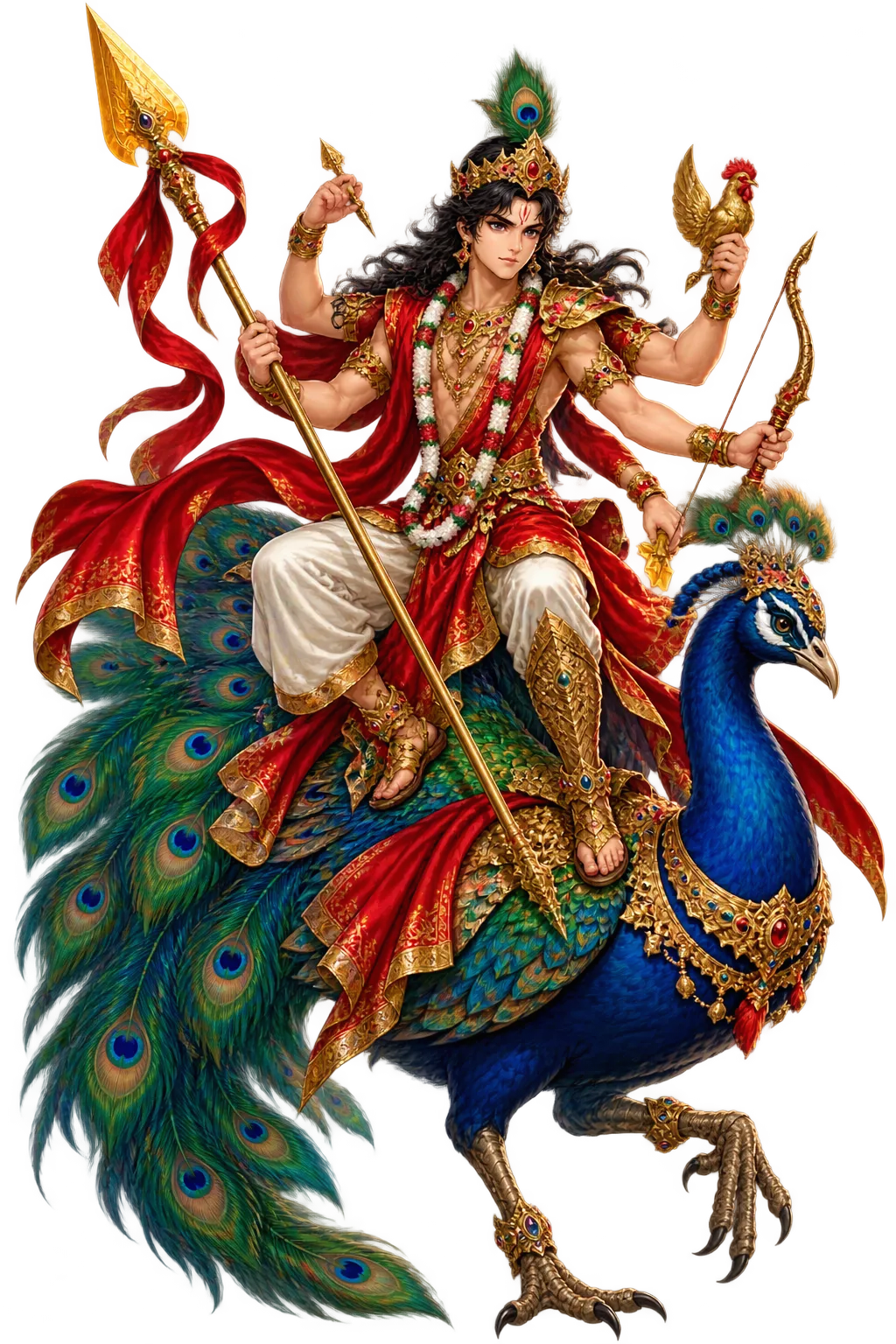
The provenance file on Skanda
Provenance record 490 · Skanda · one temple, fully accounted for.
Provenance
1. The attestation. स्कन्द, from the tradition's own record. On record: Kumārasaṃbhava of Kālidāsa (the birth of the war-god), Skanda Purāṇa (the senāpati theology), Cilappatikāram & Tamil Murugan epics (Vaḷḷi cycle), Kushan-period Skanda-Kumāra coinage.
2. The narrative record. The Birth of Fire — When Agni and the river Ganges could not carry the god’s seed, they left it in the reeds of the Gangā’s bank; six infants were found there by the six Kṛttikā nymphs, each nursing one — until Pārvatī gathered them into a single six-headed child. His first week closed with the death of Tāraka, slain by the spear his mother gave him. The Deva-Senāpati — The great Purāṇa bearing his name makes him general of the gods’ hosts and husband of Devasenā — ‘the army of the gods’ — a marriage arranged before his birth. His camp is on the world’s margin; his peacock mount, the demon Siṃhakeśin subdued, struts beneath his banner.
3. The physical record. The six abodes (Ārupadaiveṭṭu) of Tamil Nadu are his living monuments; Gupta and Kushan sculpture give him his classical six-headed infant form. The Batu Caves of Malaysia, a modern Murugan shrine of cathedral scale, extend his geography into the diaspora.
4. The current holding. The temple at /skanda/, a temple of the restored name. aSCII-equivalent form
5. The documented resonances. Defense, Military & Security, Sports, Fitness & Competition, Automotive & Mobility — seats argued and weighted in the pattern atlas, read through the myths in this temple's Resonance File.
6. The primary sources. Rig Veda, Ramayana — the library this file answers to, open at the Sacred Texts collection.
7. The continuing record. Murugan is Tamil country’s beloved god — the Kanda Ṣaṣṭhī festival at Tiruchendur draws millions, and the god’s hill-shrines anchor Tamil sacred geography. His six-headed infant image, the Kārttikeya of Gupta art, defined the war-god’s iconography for Asia; and the Ṣaṣṭhī vow is observed across the subcontinent by parents of sons.
At a Glance
- Restored name: Skanda
- ASCII form: skanda
- Meaning: "‘The Attacker’ — a name of Kārttikeya, son of Śiva (or of Agni), the god of war who leads the divine hosts against the enemies of the gods."
- Domain of influence: War, Commander
- Pantheon: Sanskrit
- Restoration: ASCII-equivalent form
- Original script: स्कन्द
- Series: The Restoration Files, No. 490 of 597
The File Continues
Read the founding dispatch for the name's full story, the Resonance File for the archetype at work — or the whole archive in one sitting.
Continue the series — previous file: Skaði (read it here) · next file: Skuld (read it here).
The Restoration Files are written from the same canonical record as the temples themselves: the lexicon, the lore catalog, the pattern atlas, and the cited scholarly sources. If a file ever disagrees with its temple, the temple is right — tell us, and the file will be corrected.