
The register rules: Skanda
A letter to a colleague, 31 July 2026 — on the name Skanda, and on the forms that keep failing it.
Your note said, roughly: surely the marks are a nicety. Permit me to use Skanda to show they are not.
First, the attestation. The attested form is स्कन्द, from the tradition's own record. The canonical transliteration is Skanda.
Say it aloud as the sources heard it: “SKUN-duh” The marks are what carry that sound to a reader who has never heard it spoken.
On the plain form — and I want to be precise, because you pushed on this. The plain form skanda differs from the canonical Skanda only by convention of display — case, not content. It is acceptable everywhere: in legacy systems, in plain-text citation, in the DNS itself. What is not acceptable is what follows in the register: respellings that change the letters, not just their case.
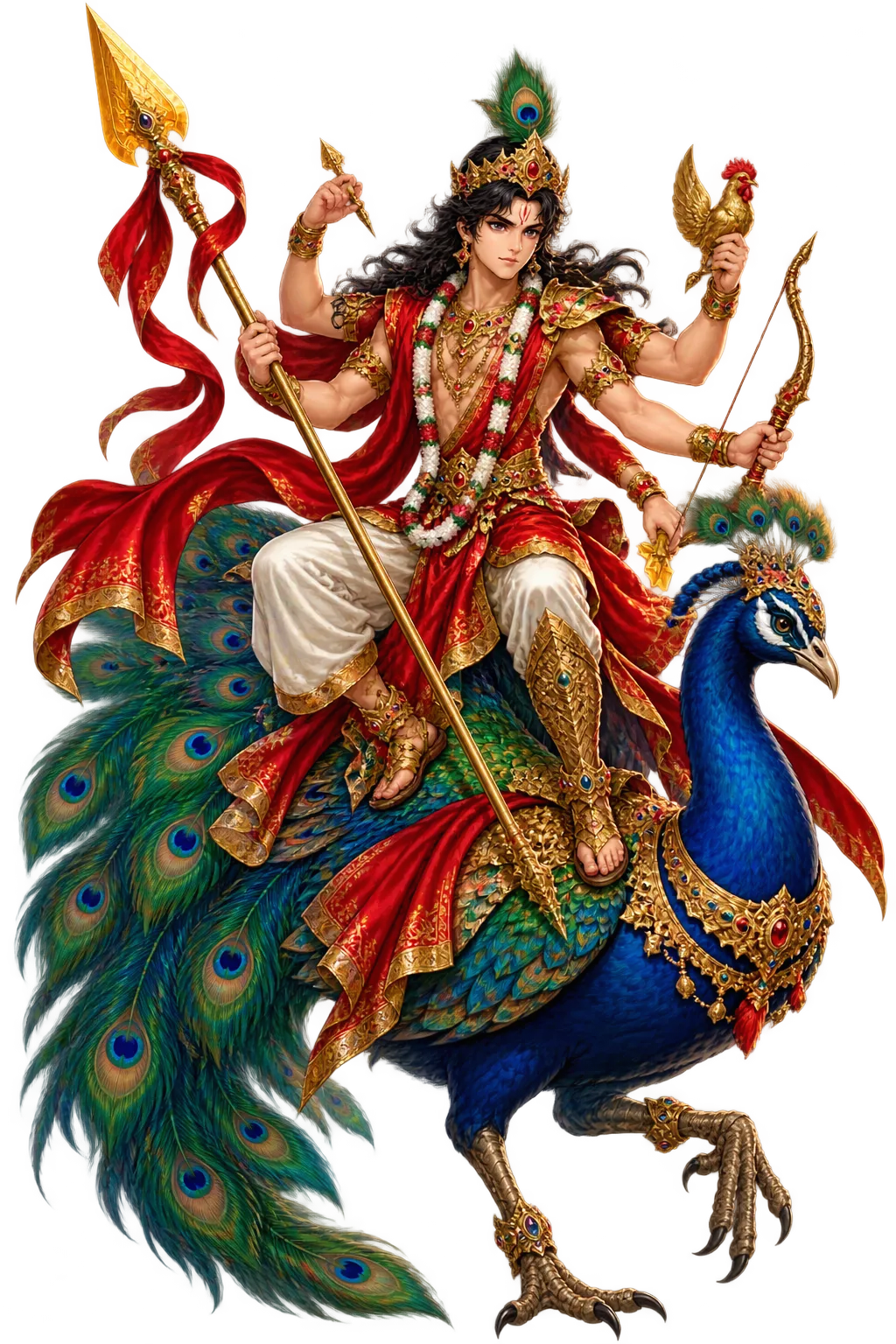
One more thing, because it always surprises: the name did not stay home. Skanda is the great pan-Indian convergence: Vedic Rudra’s son, Tamil Murugan, Buddhist Kārttikeya of the north, and the Graha of the week’s Tuesday. The Greeks of the Northwest compared him to Ares and Mars; the Kushan coins show him as Skanda-Kumāra beside the Buddha.
And it never stopped working. Murugan is Tamil country’s beloved god — the Kanda Ṣaṣṭhī festival at Tiruchendur draws millions, and the god’s hill-shrines anchor Tamil sacred geography. His six-headed infant image, the Kārttikeya of Gupta art, defined the war-god’s iconography for Asia; and the Ṣaṣṭhī vow is observed across the subcontinent by parents of sons.
The Convention's Own History
Long before IAST was formalized in 1912, Sanskrit had Pāṇini — the fourth-century-BCE grammarian whose rules describe the language's sounds with a precision no other ancient tradition matched. That heritage is why the convention is so exact: retroflexes (ṭ, ḍ, ṇ, ṣ) are not accented dentals but separate phonemes with separate meanings; long and short vowels (ā/a, ī/i, ū/u) change words, not just timing. IAST writes those distinctions down with underdots and macrons so that a reader who has never heard Sanskrit can still read it correctly. Dropping the marks is not transliteration at a lower resolution — it is a different, lesser claim.
Where Protocol Meets Practice
The technical answer is simple: the canonical marks are legal IDNA 2008 characters, encoded as punycode under `xn--`. The practical answer is messier: legal does not mean stocked (registrar inventory is partial), and stocked does not mean typeable (stacked diacritics defeat mobile keyboards).
So the register's rule is a hierarchy of attested forms — full restoration, circumflex, macron-only, attested variant, and finally plain ASCII for the systems that cannot carry marks. Every rung is defensible because every rung is attested. The forms this register rules against are not rungs; they are errors, and errors do not get rungs.
Write back when you have checked the sources; they are better company than I am.
— The Register
The Verdict
Skanda is the canonical form: attested, checkable, and enforced across the temple, the lexicon, the cards, the APIs, and this register. The plain form skanda shares that standing — the two are the same name in every system. The false forms above are documented so that no reader has to take the temple's word on faith — the violations are stated, the sources are named, and the register stands open to challenge on every line.
The temple of Skanda stands at /skanda/.
The docket for this ruling: no false forms on the docket; no contested forms attested; the attestation rests on 4 cited sources — Kumārasaṃbhava of Kālidāsa (the birth of the war-god), Skanda Purāṇa (the senāpati theology), Cilappatikāram & Tamil Murugan epics (Vaḷḷi cycle).
The Register Continues
Entry 490 of 597 in the Canonical Register. Around it: the temple's founding dispatch, the Restoration File on the marks themselves, the Resonance File on the archetype at work, and the Rulebook behind all of it.
Continue the register — previous entry: Skaði (read it) · next entry: Skuld (read it).
The Canonical Register is written from the same canonical record as the lexicon itself. If a false form is missing from this page, it is because the evidence does not support calling it false — or because we have not seen it yet. Show us, with a citation, and the register will answer.