The Living Myth
War, Commander · War, the Divine Hosts · ‘The Attacker’ — a name of Kārttikeya, son of Śiva
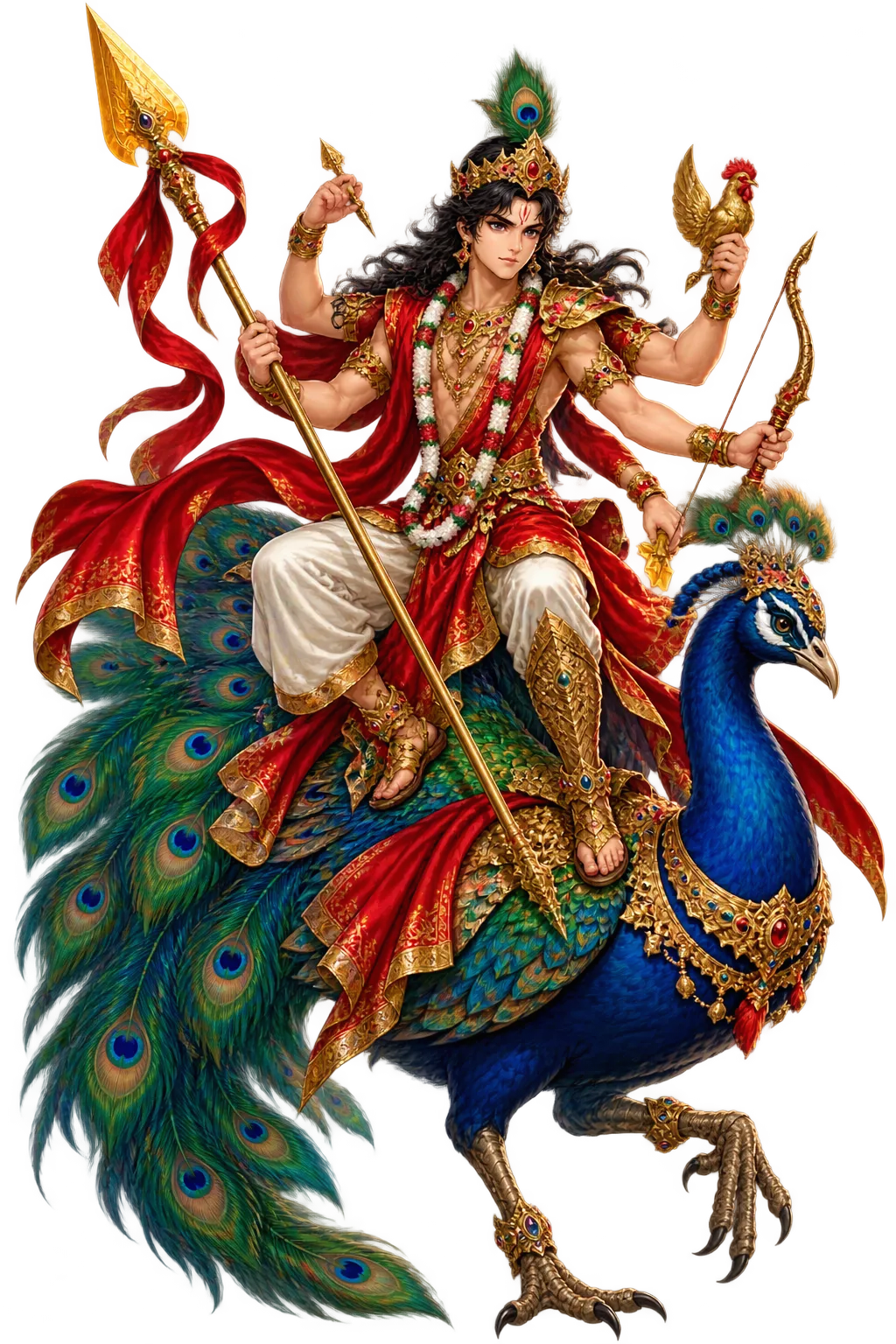
Stories of Skanda
The Skanda myth is the war-god’s birth-saga: the gods, unable to defeat Tāraka, whose boon made him unkillable except by a son of Śiva, contrived the god’s marriage to Pārvatī; the child was born as fire from the third eye, fostered by the Pleiades, and general of heaven before he was a week old. The Tamil Murugan traditions add the wooing of Vaḷḷi, the huntress, and the gnostic doctrine of the Arupadaiveedu, the six stations of grace.
When Agni and the river Ganges could not carry the god’s seed, they left it in the reeds of the Gangā’s bank; six infants were found there by the six Kṛttikā nymphs, each nursing one — until Pārvatī gathered them into a single six-headed child. His first week closed with the death of Tāraka, slain by the spear his mother gave him.
The great Purāṇa bearing his name makes him general of the gods’ hosts and husband of Devasenā — ‘the army of the gods’ — a marriage arranged before his birth. His camp is on the world’s margin; his peacock mount, the demon Siṃhakeśin subdued, struts beneath his banner.
The Tamil epics tell how Murugan wooed the huntress Vaḷḷi in the guise of a tree-shade, and wed both her and Teyvāyāṉai, Indra’s daughter, in the great marriage at Tiruchendur. The legend’s two wives read theologically: divine grace (Teyvāyāṉai) and the soul’s own effort (Vaḷḷi) are both needed for union with the lord.
As Subrahmaṇya — ‘the dear one to the Brahmins’ — he is the teacher-god, expounding the Vedas to his own father Śiva in the role of guru. The image flips the war-god into wisdom’s child, and fixes his southern temples as places of learning as much as of arms.
The Six-Headed General of the Gods’ Army
Skanda is the Hindu war-god: the ever-youthful general of the devas’ hosts, born from the combined fire of Śiva’s third eye to destroy the demon Tāraka. Tamil India knows him as Murugan, the eternally beautiful mountain lord of the six abodes; the Sanskrit world as Kārttikeya, son of the Pleiades’ fosterage.
Commander of the gods’ armies — the deva-senāpati — before whom no asura line holds.
Six sparks from the gods’ wrath-eyes, fostered by the Kṛttikā — the Pleiades — as six infants, fused into one.
Śakti, the lance his mother Umā gave him — one throw ended Tāraka, the boon-armed demon.
Murugan’s six mountain shrines from Tirupparankunram to Palani mark his Tamil country.
From the original script to the living URL
स्कन्द
The name in its original Sanskrit form. Skanda (स्कन्द) is attested in the source tradition — “‘The Attacker’ — a name of Kārttikeya, son of Śiva (or of Agni), the god of war who leads the divine hosts against the enemies of the gods.”. Its original diacritics and script distinctions carry the full phonetic and orthographic weight of the source tradition.
skanda
The plain skanda form is identical to the Unicode restoration. Because this name is already written in Latin letters, no diacritics, stress, or script information were lost — only capitalization differs.
Skanda
The Unicode restoration does not need to recover lost marks for Skanda. Its value is canonical spelling and consistent cataloguing, not the reconstruction of erased orthography. The domain is readable as-is to both DNS and humanity.
Skanda.com
This restoration is written entirely in ASCII letters — no Punycode encoding stands between Skanda and the DNS. The domain reads identically to machines and to human eyes.
The attested spelling family of Skanda
Skanda
Restores स्कन्द. The full Unicode restoration. skanda.com is not in the PuniCodex collection — it is watched for release; if it drops, this temple upgrades to an owned flagship. Attested by MW, Puranas.
How Skanda was spoken
How Skanda travels from ancient script to the modern URL
The lore you have read is the living myth. Extended Lore opens the scholarly vault beneath it: the cult and its material remains, a history of the image, the name after antiquity, a meditation on what the name still means, and the full scholarly apparatus — etymology, orthography, sources.
Enter Extended Lore