
How Lóngwáng got its accent back
The ASCII form longwang is missing something. Lóngwáng restores the marks the source language used to distinguish this name from a thousand others — and those marks change how the name is read, pronounced, and understood. This post explains, with the full scholarly record behind it, what each restored mark preserves: the Chinese characters evidence, the reconstructed sound, the myths the name carries, and the classification logic that separates Tier 1 restorations from Tier 2. By the end, the marks in Lóngwáng will look less like ornaments and more like what they are — recovered evidence, pinned back in its proper place.
At a Glance
- Restored name: Lóngwáng
- ASCII form: longwang
- Meaning: "water deity in Chinese mythology"
- Domain of influence: Dragons, Rain, Rivers
- Pantheon: Chinese
- Classification: Tier 1
- Original script: 龍王 (Chinese characters)
- Live domain: lóngwáng.com
Overview
Lóngwáng (longwang) — Dragons, Rain, Rivers · water deity in Chinese mythology — belongs to the Chinese tradition, where it is catalogued under the domain "Dragons, Rain, Rivers". The name means "water deity in Chinese mythology".
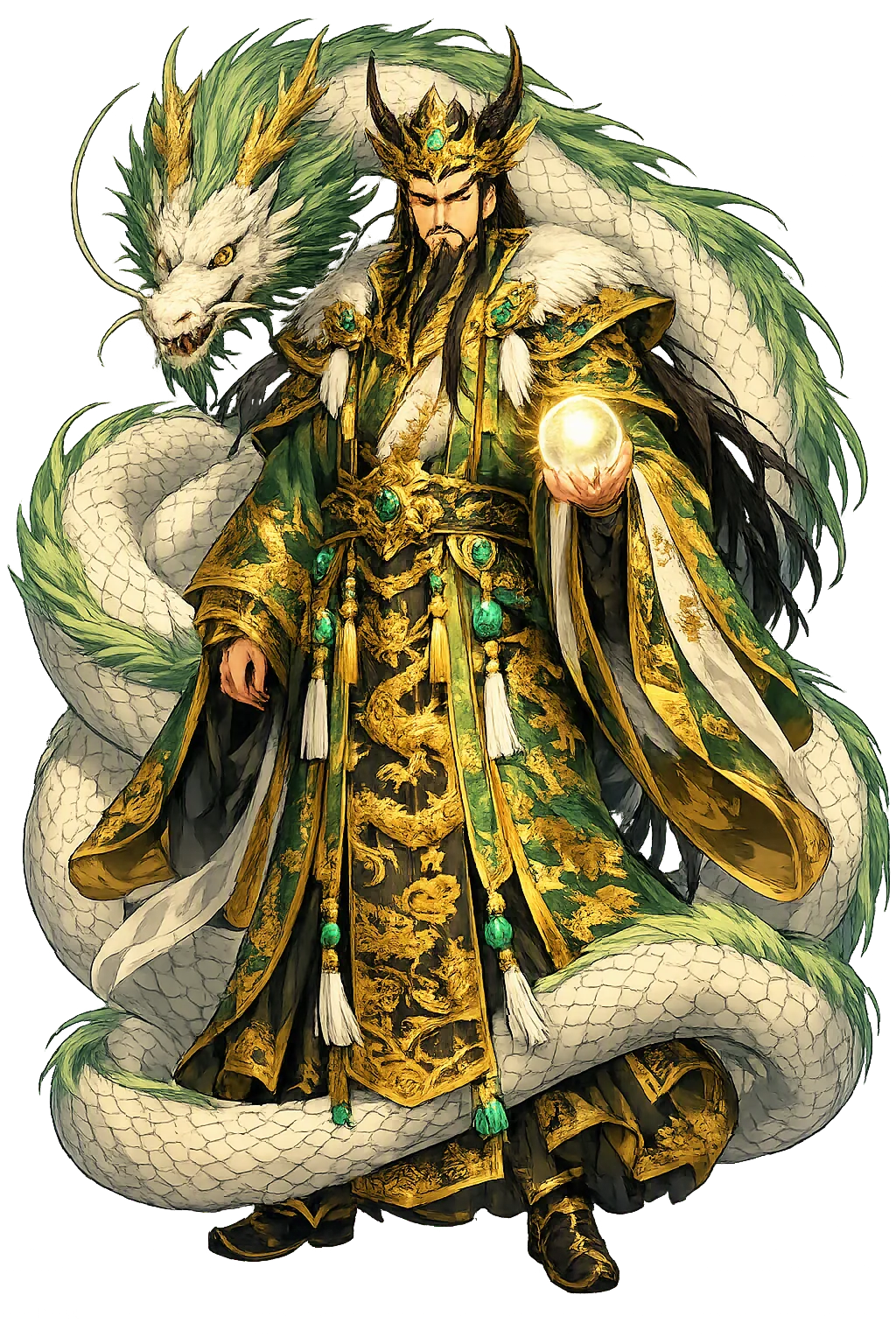
Lóngwáng, the Dragon King, is not one god but a crowned office — four brothers who hold the Four Seas that ring the Chinese world, each enthroned in an underwater crystal palace with its own court, treasury, and army of shrimp soldiers and crab generals. Āo Guǎng 敖廣 of the East Sea is the most prominent; beside him rule Āo Qīn 敖欽 of the South, Āo Rùn 敖閏 of the West, and Āo Shùn 敖順 of the North. Beneath them, lesser dragon kings govern every river, lake, and well worth the naming.
In their world, rainfall is a bureaucratic act. The Jade Emperor issues the mandate — how much rain, where, and at what hour — and the Dragon King delivers it, down to the last tenth of an inch. It is the Chinese imagination at its most characteristic: the wild water of heaven brought under a seal, a ledger, and a chain of command. The novels and the village temples agree on the stakes — a king who edits the figures loses his head, and a village that loses the king's favour loses its harvest.
PuniCodex restores the name as Lóngwáng and serves its temple at lóngwáng.com. The restoration preserves at least one distinctive feature — a diacritic or a distinctive letter — that the ASCII form loses, and exactly one historically valid Unicode restoration exists, which places the name in Tier 1. The plain ASCII form longwang survives as a modern convenience imposed by the early domain-name system; the restoration, not the fallback, is the form the project defends as philologically complete.
The Name
The name is attested in Chinese characters as 龍王. Etymologically it means "water deity in Chinese mythology".
The ASCII form longwang survives only because the early domain-name system could not carry diacritics; it is a technological compromise, not an ancient spelling. The Unicode restoration Lóngwáng recovers the stress accent of the original directly in the address bar. The restoration preserves at least one distinctive feature — a diacritic or a distinctive letter — that the ASCII form loses, and exactly one historically valid Unicode restoration exists, which places the name in Tier 1.
The letter-by-letter transformation runs:
- l → L — Same, capitalized
- o → ó — Stress on o
- n → n — Same
- g → g — Same
- w → w — Same
- a → á — Stress on a
- n → n — Same
- g → g — Same
The project holds the domain lóngwáng.com (xn--lngwng-sta4l.com) as the canonical home of this name.
The Original Script
The name is written in Chinese characters as 龍王. This original script is the form against which the ASCII fallback longwang and the PuniCodex restoration Lóngwáng are measured: the restoration preserves its pitch accent of the written form, so that a reader typing the modern address still speaks the ancient name.
The original script is 龍王 in traditional Chinese and 龙王 in simplified. The Pinyin reading Lóngwáng — two Tone-2 (rising) syllables — is the Modern Standard Mandarin citation form, recorded in the Unihan Database (kMandarin) and standard dictionaries. The tone-marked restoration keeps both acute accents as the display form; the registrable domain maps the accented vowels to their ASCII base letters, giving longwang. No syllable-boundary apostrophe is required: the segmentation lóng·wáng is unambiguous, so the display and domain forms differ only in the tone marks. Baxter & Sagart (2014) reconstruct the Old Chinese forms as [m]-roŋ (龍) and [ɢ]ʷaŋ (王).
Pronunciation
The reconstructed pronunciation of the name is /lʊŋ˧˥ waŋ˧˥/ — Modern Standard Mandarin (Pinyin).
Phoneme by phoneme:
- lóng — First syllable with voiced alveolar lateral approximant [l], final [ʊŋ] (close-mid back rounded vowel + velar nasal), and Tone 2 (rising, ˧˥). Pinyin 'o' before 'ng' corresponds to IPA [ʊ].
- wáng — Second syllable with labial-velar glide [w], open vowel [a], velar nasal coda [ŋ], and Tone 2 (rising, ˧˥).
For the modern speaker, the closest approximation is: LUHNG-WAHNG — two even syllables, each rising from mid to high pitch; the 'o' of the first is like the 'oo' in 'book', the 'a' of the second like the 'a' in 'father'.
Kindred and historical forms of the name:
- Traditional — 龍王
- Simplified — 龙王
- Wade-Giles — Lung²-wang²
- Cantonese — lung⁴ wong⁴
- Related terms — 東海龍王 Dōnghǎi Lóngwáng (Dragon King of the East Sea); 敖廣 Āo Guǎng; 如意金箍棒 Rúyì Jīngū Bàng; 龍王廟 Lóngwáng miào (Dragon King temple)
龍王 denotes the Dragon King, the crowned ruler of the waters in Chinese religion and literature. The Modern Standard Mandarin reading is Lóngwáng — both syllables in Tone 2 (rising, ˧˥) — as recorded in the Unihan Database (Unicode Consortium, kMandarin) for 龍 and 王, and in standard Mandarin dictionaries. Baxter & Sagart (2014) reconstruct the Old Chinese forms as [m]-roŋ (龍, GSR 1193a) and [ɢ]ʷaŋ (王). The tone-marked Pinyin restoration Lóngwáng preserves the citation rising tones of both syllables; in connected speech the contours may be compressed, but the lexical tones remain Tone 2 throughout.
Mythology
The Dragon Kings stand at the crossing of two Chinas: the literary China of the great Ming novels, where they are foils, creditors, and comic bureaucrats, and the living China of the village temple, where they were the address to which a drought-stricken county sent its prayers. The same figure is mocked in the novel and begged in the field.
The Jìng River Dragon King's Wager (Journey to the West)
The Journey to the West preserves the great cautionary tale of the celestial bureaucracy. The Dragon King of the Jìng River wagers with a mortal fortune-teller over the next day's rain; when the Jade Emperor's decree arrives matching the diviner's figures exactly, the king — unwilling to lose — secretly alters the amount and delays the timing. The difference is trifling, and it does not matter. For editing heaven's paperwork he is sentenced to death and executed, a reminder that in a cosmos run as an administration, the smallest forged figure is treason.
Nézhā and the Third Prince (Investiture of the Gods)
In the Investiture of the Gods (Féngshén Yǎnyì), the boy Nézhā, bathing in the eastern stream, shakes the East Sea crystal palace to its foundations with his magic sash. Āo Guǎng sends his third son, Āo Bǐng, to subdue the child; Nézhā kills the prince and plucks out his sinews to make a belt. Faced with the Dragon King's wrath against his family and his town, Nézhā answers with the terrible arithmetic of filial duty — he cuts himself apart, returning his flesh to his mother and his bones to his father, so that the debt dies with him.
The Sea-Pinning Iron (Journey to the West)
Needing a weapon worthy of him, Sūn Wùkōng descends to the East Sea treasury and passes over every blade and spear Āo Guǎng can offer. What he takes instead is the Rúyì Jīngū Bàng — the Compliant Gold-Banded Staff, a black iron pillar that once pinned the seas and measured the flood-waters of the world. To the Dragon King it was a fixture of the deep; to the Monkey King it shrinks to a needle behind the ear and grows to a pillar that props up heaven. The East Sea never got it back.
Parading the King in the Sun (Folk Religion)
Dragon King temples (龍王廟) dotted farming China, and when the rains failed, the village went to the temple: processions, offerings, and rain-prayers addressed to the local king as to a magistrate who had neglected his district. In extreme drought the negotiation turned coercive — the king's effigy was carried out and paraded in the burning sun, so that he might feel on his own lacquered scales the heat his fields were dying of. Few religions have made their god's accountability so literal.
Symbols & Iconography
The iconography associated with Lóngwáng concentrates in a small set of recurring attributes, each a compressed statement about the name:
- Crystal palace — The underwater court (龍宮, Dragon Palace) — sovereignty, hidden wealth, and the ordered world beneath the chaos of the sea
- Rúyì Jīngū Bàng — The compliant gold-banded staff, an iron pillar that once pinned the seas — the tameable measure of the waters, taken from the East Sea treasury by Sūn Wùkōng
- Dragon robe and royal crown — Enfeoffed kingship within the celestial bureaucracy — the Dragon King rules as a peer of heaven's administration, not as a free lord
- Rain clouds and tidal bore — The waters he commands — rain, rivers, lakes, and tides delivered by decree, withheld in drought, unleashed in flood
- Shrimp soldiers and crab generals — The aquatic retinue of the Dragon Palace — the sea's own creatures enrolled as a court, a mirror of the imperial administration below the waves
Archaeology & Evidence
The material cult behind the Dragon Kings is far older than the kings themselves. Shang oracle bones (c. 1250–1045 BCE) record rain sacrifices addressed to river and water powers, and Han texts describe rain-making rites performed with clay dragons — Dong Zhongshu's Chunqiu Fanlu gives the liturgy, and Wang Chong's Lunheng argues against it. Han mirrors and tomb reliefs show the older cosmic dragon of clouds and ascent, not yet a crowned bureaucrat. The named Dragon Kings of the Four Seas crystallize in medieval China under Buddhist influence: nāga kings with submarine palaces appear in translated sūtras from the early centuries CE, the Tang court formally enfeoffed the dragon kings of the Four Seas with royal titles, and by the Song their temples stood in the official register of sacrifices. The literary cycle reaches canonical form in the Ming novels Fengshen Yanyi and Xiyouji.
Realm & Domain
Lóngwáng, the Dragon King, is not one god but a crowned office — four brothers who hold the Four Seas that ring the Chinese world, each enthroned in an underwater crystal palace with its own court, treasury, and army of shrimp soldiers and crab generals. Āo Guǎng 敖廣 of the East Sea is the most prominent; beside him rule Āo Qīn 敖欽 of the South, Āo Rùn 敖閏 of the West, and Āo Shùn 敖順 of the North. Beneath them, lesser dragon kings govern every river, lake, and well worth the naming.
In their world, rainfall is a bureaucratic act. The Jade Emperor issues the mandate — how much rain, where, and at what hour — and the Dragon King delivers it, down to the last tenth of an inch. It is the Chinese imagination at its most characteristic: the wild water of heaven brought under a seal, a ledger, and a chain of command. The novels and the village temples agree on the stakes — a king who edits the figures loses his head, and a village that loses the king's favour loses its harvest.
The Four Seas
Four royal brothers divide the encircling oceans — East, South, West, and North — each ruling tides, storms, and every creature of his sea from a crystal palace below the waves.
Rain by Mandate
Rainfall is paperwork: the Jade Emperor decrees the amount and the hour, and the Dragon King executes the order exactly — to alter either is treason against heaven.
The Sea Treasury
The crystal palace hoards the wealth of the waters — pearls, coral, and the Rúyì Jīngū Bàng, the iron pillar that once pinned the seas, until the Monkey King claimed it for a staff.
Kingship under Heaven
The Dragon King is sovereign in his own water and a subject above it — a king who kneels to the celestial bureaucracy and answers with his life for every misplaced drop.
Across Cultures
The Dragon Kings are among the clearest cases of Buddhism and native Chinese religion merging into a single figure. Native Chinese water-dragon and river-god cults are ancient, but the named kings with submarine palaces, retinues, and treasuries owe much to the Indian nāgarājas — serpent kings of the waters — carried into China with the translated sūtras; Chinese translators rendered nāga as lóng (dragon), and the eight nāga kings of Buddhist scripture became native sea-kings. The relative weight of the Indian import against the older Chinese cult remains a matter of scholarly debate. Taoism then absorbed the kings wholesale into its celestial administration as rain officials answerable to the Jade Emperor. From China the figure travelled with the culture: in Japan the dragon kings appear as ryūō, kin to the sea-god Ryūjin of the undersea palace; in Korea as Yongwang, propitiated by fishing and farming villages alike; in Vietnam as Long Vương, guardian of waters and of the nation's own dragon genealogy.
Within the Chinese tradition, closely related names in the corpus include Bāguà, Cháng'é, Fúxī, Guāndì, Guānyīn, and Hòuyì.
Cultural Legacy
The Dragon King never fully retired. His temples still stand along China's coasts and rivers, and rain-processions to the local king persisted in the countryside into the twentieth century. In literature and performance he is a permanent stock character: every adaptation of the Journey to the West — opera, film, television, animation — must eventually send someone down to the crystal palace, whether to borrow a weapon or to wreck the court. The feud with Nézhā alone has carried him through a century of Chinese animation, from the 1979 feature Nézhā Nào Hǎi (Nezha Conquers the Dragon King) to the 2019 blockbuster Ne Zha, where the dragon clan's grievance drives the plot. In the modern idiom the Dragon King's palace remains a byword for fabulous drowned wealth, and the figure himself endures wherever Chinese fantasy needs a throne beneath the sea.
The Scholarly Record
The account of Lóngwáng given in this edition rests on the witnesses and reference works listed below. Lexica and etymological dictionaries secure the form and meaning of the name; the literary and religious texts supply the narrative evidence.
- Journey to the West (Xiyouji). Full text
- Investiture of the Gods (Fengshen Yanyi). Full text
- Dragon King (encyclopedia overview). Full text
- Ao Guang, Dragon King of the East Sea. Full text
- Shanhaijing (Classic of Mountains and Seas). Full text
- Huainanzi, Liu An; Chinese Text Project, 139 BCE. Full text
- Encyclopaedia Britannica: Longwang. Full text
- Unihan Database (Unicode Consortium). Full text
A Meditation
The Dragon King teaches that water is governed, not merely unleashed. In the Chinese imagination even rain is paperwork: every shower has an issuing authority, an amount, an hour, and a signature. This is not a failure of wonder but a different kind of wonder — the conviction that the wildest force in the farmer's world can be brought under seal and ledger, and that the price of that order is absolute accountability. The Jìng River king lost his head for a trifle of water and an hour's delay, because in a cosmos run as an administration there is no such thing as a small alteration.
To name a domain Lóngwáng is therefore to claim the throne under the waves: the palace where treasure and law are kept together, where the sea's own creatures wear the robes of ministers, and where a king may be sovereign of all he surveys and still answer for every drop. It is the oldest Chinese lesson about power — that it is real only when it is answerable.
The Unicode Restoration
Lóngwáng is classified as Tier 1: the restoration preserves at least one distinctive feature — a diacritic or a distinctive letter — that the ASCII form loses. The ASCII fallback longwang still resolves everywhere, but it is the restored form that carries the name's full information. Across the 8 characters of the name, the restoration adjusts 2: 2 marks of stress (ó, á). That is the whole thesis of this temple: the marks are the message.
The Domain Name
The restored name is live as a working domain: lóngwáng.com, which the DNS carries in punycode form as xn--lngwng-sta4l.com — an ASCII-compatible encoding that lets a non-ASCII name travel the global network without breaking older infrastructure. The visitor sees Lóngwáng; the machines see the encoding. That duality is the engineering compromise on which the entire restoration rests, and it is why a name written the way its own tradition wrote it in Chinese characters can now be typed into any browser on earth.
Why This Restoration Matters
The marks in Lóngwáng were never lost; they were only waiting for a carrier that could hold them. Now that the carrier exists, the burden flips: every use of longwang is a choice to leave evidence on the table. The PuniCodex temple keeps the restored form in circulation — as a domain, a dataset entry, and a scholarly argument — so that the choice to use it stays easy. Accent by accent, macron by macron, that is how the original names come back: not with a single grand gesture, but with a spelling that finally works everywhere.
Explore Further
This post is one doorway into the temple. The home page carries the full character breakdown and the ambient canvas; the lore page tells the myths in long form; the Scholarly Edition preserves the sources, pronunciation data, and revision history; and the patron wall supports the restoration directly. For the wider map, browse the Lexicon, explore the Pantheon, or return to the PuniCodex blog.
Related Names
Sources
The full scholarly apparatus — every citation, revision, and review — lives in the Scholarly Edition. Key references for this post:
- Journey to the West (Xiyouji).
- Investiture of the Gods (Fengshen Yanyi).
- Dragon King (encyclopedia overview).
- Ao Guang, Dragon King of the East Sea.
- Shanhaijing (Classic of Mountains and Seas).
- Huainanzi, Liu An; Chinese Text Project, 139 BCE.
- Lexicon authorities for this entry: Shan Hai Jing, Chinese folklore.