
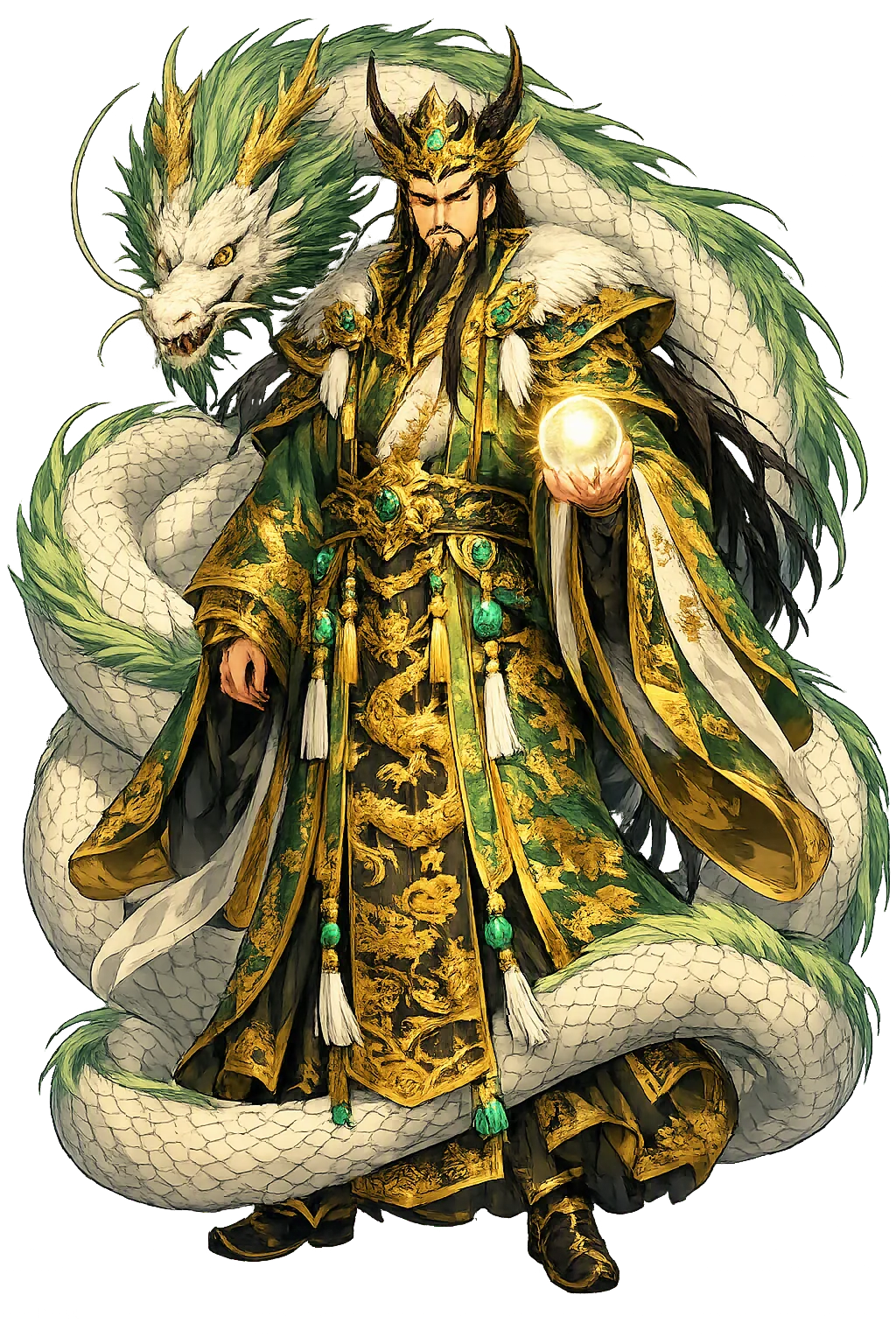
Lóngwáng: canonical, contested, and the false forms on record
The internet spells Lóngwáng more ways than one, and only one of them is the name the sources wrote. This is the register's ruling — canonical, fallback, contested, and false, each in its proper place.
At a Glance
- Canonical form: Lóngwáng
- Original script: 龍王
- Pantheon: Chinese
- Convention: pinyin with tone marks — tones shown, ǖ kept distinct from u
- False forms on record: 1
- Contested forms: none attested
- Series: The Canonical Register, No. 150 of 287
The Canonical Form
The name is attested as 龍王, as Journey to the West (Xiyouji) and Investiture of the Gods (Fengshen Yanyi) preserve it. On the evidence, it means "water deity in Chinese mythology". The canonical transliteration is Lóngwáng.
Every mark is evidence, and every piece of evidence is checkable:
- o → ó — Stress on o: the stress position, as the sources give it.
- a → á — Stress on a: the stress position, as the sources give it.
Where the Flattened Form Stands
The plain form longwang is not false — it is a fallback, and the register is exact about what that means. In systems that cannot carry diacritics (legacy databases, older tooling, parts of the address-bar pipeline) the flattened form is the accepted vehicle, and the rulebook names it explicitly as the final rung of the fallback hierarchy: full restoration first, circumflex where attested, macron-only by the academic standard, an attested variant, and only then plain ASCII.
What the fallback status forbids is promotion: longwang may carry the name where marks are impossible, but it may not represent the name where marks are possible. Every mark it drops — o → ó, a → á — is a fact the sources recorded. A fallback is a vehicle, never the primary.
The Register of False Forms
False form 1: Longwang
Origin: the publisher compromise — older books and hurried websites that print the "English equivalent" as if it were the name itself.
Violation: every substitution here (á→a, ó→o) is a romanization of convenience, not an attested spelling — it teaches the reader to guess, not to read.
The Contested Forms
No alternate form of this name carries documented scholarly support in the lexicon's record. The convention here — pinyin with tone marks — tones shown, ǖ kept distinct from u — produces exactly one defensible transliteration: Lóngwáng. Forms that differ from it are not contested; they are simply wrong.
The Convention's Own History
Every tradition in this register has its own scholarly transliteration standard, built by its own specialists over decades or centuries, and the register follows each on its own terms: pinyin with tone marks — tones shown, ǖ kept distinct from u. The principle that unifies them is the one the whole project stands on: a name is evidence, and evidence is not negotiable — not for keyboards, not for convenience, not for anyone.
What the Address Bar Allows
IDNA 2008 permits the letters these restorations use — macrons, acutes, underdots, thorn, ogonek, the lot — and the DNS carries them as punycode (`xn--` labels). Two honest constraints remain. First, registrar inventory: the protocol permits a character; the registrar's stock decides whether the exact domain can be bought today. Second, combined marks: forms like Apṓllōn (acute stacked on a macron) are philologically ideal yet effectively untypeable on phones and unsupported across much of the registration system.
That is why the rulebook keeps a fallback hierarchy — full restoration first, then the circumflex when the source carries one, then the macron-only academic standard, then an attested variant, and only as a last resort the plain ASCII form. Every step down the ladder is still defensible; nothing on the ladder is a wrong mark. A fallback is a choice among attested forms. A false form is not on the ladder at all.
Where the Name Stood First
The material cult behind the Dragon Kings is far older than the kings themselves. Shang oracle bones (c. 1250–1045 BCE) record rain sacrifices addressed to river and water powers, and Han texts describe rain-making rites performed with clay dragons — Dong Zhongshu's Chunqiu Fanlu gives the liturgy, and Wang Chong's Lunheng argues against it. Han mirrors and tomb reliefs show the older cosmic dragon of clouds and ascent, not yet a crowned bureaucrat. The named Dragon Kings of the Four Seas crystallize in medieval China under Buddhist influence: nāga kings with submarine palaces appear in translated sūtras from the early centuries CE, the Tang court formally enfeoffed the dragon kings of the Four Seas with royal titles, and by the Song their temples stood in the official register of sacrifices. The literary cycle reaches canonical form in the Ming novels Fengshen Yanyi and Xiyouji. The temple on the web is the newest of these addresses — the first one that fits in a pocket.
The Verdict
The register rules for Lóngwáng, and the ruling is checkable: every mark sourced, every violation stated, every borderline form given its honest standing. longwang is the sanctioned fallback for systems without marks — a vehicle, never the scholarly primary. Anything else in circulation has its origin and its failure recorded above. That is the whole of the law on this name — and the temple at /sites/longwang/ enforces it.
The docket for this ruling: 1 false form ruled against, Longwang first on the docket; 2 preserved marks verified: o → ó, a → á; no contested forms attested; the attestation rests on 8 cited sources — Journey to the West (Xiyouji), Investiture of the Gods (Fengshen Yanyi), Dragon King (encyclopedia overview).
The Register Continues
Entry 150 of 287 in the Canonical Register. Around it: the temple's founding dispatch, the Restoration File on the marks themselves, the Resonance File on the archetype at work, and the Rulebook behind all of it.
Continue the register — previous entry: Lóng (read it) · next entry: Mꜣ (read it).
The Canonical Register is written from the same canonical record as the lexicon itself. If a false form is missing from this page, it is because the evidence does not support calling it false — or because we have not seen it yet. Show us, with a citation, and the register will answer.