
Why Lóngwáng is spelled that way — and what it costs to get it right
There is a version of this name the early internet had to settle for: longwang. This is the file on how Lóngwáng replaced it.
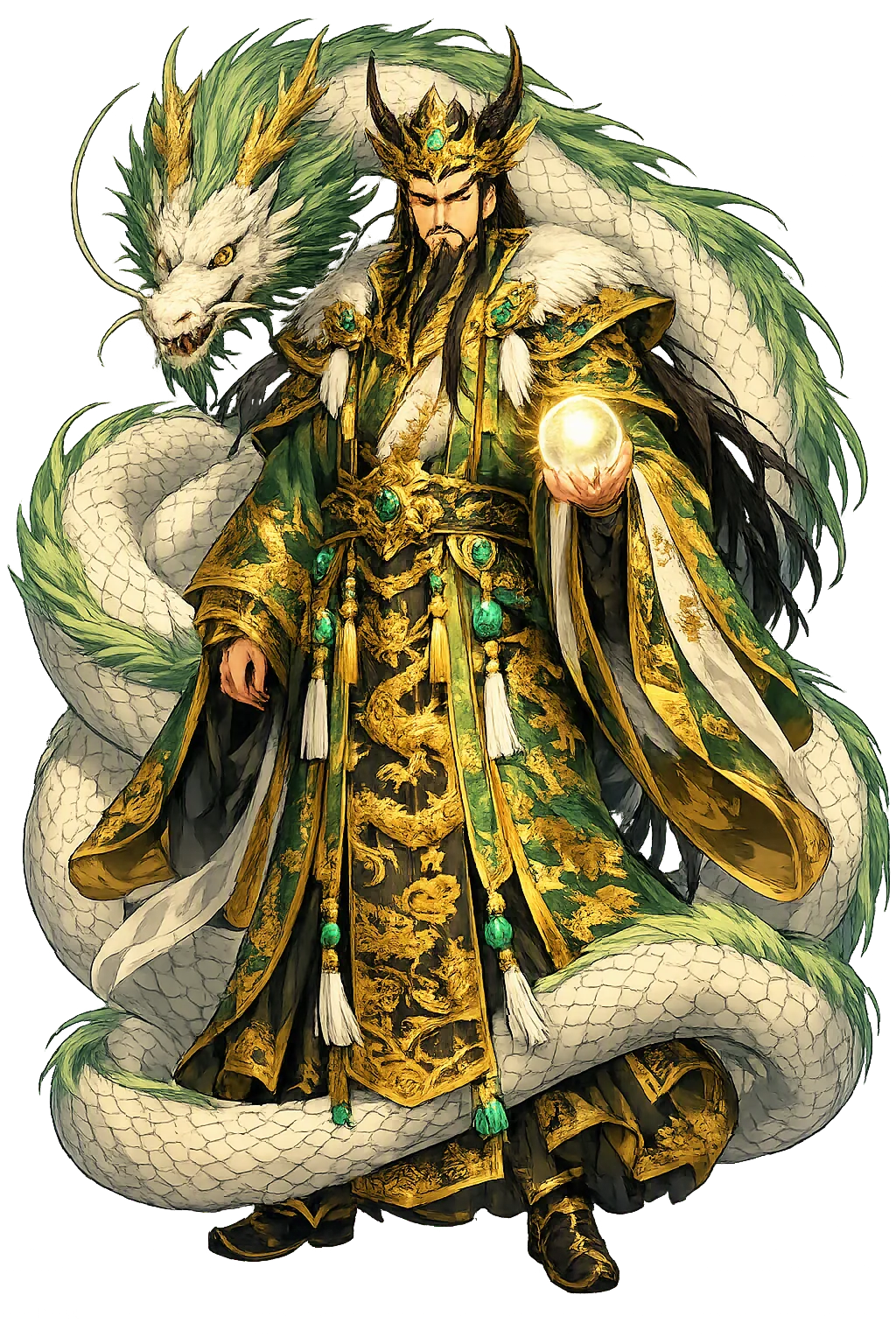
The Dragon Kings stand at the crossing of two Chinas: the literary China of the great Ming novels, where they are foils, creditors, and comic bureaucrats, and the living China of the village temple, where they were the address to which a drought-stricken county sent its prayers. The same figure is mocked in the novel and begged in the field.
At a Glance
- Restored name: Lóngwáng
- ASCII form: longwang
- Meaning: "water deity in Chinese mythology"
- Domain of influence: Dragons, Rain, Rivers
- Pantheon: Chinese
- Classification: Tier 1
- Original script: 龍王
- Series: The Restoration Files, No. 150 of 287
The Name Before the Marks
The name is attested as 龍王, as Journey to the West (Xiyouji) and Investiture of the Gods (Fengshen Yanyi) preserve it. On the evidence, it means "water deity in Chinese mythology".
Strip Lóngwáng to longwang and 2 pieces of evidence vanish:
- o → ó — Stress on o: the stress position the ASCII form cannot show.
- a → á — Stress on a: the stress position the ASCII form cannot show.
These are the small, provable things a restoration is made of: not taste, not branding — attestation.
Spoken, the name runs `/lʊŋ˧˥ waŋ˧˥/` — lUHNG-WAHNG — two even syllables, each rising from mid to high pitch; the 'o' of the first is like the 'oo' in 'book', the 'a' of the second like the 'a' in 'father'.
The Temple That Stands Now
The restored name is not a plaque; it is an address. The temple of Lóngwáng lives at /sites/longwang/, with its mythology in the lore halls, its peer-reviewed record in the Scholarly Edition, and its place in the pattern atlas on the patterns floor.
The restoration preserves more than the ASCII form can express — stress, length, or a letter the Latin keyboard lost — which places it, mechanically, in Tier-1.
Where the Name Stood First
The material cult behind the Dragon Kings is far older than the kings themselves. Shang oracle bones (c. 1250–1045 BCE) record rain sacrifices addressed to river and water powers, and Han texts describe rain-making rites performed with clay dragons — Dong Zhongshu's Chunqiu Fanlu gives the liturgy, and Wang Chong's Lunheng argues against it. Han mirrors and tomb reliefs show the older cosmic dragon of clouds and ascent, not yet a crowned bureaucrat. The named Dragon Kings of the Four Seas crystallize in medieval China under Buddhist influence: nāga kings with submarine palaces appear in translated sūtras from the early centuries CE, the Tang court formally enfeoffed the dragon kings of the Four Seas with royal titles, and by the Song their temples stood in the official register of sacrifices. The literary cycle reaches canonical form in the Ming novels Fengshen Yanyi and Xiyouji. The temple on the web is the newest of these addresses — the first one that fits in a pocket.
The Archetype at Work
The pattern atlas seats this temple in 4 industries, each match argued and weighted: Maritime, Shipping & Ocean Industries (the four seas are his family's jurisdiction; every hull in Chinese waters sailed under the Dragon Kings' toll.); Freshwater & Hydrology (rain, rivers, and wells are the office — drought-stricken counties petitioned his temple as the water ministry of last resort.); Agriculture, Food & Harvest (the rain-prayer was farming China's oldest agtech; his temple stood where the irrigation district now sits.). The Resonance File reads those seats through the myths themselves.
In the Sacred Texts
The Chinese tradition is not a vibe; it is a library. The Sacred Texts collection holds Tao Te Ching — the primary sources the temple's scholarship is built on. The temple is the argument; the texts are the evidence.
The File Continues
The temple's founding dispatch tells the name's story; its Resonance File reads the myths into the industries; the blog index holds the whole archive.
Continue the series — previous file: Lóng (read it here) · next file: Mꜣ (read it here).
The Restoration Files are written from the same canonical record as the temples themselves: the lexicon, the lore catalog, the pattern atlas, and the cited scholarly sources. If a file ever disagrees with its temple, the temple is right — tell us, and the file will be corrected.