The Authentic Orthography
Dragons, Rain, Rivers · Dragons, Rain, Rivers · water deity in Chinese mythology
Unicode restoration and ASCII comparison
龍王
The name in its original Chinese form. Lóngwáng (龍王) is attested in the source tradition — “water deity in Chinese mythology”. Its acute stress marks carry the full phonetic and orthographic weight of the source tradition.
longwang
Reduced to plain longwang, the name loses everything that made it specific: acute stress marks. What remains is an ASCII string that machines can parse but that no longer speaks with its original voice.
Lóngwáng
The Unicode restoration recovers what ASCII flattened. Lóngwáng restores acute stress marks, returning the name to its original written dignity. The domain encodes to Punycode, but the browser displays the truth.
Lóngwáng.com → xn--lngwng-sta4l.com
The non-ASCII characters in Lóngwáng are encoded while the ASCII remains visible. To the DNS, it is Punycode. To humanity, it is Lóngwáng.
How Lóngwáng is preserved in writing
A bespoke provenance study for Lóngwáng is being prepared by the PUNICODEX scholarly team.
Contribute scholarly provenance →Owned, ideal, and ASCII forms of Lóngwáng
Lóngwáng
Restores 龍王. The live temple domain — lóngwáng.com.
longwang
Flattens 龍王. The plain ASCII fallback — what DNS and legacy systems see.
How Lóngwáng was spoken
Crystal Palaces, Rain by Mandate, the Bureaucracy of Water
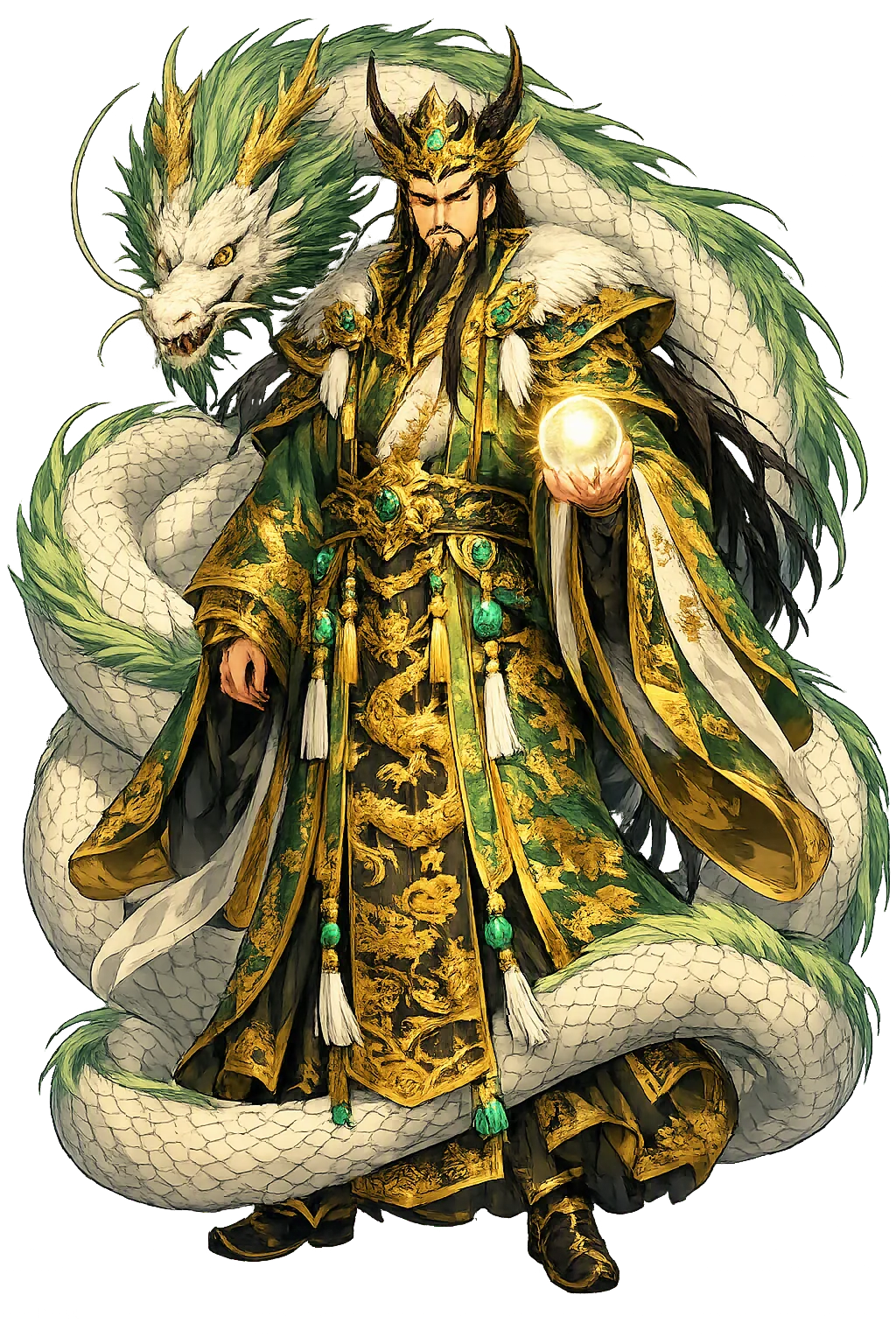
Lóngwáng, the Dragon King, is not one god but a crowned office — four brothers who hold the Four Seas that ring the Chinese world, each enthroned in an underwater crystal palace with its own court, treasury, and army of shrimp soldiers and crab generals. Āo Guǎng 敖廣 of the East Sea is the most prominent; beside him rule Āo Qīn 敖欽 of the South, Āo Rùn 敖閏 of the West, and Āo Shùn 敖順 of the North. Beneath them, lesser dragon kings govern every river, lake, and well worth the naming.
In their world, rainfall is a bureaucratic act. The Jade Emperor issues the mandate — how much rain, where, and at what hour — and the Dragon King delivers it, down to the last tenth of an inch. It is the Chinese imagination at its most characteristic: the wild water of heaven brought under a seal, a ledger, and a chain of command. The novels and the village temples agree on the stakes — a king who edits the figures loses his head, and a village that loses the king's favour loses its harvest.
Four royal brothers divide the encircling oceans — East, South, West, and North — each ruling tides, storms, and every creature of his sea from a crystal palace below the waves.
Rainfall is paperwork: the Jade Emperor decrees the amount and the hour, and the Dragon King executes the order exactly — to alter either is treason against heaven.
The crystal palace hoards the wealth of the waters — pearls, coral, and the Rúyì Jīngū Bàng, the iron pillar that once pinned the seas, until the Monkey King claimed it for a staff.
The Dragon King is sovereign in his own water and a subject above it — a king who kneels to the celestial bureaucracy and answers with his life for every misplaced drop.
Stories of Lóngwáng
The Dragon Kings stand at the crossing of two Chinas: the literary China of the great Ming novels, where they are foils, creditors, and comic bureaucrats, and the living China of the village temple, where they were the address to which a drought-stricken county sent its prayers. The same figure is mocked in the novel and begged in the field.
The Journey to the West preserves the great cautionary tale of the celestial bureaucracy. The Dragon King of the Jìng River wagers with a mortal fortune-teller over the next day's rain; when the Jade Emperor's decree arrives matching the diviner's figures exactly, the king — unwilling to lose — secretly alters the amount and delays the timing. The difference is trifling, and it does not matter. For editing heaven's paperwork he is sentenced to death and executed, a reminder that in a cosmos run as an administration, the smallest forged figure is treason.
In the Investiture of the Gods (Féngshén Yǎnyì), the boy Nézhā, bathing in the eastern stream, shakes the East Sea crystal palace to its foundations with his magic sash. Āo Guǎng sends his third son, Āo Bǐng, to subdue the child; Nézhā kills the prince and plucks out his sinews to make a belt. Faced with the Dragon King's wrath against his family and his town, Nézhā answers with the terrible arithmetic of filial duty — he cuts himself apart, returning his flesh to his mother and his bones to his father, so that the debt dies with him.
Needing a weapon worthy of him, Sūn Wùkōng descends to the East Sea treasury and passes over every blade and spear Āo Guǎng can offer. What he takes instead is the Rúyì Jīngū Bàng — the Compliant Gold-Banded Staff, a black iron pillar that once pinned the seas and measured the flood-waters of the world. To the Dragon King it was a fixture of the deep; to the Monkey King it shrinks to a needle behind the ear and grows to a pillar that props up heaven. The East Sea never got it back.
Dragon King temples (龍王廟) dotted farming China, and when the rains failed, the village went to the temple: processions, offerings, and rain-prayers addressed to the local king as to a magistrate who had neglected his district. In extreme drought the negotiation turned coercive — the king's effigy was carried out and paraded in the burning sun, so that he might feel on his own lacquered scales the heat his fields were dying of. Few religions have made their god's accountability so literal.
The Dragon King teaches that water is governed, not merely unleashed. In the Chinese imagination even rain is paperwork: every shower has an issuing authority, an amount, an hour, and a signature. This is not a failure of wonder but a different kind of wonder — the conviction that the wildest force in the farmer's world can be brought under seal and ledger, and that the price of that order is absolute accountability. The Jìng River king lost his head for a trifle of water and an hour's delay, because in a cosmos run as an administration there is no such thing as a small alteration.
Enter Extended Lore