
The hidden history behind Kleió
Behind the modern ASCII form kleio hides a much longer story. Kleió reaches back through manuscripts, inscriptions, and oral tradition long before it ever touched a keyboard, and every mark in the restored spelling is a receipt from that journey. In what follows we trace the name from its Greek attestations through its mythology, its cult, its symbols, and its afterlife in other cultures — and we show how the PuniCodex project turned that philological record into a Unicode domain that resolves today. The history was never lost. It was only waiting for the infrastructure to catch up.
At a Glance
- Restored name: Kleió
- ASCII form: kleio
- Meaning: "Proclaimer, glorifier"
- Domain of influence: History
- Pantheon: Greek
- Classification: Tier 1
- Original script: Κλειώ (Greek)
- Live domain: kleiṓ.com
Overview
Kleió (kleio) — History · Proclaimer, glorifier — belongs to the Greek tradition, where it is catalogued under the domain "History". The name means "Proclaimer, glorifier".
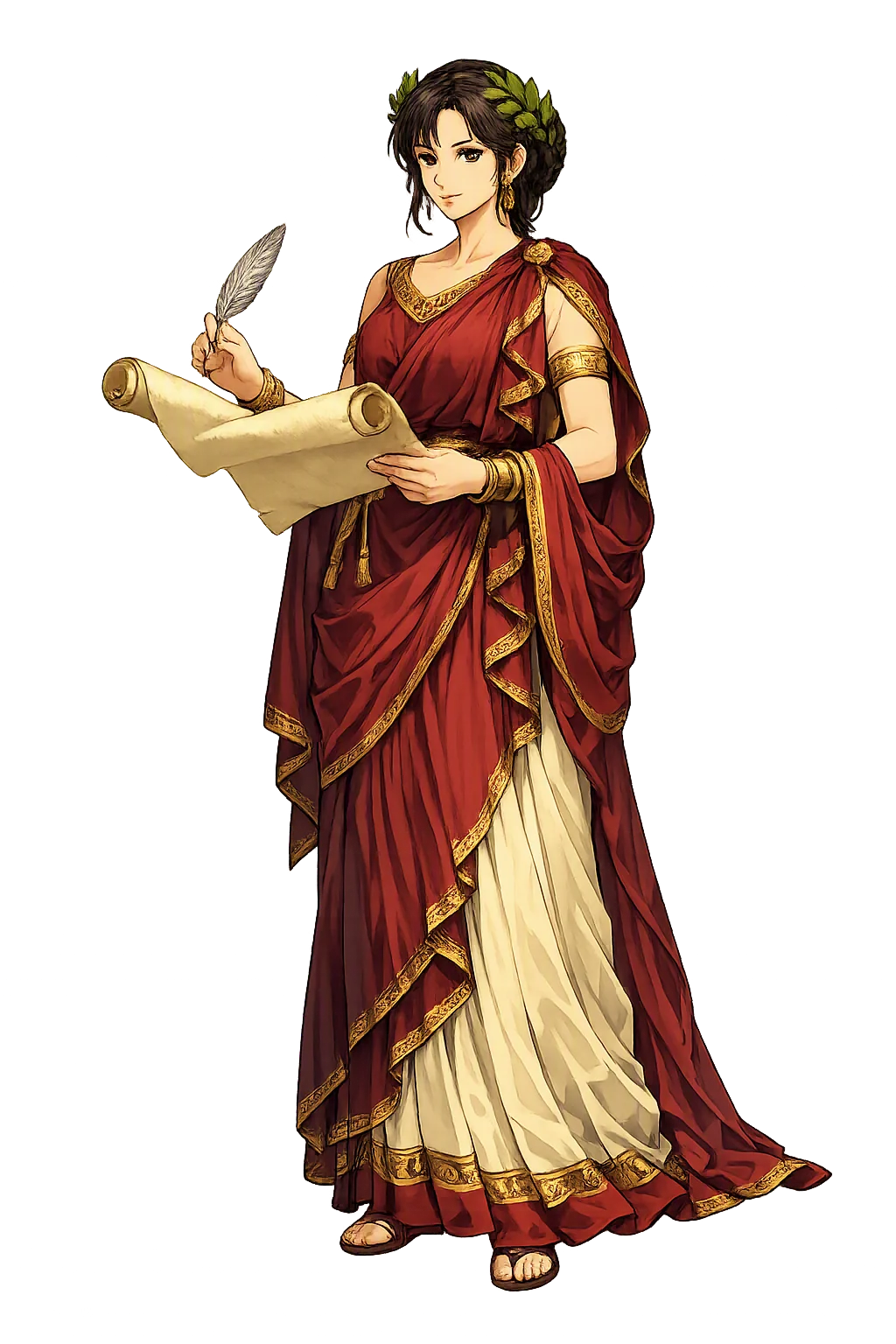
Kleiṓ is the Muse of history — in Greek terms, of ἱστορία, 'inquiry, research'. First-named of the nine daughters of Zeus and Mnēmosýnē, her name is her office: from κλέος, 'glory', she is she who proclaims fame, the power that keeps great deeds from being erased by time. In art she sits with an open scroll or a chest of books — the archive made divine.
PuniCodex restores the name as Kleió and serves its temple at kleiṓ.com. The original carries both stress and vowel length, and exactly one historically valid Unicode restoration exists, which places the name in Tier 1. The plain ASCII form kleio survives as a modern convenience imposed by the early domain-name system; the restoration, not the fallback, is the form the project defends as philologically complete.
The Name
The name is attested in Greek as Κλειώ. Etymologically it means "Proclaimer, glorifier".
The ASCII form kleio survives only because the early domain-name system could not carry diacritics; it is a technological compromise, not an ancient spelling. The Unicode restoration Kleió recovers the stress accent of the original directly in the address bar. The original carries both stress and vowel length, and exactly one historically valid Unicode restoration exists, which places the name in Tier 1.
The letter-by-letter transformation runs:
- k → K — K uppercase
- l → l — l same
- e → e — e same
- i → i — i same
- o → ó — Acute on o
Attested and derived spellings of the name:
- Kleiṓ — owned form: Owned domain form — the stacked marks echoing the circumflex of Κλειώ
The project holds the domain kleiṓ.com (xn--klei-3f5a.com) as the canonical home of this name.
The Original Script
The name is written in Greek as Κλειώ. This original script is the form against which the ASCII fallback kleio and the PuniCodex restoration Kleió are measured: the restoration preserves its pitch accent of the written form, so that a reader typing the modern address still speaks the ancient name.
Pronunciation
The reconstructed pronunciation of the name is /kleː.ɔ́ː/ — Attic Greek Reconstruction.
Phoneme by phoneme:
- Kl- — [kl], a voiceless velar stop released straight into a clear lateral — a sharp, liquid onset.
- -ei- — The digraph ει, by the classical period a close long [eː], held steady and bright.
- -ṓ — Long omega [ɔ́ː] bearing the acute accent: the voice rises on the final syllable and holds it long.
For the modern speaker, the closest approximation is: 'kleh-OH' — two syllables; keep the first short and bright, then rise and linger on the long final ō. Not the modern 'KLY-oh'.
Kindred and historical forms of the name:
- Greek — κλέος (kleos), 'glory, fame, that which is heard of someone' — the noun behind the name; compare κλείω, 'to proclaim, celebrate'.
- PIE — *ḱlew-, 'to hear' — the same root as Sanskrit śrávas ('fame') and, through Germanic, English loud.
- Latin — Clio, adopted directly into Latin poetry without alteration.
Kleiṓ is Tier 1: the Greek original Κλειώ carries both acute stress and the long vowel ω. The restoration preserves both features — the macron marking the long ō and the acute marking the accented syllable — which the ASCII form 'Kleio' loses.
Mythology
Kleiṓ rarely acts in myths of her own; she is the authority behind them. Her province is not adventure but memory — the fame by which every other story survives.
Daughter of Memory (Theogony)
In the Theogony (53–62) Hesiod tells how Zeus lay with Mnēmosýnē, Memory, for nine nights, and how she bore nine daughters in Pieria 'of one mind, whose hearts are set upon song'. At 76–79 he names them, and Kleiṓ stands first: 'Κλειώ τ᾽ Εὐτέρπη τε…'. Their purpose is stated plainly (Theogony 55): they were born to be 'forgetfulness of evils and rest from cares' — memory, paradoxically, as the cure of sorrow.
The First History (Herodotus)
Kleiṓ's office becomes literature in the proem of Herodotus (1.1): he publishes his ἱστορίη — literally 'inquiry, research' — 'so that the deeds of men may not be erased by time, nor the great and wondrous works of Greeks and barbarians become aklea, without glory'. The word ἀκλεᾶ is her own name negated: history exists so that κλέος survives. Cicero would later call Herodotus the father of history (De Legibus 1.5), but the Greeks had already given history a Muse.
The Mother of Hyacinthus (Mythography)
Apollodorus (Bibliotheca 1.3.3) records that Pierus of Macedon begot Hyacinthus by Kleiṓ. The beautiful youth was loved by Apollo and killed by a ricocheting discus; from his blood sprang the flower marked with the cry of lamentation. The fuller telling is Ovid's (Metamorphoses 10.162–219). A late scholastic tradition adds that Kleiṓ had mocked Aphrodítē's passion for Adōnis and was repaid with this bitter love of her own — a rare, unhappy glimpse of the Muse drawn into a story rather than telling one.
The Invocation of the Nine (Orphic Hymns)
The Orphic Hymn to the Muses (76) calls on Kleiṓ together with her eight sisters as daughters of Zeus and Mnēmosýnē, queens of the Pierian spring, and begs them to come to the initiates bringing fame and wisdom. Here the sisterhood is one power: song, memory, and the glory that outlasts death.
Symbols & Iconography
The iconography associated with Kleió concentrates in a small set of recurring attributes, each a compressed statement about the name:
- Open scroll (volumen) — Her constant attribute in Roman Muse-sarcophagi and later art: the unrolled record of human deeds.
- Chest of books (capsa) — The archive she guards — history as something collected, ordered, and kept.
- Writing tablets and stylus — The instruments of the recorder; ἱστορία begins as inquiry set down in notes.
- Laurel wreath — The crown of poet and victor alike — kleos is the immortality that song confers.
- Trumpet of Fame — A post-classical addition to her iconography: renown proclaimed across the ages.
- The spring Hippokrene — The 'horse's spring' on Helicon, struck open by Pēgasos' hoof, sacred to Kleiṓ and her sisters (Pausanias 9.31).
Archaeology & Evidence
Kleiṓ never had a sanctuary of her own; her cult is the collective cult of the Muses. Pausanias (9.29–31) walked the Valley of the Muses below Mount Helicon and describes the sacred grove, the statues of the nine, and the springs Aganippe and Hippokrene near the festival ground where the Thespians held the Mouseia. Beyond Greece, the great Mouseion of Alexandria — literally a 'shrine of the Muses' — made the sisterhood the patronesses of scholarship itself, while Roman sarcophagi identify Kleiṓ within the Muse-choir by her unrolled scroll.
Realm & Domain
Kleiṓ is the Muse of history — in Greek terms, of ἱστορία, 'inquiry, research'. First-named of the nine daughters of Zeus and Mnēmosýnē, her name is her office: from κλέος, 'glory', she is she who proclaims fame, the power that keeps great deeds from being erased by time. In art she sits with an open scroll or a chest of books — the archive made divine.
The Written Record
Her unrolled scroll — the volumen of the Roman portraits — is history itself: deeds fixed against forgetting.
The Voice of Fame
To proclaim, κλείειν, is to make heard; later allegory gives her the trumpet that blows renown down the generations.
The Archive
The book-chest at her feet: the memory of the world, stored, ordered, and retrievable.
Across Cultures
Rome received the Muses wholesale and gave them no new names: Kleiṓ became Clio, invoked by Latin poets and pictured on sarcophagi with her scroll. The native Camenae — Italic spring-nymphs equated with the Muses since Livius Andronicus rendered the Odyssey's 'Musa' as 'Camena' — absorbed the cult but never the individual names. In the Renaissance, Clio was lifted out of the sisterhood altogether and made the personification of History itself, book and trumpet in hand, in iconographic manuals such as Cesare Ripa's Iconologia.
Within the Greek tradition, closely related names in the corpus include Achérōn, Achilleús, Adámas, Aḗr, Aithḗr, and Anánkē.
Cultural Legacy
She is the one Muse whose name became a discipline's nickname: historians still speak of 'Clio' when they mean their craft personified. The quantitative school of history that rose in the 1960s called itself cliometrics — her name wedded to measurement. The asteroid 84 Klio, discovered in 1865, carries her into the sky, and the Clio Awards borrow her proclamation for advertising. The word 'history' itself descends from her Greek province, ἱστορία, 'inquiry'.
The Scholarly Record
The account of Kleió given in this edition rests on the witnesses and reference works listed below. Lexica and etymological dictionaries secure the form and meaning of the name; the literary and religious texts supply the narrative evidence.
- Hesiod, Theogony / Works and Days / Shield, Loeb Classical Library No. 57, 700 BCE. Full text
- Theogony.
- Histories, Loeb Classical Library, 440 BCE. Full text
- Apollodorus, Bibliotheca, Loeb Classical Library (Frazer), 150.
- Pausanias, Description of Greece, Loeb Classical Library, 180. Full text
- Ovid (Publius Ovidius Naso), Metamorphoses / Fasti / Heroides, Loeb Classical Library, 17. Full text
- Orphic Hymns.
- Wörterbuch der griechischen Eigennamen, 3rd ed., 1863. Full text
- Liddell-Scott-Jones Greek-English Lexicon, 9th ed. with 1996 supplement, 1940. Full text
- Etymological Dictionary of Greek, 2 vols., Brill, 2010. Full text
A Meditation
That the Greeks made history a Muse is the fact worth pausing on: the recording of the past was not clerical work but an inspired art, daughter of Memory herself. Her parentage states a whole philosophy — Zeus begets on Mnēmosýnē the power that turns what is remembered into what is proclaimed. For κλέος was what heroes died to win, and Kleiṓ is the arbiter of it: she decides what is still heard when the generations have turned to dust. There is ambivalence in that gift, for memory selects as much as it preserves, and every archive is also an act of omission. Herodotus, her first great servant, understood this: his ἱστορίη is research in the service of fame, so that the deeds of Greeks and barbarians alike should not go aklea — ungloried, unheard.
The Unicode Restoration
Kleió is classified as Tier 1: the original carries both stress and length, and only one valid Unicode restoration exists. The ASCII fallback kleio still resolves everywhere, but it is the restored form that carries the name's full information. Across the 5 characters of the name, the restoration adjusts 1: 1 mark of stress (ó). That is the whole thesis of this temple: the marks are the message.
Name Variations
The lexicon records 1 additional form of the name:
- Kleiṓ (owned) — Owned domain form — the stacked marks echoing the circumflex of Κλειώ
The temple uses Kleió as the primary form: it is the spelling that best balances philological accuracy with the practical limits of DNS.
Character by Character
The journey from kleio to Kleió, one character at a time:
- k → K — K uppercase
- l → l — l same
- e → e — e same
- i → i — i same
- o → ó — Acute on o
The Domain Name
The restored name is live as a working domain: kleiṓ.com, which the DNS carries in punycode form as xn--klei-3f5a.com — an ASCII-compatible encoding that lets a non-ASCII name travel the global network without breaking older infrastructure. The visitor sees Kleió; the machines see the encoding. That duality is the engineering compromise on which the entire restoration rests, and it is why a name written the way its own tradition wrote it in Greek can now be typed into any browser on earth.
The Greek Pantheon
Kleió is one of 266 entries the PuniCodex lexicon catalogues under the Greek pantheon. The Pantheon page gathers the tradition's major figures in one place, and the Lexicon lets you filter all 925 restorations by tradition, tier, or script — the fastest way to see where this name sits among its kin.
Frequently Asked Questions
What does Kleió mean? The traditional gloss is "Proclaimer, glorifier."
Which tradition does Kleió belong to? Kleió is catalogued in the Greek pantheon of the PuniCodex lexicon.
Why is Kleió classified as Tier 1? Because the original carries both stress and length, and only one valid Unicode restoration exists — and the marks in the restored spelling preserve exactly that evidence.
Is Kleió a working domain? Yes — kleiṓ.com resolves today and routes to this temple.
What is the punycode for kleiṓ.com? The DNS encoding is xn--klei-3f5a.com; browsers perform the translation automatically, so visitors only ever see the restored name.
Typing Kleió
You do not need a special keyboard to use this restoration. The PuniCodex Type Tool converts the ASCII form kleio into Kleió as you type, and the browser extension offers the same conversion inside any text field. Copy the restored form, paste it into the address bar, and the DNS does the rest.
Sister Temples
Other temples in the Greek pantheon include Meleágros, Mínōs, and Mómos — each with its own restoration story, its own scholarly record, and its own place in the lexicon.
Why This Restoration Matters
The story of Kleió did not end in antiquity; it changed medium. Names that survive for millennia do so because each generation finds a new carrier for them — clay, papyrus, print, and now DNS. The PuniCodex restoration simply makes the carrier honest: the spelling that resolves is the spelling the evidence supports. If this post showed anything, it is that kleio and Kleió are not the same name with different styling. They are a summary and the text it summarizes. The web can now serve the text.
Explore Further
This post is one doorway into the temple. The home page carries the full character breakdown and the ambient canvas; the lore page tells the myths in long form; the Scholarly Edition preserves the sources, pronunciation data, and revision history; and the patron wall supports the restoration directly. For the wider map, browse the Lexicon, explore the Pantheon, or return to the PuniCodex blog.
Related Names
Sources
The full scholarly apparatus — every citation, revision, and review — lives in the Scholarly Edition. Key references for this post:
- Hesiod, Theogony / Works and Days / Shield, Loeb Classical Library No. 57, 700 BCE.
- Histories, Loeb Classical Library, 440 BCE.
- Pausanias, Description of Greece, Loeb Classical Library, 180.
- Ovid (Publius Ovidius Naso), Metamorphoses / Fasti / Heroides, Loeb Classical Library, 17.
- Wörterbuch der griechischen Eigennamen, 3rd ed., 1863.
- Liddell-Scott-Jones Greek-English Lexicon, 9th ed. with 1996 supplement, 1940.
- Theogony.
- Apollodorus, Bibliotheca, Loeb Classical Library (Frazer), 150.
- Orphic Hymns.
- Lexicon authorities for this entry: Hesiod, LSJ.