Unicode restoration and ASCII comparison
Κλειώ
The name in its original Greek form. Kleió (Κλειώ) is attested in the source tradition — “Proclaimer, glorifier”. Its diphthongs, long vowels, and acute accents carry the full phonetic and orthographic weight of the source tradition.
kleio
Reduced to plain kleio, the name loses everything that made it specific: diphthongs, long vowels, and acute accents. What remains is an ASCII string that machines can parse but that no longer speaks with its original voice.
Kleió
The Unicode restoration recovers what ASCII flattened. Kleió restores diphthongs, long vowels, and acute accents, returning the name to its original written dignity. The domain encodes to Punycode, but the browser displays the truth.
Kleió.com → xn--klei-tqa.com
The non-ASCII characters in Kleió are encoded while the ASCII remains visible. To the DNS, it is Punycode. To humanity, it is Kleió.
How Kleió is preserved in writing
A bespoke provenance study for Kleió is being prepared by the PUNICODEX scholarly team.
Contribute scholarly provenance →Owned, ideal, and ASCII forms of Kleió
Kleiṓ
Restores Κλειώ. The live temple domain — kleiṓ.com.
kleio
Flattens Κλειώ. The plain ASCII fallback — what DNS and legacy systems see.
How Kleió was spoken
Muse of History · Memory, Fame, and the Written Record
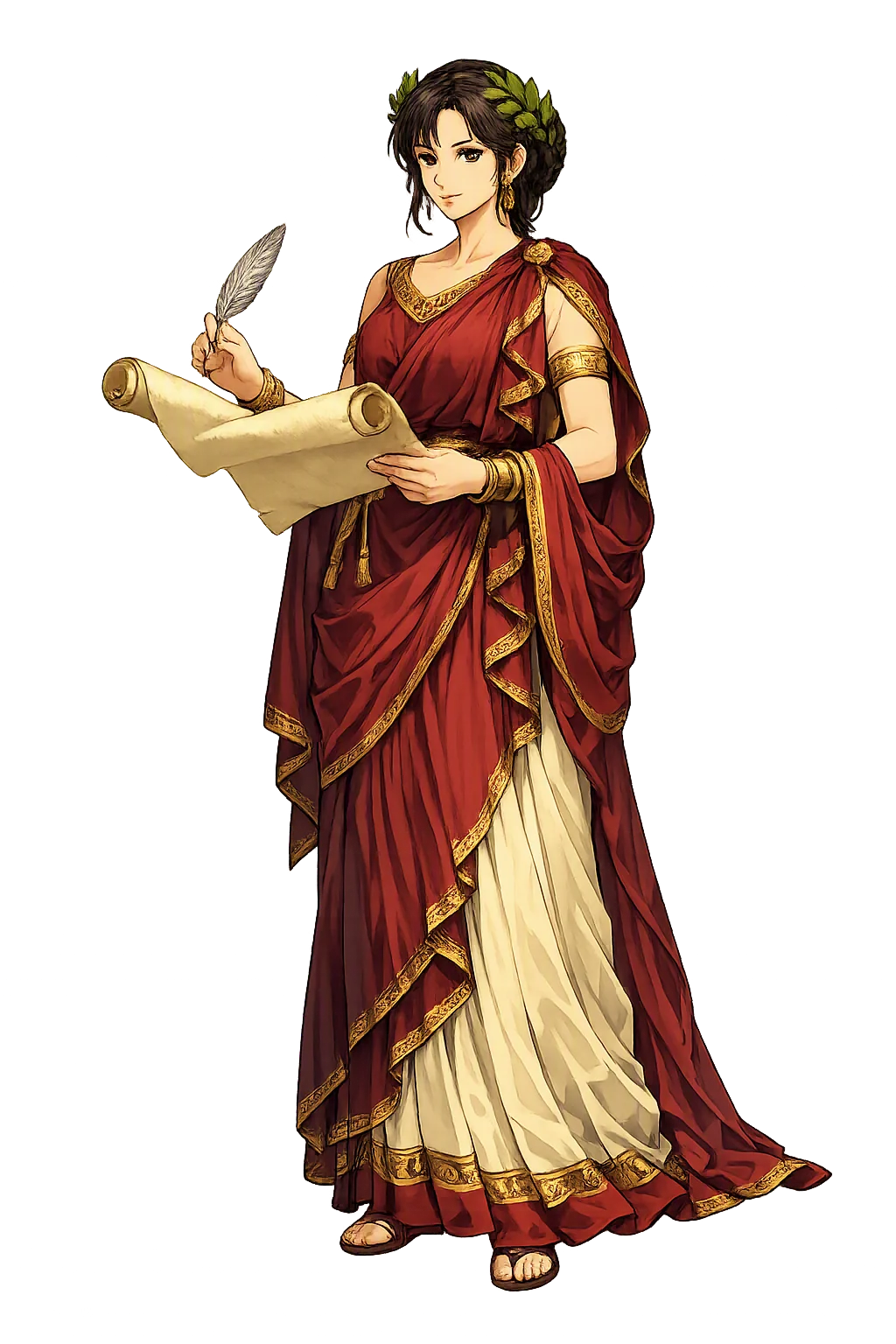
Kleiṓ is the Muse of history — in Greek terms, of ἱστορία, 'inquiry, research'. First-named of the nine daughters of Zeus and Mnēmosýnē, her name is her office: from κλέος, 'glory', she is she who proclaims fame, the power that keeps great deeds from being erased by time. In art she sits with an open scroll or a chest of books — the archive made divine.
Her unrolled scroll — the volumen of the Roman portraits — is history itself: deeds fixed against forgetting.
To proclaim, κλείειν, is to make heard; later allegory gives her the trumpet that blows renown down the generations.
The book-chest at her feet: the memory of the world, stored, ordered, and retrievable.
Stories of Kleió
Kleiṓ rarely acts in myths of her own; she is the authority behind them. Her province is not adventure but memory — the fame by which every other story survives.
In the Theogony (53–62) Hesiod tells how Zeus lay with Mnēmosýnē, Memory, for nine nights, and how she bore nine daughters in Pieria 'of one mind, whose hearts are set upon song'. At 76–79 he names them, and Kleiṓ stands first: 'Κλειώ τ᾽ Εὐτέρπη τε…'. Their purpose is stated plainly (Theogony 55): they were born to be 'forgetfulness of evils and rest from cares' — memory, paradoxically, as the cure of sorrow.
Kleiṓ's office becomes literature in the proem of Herodotus (1.1): he publishes his ἱστορίη — literally 'inquiry, research' — 'so that the deeds of men may not be erased by time, nor the great and wondrous works of Greeks and barbarians become aklea, without glory'. The word ἀκλεᾶ is her own name negated: history exists so that κλέος survives. Cicero would later call Herodotus the father of history (De Legibus 1.5), but the Greeks had already given history a Muse.
Apollodorus (Bibliotheca 1.3.3) records that Pierus of Macedon begot Hyacinthus by Kleiṓ. The beautiful youth was loved by Apollo and killed by a ricocheting discus; from his blood sprang the flower marked with the cry of lamentation. The fuller telling is Ovid's (Metamorphoses 10.162–219). A late scholastic tradition adds that Kleiṓ had mocked Aphrodítē's passion for Adōnis and was repaid with this bitter love of her own — a rare, unhappy glimpse of the Muse drawn into a story rather than telling one.
The Orphic Hymn to the Muses (76) calls on Kleiṓ together with her eight sisters as daughters of Zeus and Mnēmosýnē, queens of the Pierian spring, and begs them to come to the initiates bringing fame and wisdom. Here the sisterhood is one power: song, memory, and the glory that outlasts death.
That the Greeks made history a Muse is the fact worth pausing on: the recording of the past was not clerical work but an inspired art, daughter of Memory herself. Her parentage states a whole philosophy — Zeus begets on Mnēmosýnē the power that turns what is remembered into what is proclaimed. For κλέος was what heroes died to win, and Kleiṓ is the arbiter of it: she decides what is still heard when the generations have turned to dust. There is ambivalence in that gift, for memory selects as much as it preserves, and every archive is also an act of omission. Herodotus, her first great servant, understood this: his ἱστορίη is research in the service of fame, so that the deeds of Greeks and barbarians alike should not go aklea — ungloried, unheard.
Enter Extended Lore