
Kleió: the stories first, then the spelling
The marks in Kleió make the most sense standing next to the myths they have to carry. So the myths come first.
The Stories That Carry the Name
Daughter of Memory. In the Theogony (53–62) Hesiod tells how Zeus lay with Mnēmosýnē, Memory, for nine nights, and how she bore nine daughters in Pieria 'of one mind, whose hearts are set upon song'. At 76–79 he names them, and Kleiṓ stands first: 'Κλειώ τ᾽ Εὐτέρπη τε…'. Their purpose is stated plainly (Theogony 55): they were born to be 'forgetfulness of evils and rest from cares' — memory, paradoxically, as the cure of sorrow.
The First History. Kleiṓ's office becomes literature in the proem of Herodotus (1. 1): he publishes his ἱστορίη — literally 'inquiry, research' — 'so that the deeds of men may not be erased by time, nor the great and wondrous works of Greeks and barbarians become aklea, without glory'. The word ἀκλεᾶ is her own name negated: history exists so that κλέος survives.
The Mother of Hyacinthus. Apollodorus (Bibliotheca 1. 3. 3) records that Pierus of Macedon begot Hyacinthus by Kleiṓ.
And Here Is What the Spelling Preserves
Against those stories, the attestation: Κλειώ, on the evidence Hesiod and Theogony set down. The name means "Proclaimer, glorifier".
The restoration keeps one feature the ASCII form kleio cannot show:
- o → ó — Acute on o: where the voice peaks.
A storyteller pronouncing the name would restore every one of them by instinct. The file only writes down what the voice already knows.
At a Glance
- Restored name: Kleió
- ASCII form: kleio
- Meaning: "Proclaimer, glorifier"
- Domain of influence: History
- Pantheon: Greek
- Classification: Tier 1
- Original script: Κλειώ
- Series: The Restoration Files, No. 136 of 282
The Name Travels
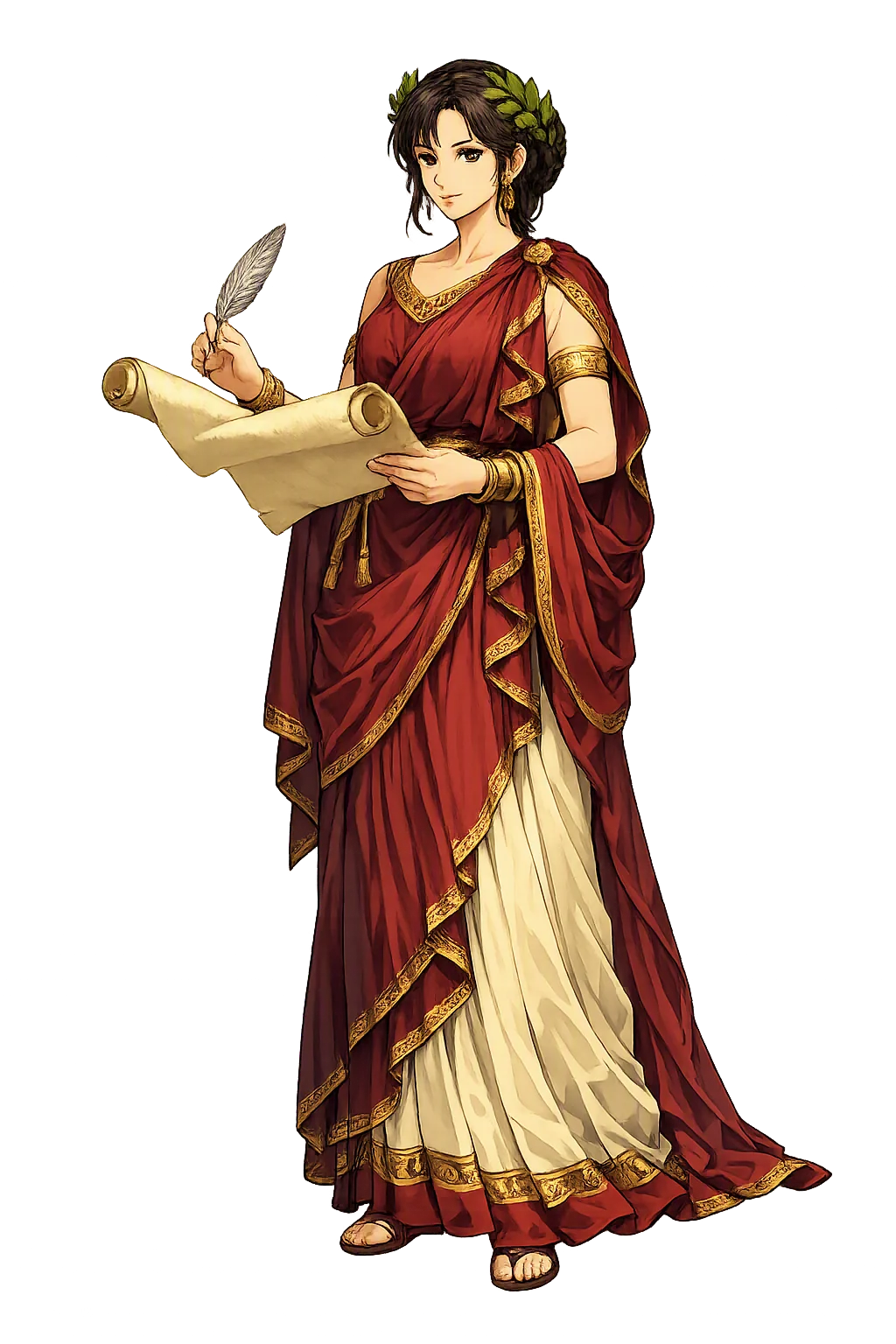
Rome received the Muses wholesale and gave them no new names: Kleiṓ became Clio, invoked by Latin poets and pictured on sarcophagi with her scroll. The native Camenae — Italic spring-nymphs equated with the Muses since Livius Andronicus rendered the Odyssey's 'Musa' as 'Camena' — absorbed the cult but never the individual names.
The Address It Earned
The temple of Kleió stands at /sites/kleio/ — lore, scholars, patterns — because a name carrying this much story deserves more than a parking page. The restoration preserves more than the ASCII form can express — stress, length, or a letter the Latin keyboard lost — which places it, mechanically, in Tier-1.
The Sources Are Open
The myths above are retold from the temple's record; the primary voices are in the Sacred Texts: Theogony, Homeric Hymns, and Works and Days. Nothing in this file outranks them.
The File Continues
Read the founding dispatch for the name's full story, the Resonance File for the archetype at work — or the whole archive in one sitting.
Continue the series — previous file: Kēr (read it here) · next file: Kōbe (read it here).
The Restoration Files are written from the same canonical record as the temples themselves: the lexicon, the lore catalog, the pattern atlas, and the cited scholarly sources. If a file ever disagrees with its temple, the temple is right — tell us, and the file will be corrected.